Airbus A321neo
A21NAirbus · Narrowbody · In production
In the wild
History
The A321neo is the largest member of the re-engined A320neo family, a stretched single-aisle jet seating around two hundred passengers in two classes and more in dense layouts. It descends from the A321, itself a stretch of the A320 launched in the late 1980s, and shares the neo programme's basic logic: keep the proven airframe, fit new and much more efficient engines, and offer airlines lower operating costs with minimal retraining. Airbus offered it, like the rest of the family, with a choice of CFM LEAP-1A or Pratt and Whitney PW1100G engines.
The aircraft first flew in 2016 and entered service in 2017, with Virgin America taking the first delivery in April of that year. From the outset the A321neo attracted attention because it carried more passengers than any competing single-aisle jet then in production, giving airlines a way to add capacity on busy routes without moving to a widebody. As demand shifted toward larger narrowbodies, the A321neo increasingly outsold the smaller A320neo and became the volume seller of the family.
The type's most consequential development, however, was range. Airbus built on the earlier A321's ability to carry additional centre fuel tanks to create two long-range derivatives. The first, the A321LR, adds up to three auxiliary centre tanks and a higher takeoff weight, extending range to roughly four thousand nautical miles. It was certified in 2018; the intended launch operator, Primera Air, collapsed before delivery, and the first aircraft instead went to Arkia of Israel in November 2018. The A321LR let carriers open thinner long-haul routes that could not fill a widebody.
Airbus then went further with the A321XLR, or extra long range, launched in 2019. Rather than relying on removable tanks, the XLR incorporates a permanent Rear Centre Tank built into the fuselage structure, raises maximum takeoff weight to around 101 tonnes, and reaches roughly four thousand seven hundred nautical miles. The permanent tank drew extended scrutiny from regulators over fuel-tank fire protection, which delayed certification and required design changes to the surrounding structure. The XLR was eventually certified and entered service with Iberia in late 2024, whose first revenue flights included a transatlantic sector from Madrid to Boston. That flight was widely noted because it demonstrated a single-aisle jet operating a scheduled transatlantic route with mainline economics, opening city pairs that previously needed a larger, costlier aircraft.
Commercially the A321neo and its long-range variants have reshaped expectations for what a narrowbody can do. Low-cost long-haul operators, full-service carriers seeking to fragment traffic away from congested hubs, and airlines replacing ageing Boeing 757s have all found uses for the type. Its principal competitor, the Boeing 737 MAX family, has no member that matches the A321neo's combination of seats and range, a gap that has helped Airbus dominate the upper end of the single-aisle market. Production continues at high rate, and the A321neo, especially the LR and XLR, is central to Airbus's narrowbody strategy for the coming decade.
Specifications
- First flight
- 2016
- Entered service
- 2017
- Engines
- 2 × CFM LEAP-1A or Pratt & Whitney PW1100G
- Typical seating
- 200 (2-class)
- Cruise speed
- Mach 0.78
- Range
- 4,000 nm
- MTOW
- 97,000 kg
- Length
- 44.51 m
- Wingspan
- 35.8 m
- Status
- In production
Design notes
Like the rest of the neo family, the A321neo pairs the existing A321 airframe with the larger, more efficient CFM LEAP-1A or Pratt and Whitney PW1100G geared turbofan, together with standard Sharklets. What distinguishes the A321neo from its smaller siblings is length and weight: it is the longest A320-family aircraft, and to preserve performance at higher weights Airbus offered a revised door and exit arrangement known as Airbus Cabin Flex, which reconfigures the emergency exits to allow denser seating.
The long-range variants are where the engineering becomes distinctive. The A321LR carries up to three additional centre fuel tanks in the cargo hold and a strengthened structure for a higher takeoff weight, trading some cargo volume for fuel. The A321XLR goes further with a permanent Rear Centre Tank integrated into the rear fuselage, so that part of the aircraft's structure doubles as the tank wall. This saves weight compared with separate tanks but adds complexity, and it became the focus of a lengthy regulatory review over how the tank would behave in a fire; Airbus modified the surrounding structure and added protective measures in response.
The XLR also uses a strengthened main landing gear and revised systems to handle its roughly 101-tonne maximum weight. Otherwise the flight deck, fly-by-wire controls and cabin architecture are common with the wider A320 family, preserving the shared type rating. A pilot rated on the A320 can fly the A321neo, including the LR and XLR, with only differences training, which is a large part of the type's operational appeal.
Notable facts
- The largest member of the A320neo family, seating about 200 in two classes.
- The long-range A321LR and extra-long-range A321XLR extend transatlantic reach with single-aisle economics.
- Shares engines and most systems with the A320neo.
- Entered service in 2017.
- The A321XLR, reaching up to about 4,700 nm, entered service in 2024.
Who flies it
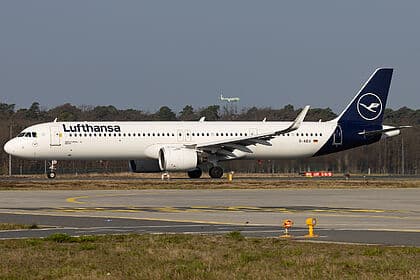
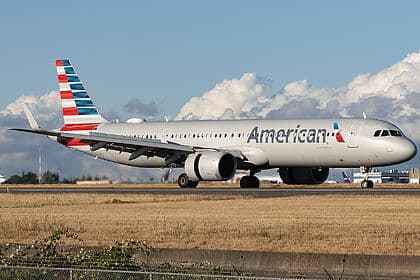
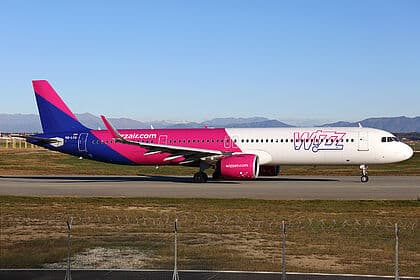
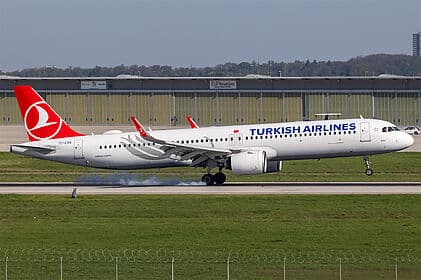
The A321neo is flown by a wide range of carriers that want maximum seats from a single-aisle jet. Large low-cost and hybrid operators such as Wizz Air, Frontier and AirAsia use dense versions on high-demand routes, while full-service airlines including the Lufthansa Group, Turkish Airlines, American Airlines and Delta operate it on domestic trunk and shorter international sectors. On many networks it has taken over the busiest routes formerly flown by older, smaller jets.
The long-range LR and XLR versions serve a distinct role. Carriers such as Aer Lingus, JetBlue, TAP Air Portugal and Iberia use them to fly transatlantic and other long, thin routes that would not fill a widebody, and to replace retiring Boeing 757s. Airlines have also used the LR to open direct city pairs that previously required a connection. Across both roles the A321neo has become the default choice at the top of the single-aisle market.
Flying on one
The A321neo shares the A320's wider-than-a-737 cabin, so the same six-abreast comfort applies — seats commonly around eighteen inches, quiet current-generation engines, and, in recent Airspace cabins, larger overhead bins that take more carry-ons. Because it is a long stretch of the airframe there are more rows, more galley and lavatory space, and a longer boarding shuffle. The twist with this aircraft is range: the long-range LR and extra-long-range XLR versions now fly genuinely long, thin routes — transatlantic and beyond — that once needed a widebody. That makes cabin choice matter more than ever, because several hours in a single-aisle jet are far more pleasant in a lie-flat business seat or a well-pitched economy than in a densely packed leisure layout. For the best seat, an over-wing exit row or a bulkhead adds legroom; on the long-haul variants, look for airlines that fit a proper premium cabin. As always, avoid the last row by the rear galleys.
Who flies it, and how
2 airline cabin layouts of the Airbus A321neo in our dataset — expand any to see the cabin breakdown and seat map.
JetBlueA321neo Mint (domestic)160 seats16J · 144Y
- Business (Mint): 16 seats, 1-1 across
- Economy (Even More Space): 42 seats, 3-3 across
- Economy (Core): 102 seats, 3-3 across
Domestic/transcon A321neo with 16 fully enclosed Mint Suites in a 1-1 layout.
JetBlueA321LR Mint (transatlantic)138 seats24J · 114Y
- Business (Mint): 24 seats, 1-1 across
- Economy (Even More Space): 24 seats, 3-3 across
- Economy (Core): 90 seats, 3-3 across
Long-range transatlantic A321LR: 24 Mint Suites (1-1) including 2 larger front-row Mint Studios; 114 economy seats total (24 Even More Space + 90 Core).
Variants
- A321LR — Long-range; extra centre tanks, around 4,000 nm
- A321XLR — Extra-long-range, around 4,700 nm; entered service 2024
How to spot it
The A321neo is recognisably an A320-family jet, with the same rounded nose, tall stance and near-circular engine nacelles that distinguish Airbus narrowbodies from the Boeing 737. What sets the A321 apart from the shorter A320 and A319 is its length and exits: the A321 is noticeably longer, and it carries either four full-size door pairs on older aircraft or, under the Cabin Flex layout, a distinctive mix of doors and over-wing exits, rather than the A320's two door pairs plus over-wing hatches.
Distinguishing an A321neo from the older A321ceo again comes down mainly to the larger neo engine nacelles. Telling an ordinary A321neo from an LR or XLR is effectively impossible from the outside, since the extra fuel tanks are internal; the giveaways are usually the operator and the route, such as a single-aisle Airbus on a scheduled transatlantic service.
Frequently asked
What is the difference between the A321neo, A321LR and A321XLR?
All three share the same basic airframe and engines. The A321LR adds up to three auxiliary fuel tanks for a range of about four thousand nautical miles, while the A321XLR uses a permanent, built-in rear centre tank and a higher takeoff weight to reach roughly four thousand seven hundred nautical miles. The standard A321neo has no extra tanks and is optimised for shorter, higher-capacity flying.
How did the A321XLR make transatlantic flights possible with a single-aisle jet?
Its permanent rear centre tank and increased takeoff weight give it enough range to cross the Atlantic on many city pairs while retaining a full passenger load. This lets airlines serve long, thin routes with narrowbody economics instead of a larger widebody. Iberia flew one of the first such services, from Madrid to Boston, after the type entered service in late 2024.
How do you tell an A321neo from an A320neo?
The main cue is length: the A321 is markedly longer than the A320, with a longer cabin and more exits. A classic A321 has four sets of full-size doors and no over-wing exits, while newer Cabin Flex A321neos use a mix of doors and over-wing exits; the A320, by contrast, has two door pairs plus a pair of over-wing exits on each side. Both share the same wingspan, so a lone aircraft can look similar until you compare fuselage length and count the exits.
Why are airlines using the A321neo to replace the Boeing 757?
The 757, long out of production, filled a niche for a narrowbody with long range and high capacity, and airlines have needed a modern successor. The A321LR and XLR come closest, offering comparable seat counts and enough range for many former 757 routes with much lower fuel burn. They do not fully match the 757's runway performance and payload-range in every case, which is a point often raised by operators.
Does the Boeing 737 MAX have a direct competitor to the A321neo?
Not really. The largest 737 MAX, the MAX 10, carries fewer passengers and has less range than the A321neo, and Boeing has no in-production narrowbody that matches the A321's combination of capacity and reach. This gap has helped Airbus win most orders at the top of the single-aisle segment.
In-depth comparisons
Compare with
Specs are approximate, compiled from public sources. See our editorial policy.