Boeing 757-200
B752Boeing · Narrowbody · Production ended
In the wild

History
The Boeing 757-200 is a narrowbody twinjet developed in the late 1970s as a modern replacement for the trijet 727. Boeing studied the project under the designation 7N7 and launched it in 1978 alongside the wider-bodied 767, with which it was developed in parallel. Eastern Air Lines and British Airways were the launch customers, placing firm orders in 1979 that committed the programme. The two aircraft shared a common flight deck and a substantial amount of systems design, an unusual arrangement that let airlines train pilots for both on a single type rating.
The 757 introduced a new wing, a modern two-crew glass cockpit and, importantly, high-bypass turbofan engines in place of the 727's three low-bypass units. Two engine families were offered: the Rolls-Royce RB211-535, selected by both launch customers, and later the Pratt and Whitney PW2000 series. The aircraft was designed for lower fuel burn, quieter operation and reduced crew cost compared with the 727, while carrying more passengers.
The prototype first flew in February 1982, and the 757-200 entered service with Eastern Air Lines on 1 January 1983, followed by British Airways the next month. The 757-200 was the sole passenger variant for most of the programme; a stretched 757-300 arrived in 1999 but sold in modest numbers, and dedicated freighter versions, the 757-200PF package freighter and a small number of convertible aircraft, extended the family into cargo work.
In service the 757 earned a reputation for performance. Its engines were powerful relative to the airframe's weight, giving it a high thrust-to-weight ratio, strong climb, and good hot-and-high and short-field capability. Those qualities made it valuable at high-altitude airports and on demanding routes, and its long range for a narrowbody, roughly three thousand nine hundred nautical miles in higher-weight versions, allowed transatlantic and other long, thin services once extended-range twin-engine approval became routine. The type became a staple for carrying full loads over distances that were awkward for other single-aisle jets.
The 757 also became known for its wake turbulence. Its vortices proved stronger than expected for an aircraft of its weight class, and in the mid-1990s regulators introduced special separation requirements, effectively treating it as a category of its own between standard and heavy aircraft.
Boeing announced the end of 757 production in 2003 as sales slowed and airlines shifted to smaller members of the 737 family and to the Airbus A320 family. The last aircraft, a 757-200, was delivered in 2005, closing the line after just over one thousand were built across all versions. No aircraft has fully matched its blend of range, payload and runway performance, and the 757 is frequently cited in discussions of a gap in the market between large narrowbodies and small widebodies.
Decades after production ended, the 757-200 remains in widespread use. Passenger operators continue to fly it on transcontinental and transatlantic routes, and it has become a mainstay of express-cargo fleets. Its combination of capability and longevity has given it a lasting following among airlines, pilots and enthusiasts, even as newer types such as the Airbus A321neo are positioned as its eventual successor.
Specifications
- First flight
- 1982
- Entered service
- 1983
- Engines
- 2 × Rolls-Royce RB211 or Pratt & Whitney PW2000
- Typical seating
- 200 (2-class)
- Cruise speed
- Mach 0.8
- Range
- 3,900 nm
- MTOW
- 115,680 kg
- Length
- 47.3 m
- Wingspan
- 38.05 m
- Status
- Production ended
Design notes
The 757 pairs a slender, narrowbody fuselage, sharing the six-abreast cross-section used by the 707, 727 and 737, with a large, efficient wing and a pair of powerful high-bypass engines. That combination is the key to its character: relative to its weight the engines produce a great deal of thrust, giving the aircraft brisk acceleration, a steep climb and the ability to operate from shorter or higher runways than most narrowbodies. Pilots frequently describe it as notably overpowered for a jet of its size.
A distinctive structural feature is the tall main landing gear. To provide rotation clearance for the long fuselage and to accommodate the stretched 757-300, the aircraft stands high off the ground on long legs, giving it a leggy stance that is one of its clearest identifiers.
The flight deck was, for its era, advanced: a two-crew glass cockpit with electronic instruments, shared in design with the larger 767. This commonality allowed a single type rating to cover both aircraft, a feature unique to the pair and valuable to airlines operating both. The engines, either the Rolls-Royce RB211-535 or the Pratt and Whitney PW2000, hang on underwing pylons and look large against the slim body.
The wing was designed for efficient high-speed cruise and good range, and the aircraft was built for extended-range twin-engine operations that let it cross oceans. Later aircraft could be fitted with winglets as a retrofit to improve fuel burn, though many 757s flew their whole careers without them.
Notable facts
- Its high thrust-to-weight ratio makes it a strong performer on hot-and-high and long, thin routes.
- Widely used on transcontinental US and some transatlantic services despite being a single-aisle.
- Often described as having no direct successor after production ended in 2004.
- Shared a common type rating with the widebody 767 to ease crew training.
Who flies it
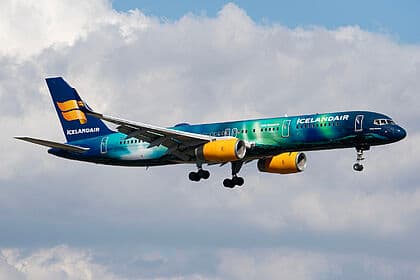
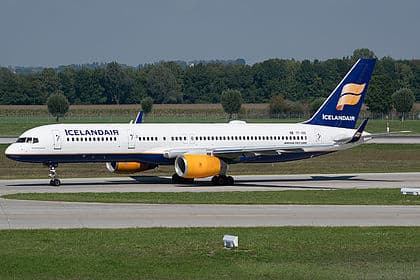
Although out of production since the mid-2000s, the 757-200 remains widely flown. In passenger service the largest operators have been United States carriers, with Delta Air Lines long the biggest user, alongside United and, historically, American. Icelandair built much of its transatlantic network around the type, exploiting its range and payload from a hub between two continents, and several leisure and charter airlines have relied on it as well.
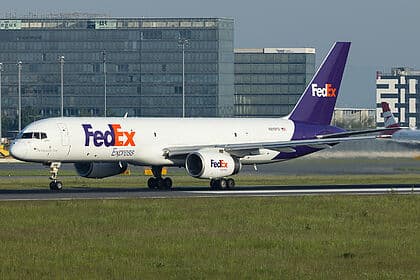
The 757's roles today reflect its strengths: transcontinental flying within North America, transatlantic and other long, thin international routes, and demanding airfields. In parallel, the freighter versions have become central to express and parcel logistics, with FedEx, UPS and DHL-affiliated operators flying large numbers. As airframes age, passenger operators are gradually replacing them with types such as the Airbus A321neo and Boeing 737 MAX, but the absence of an exact successor has kept the 757 in service far longer than once expected.
Flying on one
Enthusiasts adore the 757, and even from a passenger seat you can sense why. It is a narrowbody — six-abreast, 3-3, seats commonly around seventeen to eighteen inches — but it is a tall, substantial-feeling one, with powerful engines that give a famously brisk, steep climb off the runway. Its long fuselage means a lot of rows and a longer boarding line, and because many 757-200s are now veterans, cabins range from dated to refreshed depending on the airline. It has long punched above its single-aisle weight on range, flying transcontinental and even transatlantic routes, so you may find yourself aboard one for four or five hours in a seat designed for shorter hops — comfort then depends heavily on pitch and the operator's product. Overhead bins are of their era and can fill quickly. For the best seat, an over-wing exit row offers extra legroom, and forward windows keep you away from the aft galleys; avoid the last rows near the rear service area.
Variants
- 757-300 — Stretched, higher-capacity variant
- 757-200PF — Package freighter
How to spot it
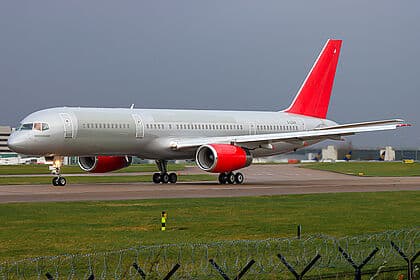
The 757-200 is most easily recognised by its proportions: a long, slim single-aisle fuselage combined with only two large engines and a notably tall stance on long landing gear. It is considerably longer than a 737 or A320, yet unmistakably a narrowbody, with a pointed nose and a slender profile.
The commonest confusion is with the wider 767, which shares the same cockpit and nose family. The giveaway is the fuselage: the 757 is a single-aisle narrowbody and looks slim, whereas the 767 is a twin-aisle widebody and appears distinctly fatter and rounder. Against large narrowbodies such as the A321, the 757 is longer still, sits much higher off the ground and carries proportionally larger engines. The stretched 757-300 is longer again than the -200, with an extra pair of doors, though it is far less common.
Frequently asked
How do you tell a Boeing 757 from a 767?
The two share a very similar nose and cockpit because they were designed together, so the fuselage is the key. The 757 is a single-aisle narrowbody with a slim body, while the 767 is a twin-aisle widebody that looks noticeably wider and rounder. Seen alone, the 757 also stands taller on longer landing gear relative to its width.
Why is the 757 known for wake turbulence?
Its wingtip vortices proved stronger than expected for an aircraft of its weight, prompting concern after several upset incidents involving following aircraft. In the mid-1990s regulators introduced special separation requirements, effectively placing the 757 in its own category between standard and heavy aircraft. This is why air traffic controllers apply extra spacing behind it.
Why do airlines still fly the 757 decades after production ended?
The 757 offers a rare combination of long range, high payload and strong runway performance in a single-aisle aircraft, which no in-production type fully replicates. This makes it well suited to transatlantic and other long, thin routes, and to demanding airports. The lack of an exact successor has kept it valuable, though airlines are gradually replacing it with types such as the Airbus A321neo.
What engines does the Boeing 757 use?
The 757 was offered with two engine families: the Rolls-Royce RB211-535, chosen by both launch customers, and the Pratt and Whitney PW2000 series. Both are high-bypass turbofans that are powerful relative to the airframe, which is the source of the aircraft's strong climb and hot-and-high performance. No General Electric option was offered.
What is the difference between the 757-200 and the 757-300?
The 757-200 is the original and by far the most common version, while the 757-300 is a stretched development introduced in 1999 with greater seating capacity. The -300 is noticeably longer and has additional doors, but it sold in small numbers and is much rarer. Both share the same wings and engines.
Compare with
Specs are approximate, compiled from public sources. See our editorial policy.