Airbus A330-200 (A332)
Airbus · Widebody · Production ended
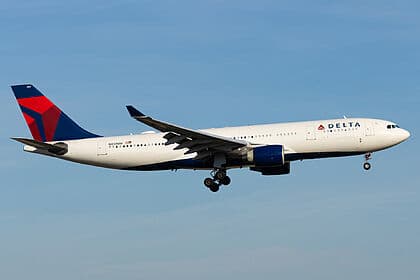
A332 is the ICAO aircraft type code for the Airbus A330-200, an Airbus widebody airliner that first flew in 1997 and entered service in 1998. It typically carries 247 passengers in a two-class layout, cruises at Mach 0.82, and has a range of about 7,250 nautical miles (13,427 km).
Loading live positions…
In the wild
History
The Airbus A330-200 was the aircraft that turned the A330 from a European medium-haul widebody into a global long-haul seller. The original A330-300 of 1994 had been designed for high-density routes of up to about eight hours, but airlines wanted a smaller, longer-legged version to replace Boeing 767-300ERs and open thinner intercontinental routes. Airbus launched the A330-200 in November 1995, shortening the fuselage by ten frames, enlarging the tail to compensate for the shorter moment arm, and adding a centre fuel tank.
The first A330-200 flew on 13 August 1997 and the Canadian leisure carrier Canada 3000 put it into service in April 1998. Its combination of 250 seats, 6,500-plus nautical miles of range and the A330's low operating costs was exactly what the market wanted: Emirates, Qantas, Air France, Delta (via Northwest), Air Canada, Swiss, Etihad and many others built fleets, and lessors found it easy to place. Through the 2000s it was the best-selling A330 variant and a direct competitor to the 767-300ER and, later, the early 787.
Airbus kept developing it. Maximum take-off weight rose in steps from 230 to 242 tonnes, extending range to around 7,250 nautical miles, and the airframe became the basis of the A330-200F freighter of 2010 and the A330 MRTT tanker-transport, now flown by air forces from the UK and Australia to France, Singapore and South Korea.
The re-engined A330neo of 2014 produced an A330-800 successor, but with only a handful of orders the -800 never matched its predecessor's popularity, and passenger A330-200 production wound down around 2020 after more than 650 deliveries. Hundreds remain in service, increasingly with leisure carriers and in freighter conversion programmes.
Specifications
- First flight
- 1997
- Entered service
- 1998
- Engines
- 2 × GE CF6-80E1, Pratt & Whitney PW4000 or Rolls-Royce Trent 700
- Typical seating
- 247 (2-class)
- Cruise speed
- Mach 0.82
- Range
- 7,250 nm
- MTOW
- 242,000 kg
- Length
- 58.82 m
- Wingspan
- 60.3 m
- Status
- Production ended
Design notes
The A330-200 keeps the A330-300's wing, engines and cockpit, so the two share a type rating with each other and, through cross-crew qualification, with the A340 and A350. The fuselage is 5.3 m shorter, and to keep the aircraft controllable with the reduced tail arm Airbus fitted a taller vertical fin, 1 m higher than the -300's, which is the quickest external way to tell the two apart. A centre wing-box fuel tank, optional on the -300, is standard.
Engines are a choice of GE CF6-80E1, Pratt & Whitney PW4000 or Rolls-Royce Trent 700, the last the most popular. Maximum take-off weight options range from 230 to 242 tonnes, and the highest-weight aircraft can fly around 7,250 nautical miles with a typical load. The cabin cross-section allows eight-abreast 2-4-2 economy, which operators have mostly retained.
Notable facts
- A shortened A330-300 with extra fuel and a taller tail, built to compete with the 767-300ER on long, thinner routes.
- Canada 3000 flew the first in 1998; it became the long-haul backbone of Delta, Qantas, Air France, Emirates and many others.
- The basis of the A330-200F freighter and the A330 MRTT tanker-transport flown by a dozen air forces.
- Replaced on the line by the re-engined A330-800neo, which found few buyers as the -900 and 787 took the market.
- Still numerous in service and a staple of leisure and secondary-market long-haul flying.
Who flies it
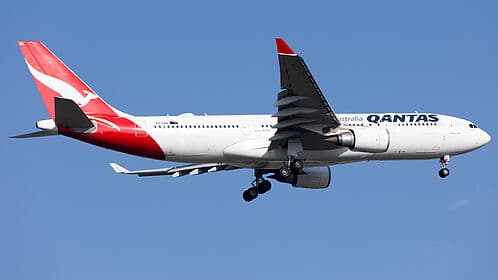
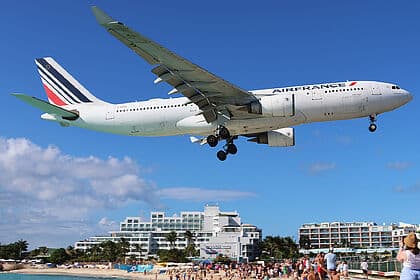
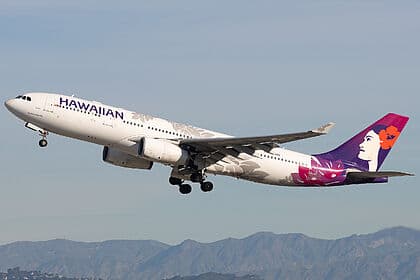
Delta, Qantas, Air France, Air Canada, Emirates (now retiring), Etihad, TAP, Iberia, Korean Air, China Eastern and Hawaiian Airlines have all operated large A330-200 fleets; Hawaiian and Qantas still use it as a long-haul mainstay, and dozens of smaller carriers from Air Mauritius to Aerolíneas Argentinas rely on it. Typical missions are seven- to twelve-hour routes with 230–280 passengers, including many ex-767 routes across the Atlantic and Pacific. The A330 MRTT serves a dozen air forces, and converted A330-200 freighters fly for DHL, Turkish Cargo and others.
Flying on one
The A330-200's great passenger strength is its 2-4-2 economy cabin: side pairs with a window and an aisle and no stranger to climb over, a layout most operators have kept rather than squeezing in a ninth seat. Seats are usually 17.5–18 inches wide at 31–32 inches of pitch. The cabin is quiet for its generation and the ride is stable; it lacks the 787's low cabin altitude and humidity, so long flights feel more conventional, but the tube is wide and the bins are decent. Because the -200 flies so many ex-767 routes, premium cabins vary a lot: lie-flat business is now common on mainline carriers, while leisure operators run dense layouts. For the best seat, take a window in the 2-4-2 side pairs ahead of the wing; avoid the last rows beside the rear galley and the row ahead of the exit, which may not recline.
Variants
- A330-300 (A333) — The original longer version
- A330-200F — Dedicated freighter with a raised nose gear
- A330 MRTT — Multi-role tanker transport
- A330-800neo (A338) — Re-engined successor
How to spot it
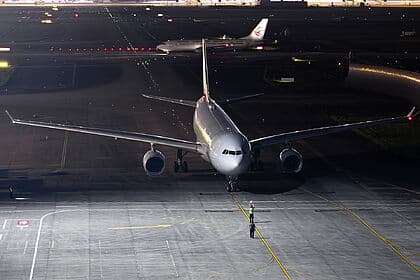
Against the A330-300, the -200 is 5 m shorter, with a stubbier look, and its fin is taller and more upright, the surest cue. Both share the A330's six-abreast-looking window line, the big twin engines and, on later aircraft, Sharklet-free wingtip fences; the A330neo has large curved wingtips and much bigger nacelles. Against a 767-300ER of similar size, the A330 is noticeably wider with a rounder nose, a longer wingspan with wingtip fences, and the Airbus-style upswept tail cone. Against the A340-200 it shares a fuselage with, count the engines.
Flights we've seen the Airbus A330-200 operate
From our own observations of notable flights — each links to the flight's status, on-time history and fares.
Frequently asked
What is the difference between the A330-200 and A330-300?
The -200 is 5.3 m shorter, seats around 50 fewer passengers, has a taller fin and carries more fuel, giving it roughly 1,000 nautical miles more range. Wing, engines and cockpit are the same.
Is the A330-200 still in production?
No. Passenger production ended around 2020 in favour of the A330-800neo, which has sold only in small numbers; A330-200F freighters and MRTT tankers were built later than the passenger version.
How far can an A330-200 fly?
Around 7,250 nautical miles (13,400 km) for the 242-tonne version with a typical passenger load; earlier, lighter aircraft manage roughly 6,750 nm.
Does the A330-200 have middle seats?
Only in the centre block. In the usual 2-4-2 layout the side pairs have none, and the four-seat centre section has two middles; a few airlines fit 3-3-3, which adds more.
What aircraft is A332?
A332 is the ICAO type designator for the Airbus A330-200, a Airbus widebody that first flew in 1997. It is the code flight trackers and air traffic control use.
What is the wingspan of the Airbus A330-200?
The Airbus A330-200 has a wingspan of 60.3 m (198 ft) and is 58.82 m (193 ft) long.
What engines does the Airbus A330-200 have?
Two GE CF6-80E1, Pratt & Whitney PW4000 or Rolls-Royce Trent 700.
What is the MTOW and range of the Airbus A330-200?
Maximum take-off weight is 242,000 kg (533,513 lb) and maximum range is about 7,250 nautical miles (13,427 km) at a cruise of Mach 0.82.
How many passengers does the Airbus A330-200 carry?
Typically 247 passengers in a two-class layout; dense single-class layouts seat more and premium-heavy layouts fewer.
In-depth comparisons
Compare with
Specs are approximate, compiled from public sources. See our editorial policy.