Airbus A320neo
A20NAirbus · Narrowbody · In production
In the wild
History
The A320neo is a re-engined development of the Airbus A320, the single-aisle jet that had anchored Airbus sales since the late 1980s. By the end of the 2000s the original A320 family, retrospectively called the A320ceo, for current engine option, faced a decision point. Fuel prices had climbed, engine makers had new geared and high-bypass designs on the drawing board, and Boeing was weighing its own answer for the competing 737. Rather than launch an all-new aircraft, Airbus chose to keep the proven A320 airframe and change its engines, a lower-risk path that could reach the market quickly.
Airbus formally launched the programme in December 2010 under the name neo, for new engine option. The core promise was a substantial cut in fuel burn without forcing airlines to retrain crews or overhaul their maintenance and spares. Two engines were offered from the start: the CFM International LEAP-1A and the Pratt and Whitney PW1100G, the latter a geared turbofan whose fan turns more slowly than its core. Airbus paired the new engines with larger-diameter nacelles and made Sharklet wingtip devices standard, quoting a reduction in fuel consumption of roughly fifteen to twenty per cent against the earlier A320.
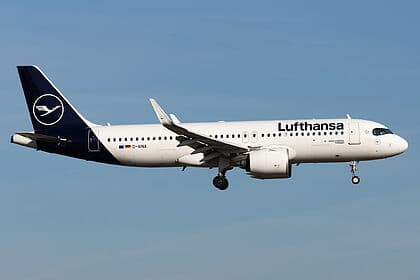
The response from airlines was immediate and unusually large. Orders accumulated faster than for almost any previous airliner, and the neo backlog quickly stretched years into the future. The A320neo itself, the middle member alongside the shorter A319neo and the stretched A321neo, made its first flight in 2014. Certification followed after a test programme split between the two engine types, and the aircraft entered service with Lufthansa in January 2016, initially with Pratt and Whitney engines; the LEAP-powered version followed soon after.
Entry into service was not entirely smooth. The Pratt and Whitney geared turbofan suffered early reliability problems affecting components such as the combustor and internal seals, which led to inspections and engine changes, and in the 2020s a powder-metal manufacturing flaw forced a large fleet-wide inspection campaign that kept many aircraft grounded awaiting spare engines. The LEAP-1A had its own durability work but generally matured with fewer headline disruptions. Neither problem dented the commercial standing of the airframe.
Commercially the A320neo family became one of the best-selling jet programmes in history, with the stretched A321neo increasingly the volume seller as airlines sought more seats per departure. For the baseline A320neo the appeal is a familiar, widely supported airframe with markedly better economics than the model it replaced. It competes head-to-head with the Boeing 737 MAX 8, and the two types dominate new single-aisle deliveries. Production continues at high rate across Airbus final assembly lines in Europe, the United States and China, and the neo now forms the backbone of short- and medium-haul fleets worldwide. Its combination of low operating cost, adequate range for most domestic and regional international routes, and commonality with the rest of the A320 family has made it a default choice for both full-service and low-cost carriers.
Specifications
- First flight
- 2014
- Entered service
- 2016
- Engines
- 2 × CFM LEAP-1A or Pratt & Whitney PW1100G
- Typical seating
- 165 (2-class)
- Cruise speed
- Mach 0.78
- Range
- 3,400 nm
- MTOW
- 79,000 kg
- Length
- 37.57 m
- Wingspan
- 35.8 m
- Status
- In production
Design notes
The essence of the neo upgrade is the engines. Both the CFM LEAP-1A and the Pratt and Whitney PW1100G are high-bypass turbofans considerably larger in diameter than the CFM56 and V2500 fitted to the earlier A320, which is why the neo sits with visibly bulkier nacelles. The Pratt and Whitney unit is a geared turbofan: a reduction gearbox lets the large fan spin slowly while the low-pressure turbine runs fast, each closer to its efficient speed. The LEAP takes a different route to similar efficiency, using a very high bypass ratio, a woven carbon-fibre fan and high core pressures.
Aerodynamically the airframe is largely carried over, the main visible addition being Sharklets, the blended, upswept wingtip devices that reduce induced drag and became standard on the neo. Airbus also revised some structural areas and systems to handle the heavier, more powerful engines and higher operating weights.
Inside, the neo can be fitted with the Airspace cabin, offering larger overhead bins, revised lighting and updated sidewalls, though cabin fit is an airline choice. The flight deck retains the fly-by-wire architecture and sidestick controls that have defined the A320 family since its introduction, preserving the type rating commonality that lets crews move across A319, A320 and A321 variants with minimal additional training. That commonality, more than any single technical feature, is central to the family's appeal: the neo behaves, to a pilot, almost exactly like the aircraft it replaced.
Notable facts
- Re-engined 'new engine option' development of the A320, offered with CFM LEAP-1A or Pratt & Whitney geared-turbofan engines.
- Delivers roughly 15–20% lower fuel burn than the A320ceo it replaced.
- Sharklet wingtip devices are standard.
- Entered service with Lufthansa in January 2016.
- The A320neo family is among the best-selling airliner programs in history.
Who flies it
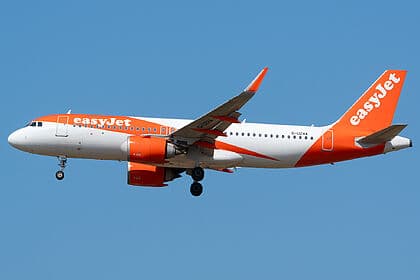
The A320neo is flown by a broad mix of operators, from global full-service groups to large low-cost carriers, and it serves as a workhorse on domestic trunk routes and shorter international sectors. Major users include the Lufthansa Group, IndiGo and other large Indian carriers, easyJet, Wizz Air, and numerous flag carriers across Asia, Europe and the Americas. In most fleets it sits between the smaller A319neo, which sold in modest numbers, and the larger A321neo, which many airlines now prefer for its extra seats.
Roles are almost entirely passenger: high-frequency city pairs, leisure routes and regional international flying within the type's range. It is not a long-haul aircraft, though it comfortably covers sectors of several hours. As the neo continues to displace older A320ceo and earlier-generation jets, it is becoming the single most common Airbus type at many airports.
Flying on one
On a single-aisle flight the A320neo has a small but real comfort edge over its Boeing rival, and it comes from the tube itself: the A320 fuselage is a few inches wider than the 737's, so in the same six-abreast 3-3 layout Airbus operators can fit seats a little broader — commonly around eighteen inches against the 737's seventeen. The "neo" engines are also noticeably quieter than the previous generation, and many recent cabins use Airbus's Airspace styling with larger overhead bins that swallow more roll-aboards and ease the scramble for space. It is a comfortable, familiar short- and medium-haul ride. For the best seat, an over-wing exit row buys extra legroom, and a forward window keeps you ahead of the galley and lavatory traffic. The row to avoid is the very last one, where seats often will not recline and you sit beside the rear galley and toilets. Middle seats are the usual compromise, though the extra width takes some of the sting out.
Variants
- A319neo (A19N) — Shorter member of the family
- A321neo (A21N) — Stretched, best-selling family member
How to spot it
The quickest confirmation that you are looking at an A320-family jet rather than a Boeing 737 is the nose and stance: the A320 has a rounder, more bulbous nose and sits higher on longer landing gear, while the 737 has a pointier nose and a low-slung stance. The engine nacelles are close to circular on the Airbus, whereas the 737's are flattened along the bottom.
Telling a neo from an older A320ceo is harder and rests mainly on the engines. The neo's nacelles are noticeably larger in diameter, and the Pratt and Whitney version emits a distinctive high-pitched whine when spooling up. Sharklets are standard on the neo but were also retrofitted to many late-build ceo aircraft, so wingtips alone are not conclusive.
Frequently asked
What does the 'neo' in A320neo mean?
Neo stands for new engine option. It marks the re-engined version of the A320, distinguishing it from the earlier models now called the A320ceo, for current engine option. The neo keeps the same basic airframe but adds new engines and standard Sharklets for lower fuel burn.
How do you tell an A320 from a Boeing 737?
Look at the nose and the way the aircraft sits. The A320 has a rounded, blunt nose and stands relatively tall on its landing gear, while the 737 has a more pointed nose and sits low to the ground. The Airbus engine intakes are nearly circular, whereas the 737's are noticeably flattened at the bottom for ground clearance.
What engines does the A320neo use?
Airlines can choose between the CFM International LEAP-1A and the Pratt and Whitney PW1100G geared turbofan. Both are larger and more efficient than the CFM56 and V2500 engines used on the previous A320. The choice is made by the buyer, and many large operators standardise on one type across their fleet.
How much more efficient is the A320neo than the older A320?
Airbus quotes a reduction in fuel burn of roughly fifteen to twenty per cent compared with the A320ceo, achieved mainly through the new engines and Sharklets. Actual savings vary with route, weight and engine choice. The improvement was large enough to make re-engining, rather than an all-new design, commercially compelling.
Is the A320neo a long-haul aircraft?
No. It is designed for short- and medium-haul flying, typically domestic trunk routes and regional international sectors of up to a few thousand nautical miles. The stretched A321neo, particularly in its LR and XLR forms, is the family member built for longer routes, including transatlantic ones.
In-depth comparisons
Compare with
Specs are approximate, compiled from public sources. See our editorial policy.