Boeing 777-300ER
B77WBoeing · Widebody · In production
In the wild
History
The Boeing 777-300ER is the extended-range version of the stretched 777-300, and part of the wider 777 family that Boeing launched in the early 1990s. The baseline 777-200 was conceived to fill the gap between the 767 and the 747, and it was notable as the first Boeing airliner designed entirely with computer-aided three-dimensional tools and developed in close consultation with a group of launch airlines. The original 777-300 was a stretch aimed at replacing early 747s on dense regional routes; it entered service in 1998 but lacked the range for the longest markets. Boeing answered with two long-range models, the 777-200LR and the 777-300ER, both built around a strengthened structure, higher fuel capacity, raked wingtips, and the General Electric GE90-115B engine.
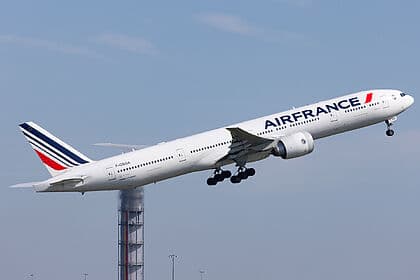
The 777-300ER first flew in 2003 and entered service with Air France in 2004. It combined the long fuselage of the -300 with the range needed for transoceanic sectors, effectively offering close to 747 capacity from a twin-engine aircraft at lower trip cost. Unlike earlier 777s, which offered engines from three manufacturers, the extended-range models were sold exclusively with the GE90-115B, a growth version of the GE90 producing around 115,000 lbf of thrust and among the most powerful jet engines ever certified. To let the long fuselage rotate on takeoff without a tail strike, Boeing fitted a semi-levered main landing gear.
Its arrival coincided with a broader shift away from three- and four-engine widebodies. As extended-range twin-engine operating rules matured, airlines increasingly favoured large twins for long overwater routes, and for many carriers the 777-300ER became the natural replacement for the 747-400 on trunk routes. It carried broadly similar passenger loads while burning considerably less fuel per trip, having two engines rather than four. That economic argument, more than any single technical feature, explains the type's commercial dominance through the 2000s and 2010s.
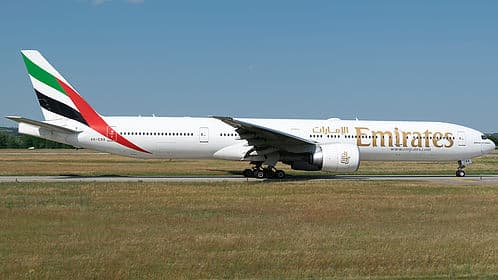
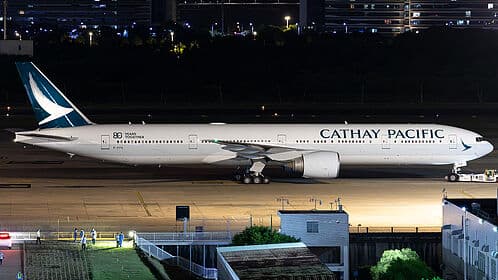
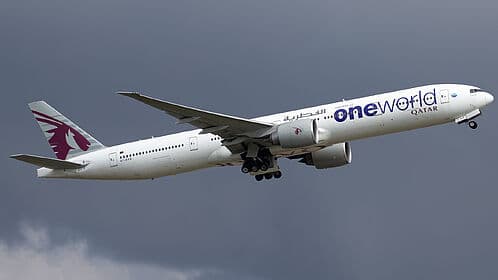
The 777-300ER became the best-selling member of the 777 family and one of the most commercially successful widebodies of its era. Emirates built much of its long-haul network around the aircraft and operates the largest fleet; other major users include Cathay Pacific, Qatar Airways, Singapore Airlines, and Air France. Boeing has begun winding down 777-300ER output as it transitions to the larger 777-9, but the -300ER remains in service in large numbers and should fly with major carriers for many years. As early examples leave front-line passenger fleets, the used-aircraft and freighter-conversion markets have started to absorb them.
Specifications
- First flight
- 2003
- Entered service
- 2004
- Engines
- 2 × General Electric GE90-115B
- Typical seating
- 396 (2-class)
- Cruise speed
- Mach 0.84
- Range
- 7,370 nm
- MTOW
- 351,530 kg
- Length
- 73.86 m
- Wingspan
- 64.8 m
- Status
- In production
Design notes
The 777-300ER is a conventional-looking but technically ambitious twin. Its defining feature is the GE90-115B engine: with a fan diameter of over three metres, it is physically wider than the fuselage of some regional jets, and it remains one of the highest-thrust engines in airline service. The exclusive use of a single very large engine, rather than a choice of three suppliers, was a departure from the earlier 777-200.
The wing carries raked wingtips, an extension of the tip that increases effective span and aspect ratio for better climb and cruise without a vertical winglet. To allow the stretched fuselage to rotate on takeoff, Boeing adopted a semi-levered main gear that pivots on the rear axle, in effect lengthening the rotation geometry. Each main gear leg carries six wheels on three axles, a 777 signature.
Structurally the aircraft is largely aluminium, predating the composite-heavy 787 and 777X. Its systems and flight deck build on the fly-by-wire architecture introduced on the original 777, which was Boeing's first fly-by-wire airliner and retained a conventional control column rather than sidesticks. The cabin cross-section, at just over six metres wide, typically seats ten abreast in modern high-density economy, though many early operators chose a more spacious nine-abreast layout. A flat, tapered tailcone houses the auxiliary power unit and helps mark the -300 series apart from shorter 777s.
Notable facts
- The best-selling variant of the Boeing 777 family.
- Powered by the General Electric GE90-115B, among the most powerful jet engines ever built (around 115,000 lbf).
- Entered service with Air France in 2004.
- Emirates operates the largest fleet.
- Being succeeded by the larger Boeing 777-9.
Who flies it
The 777-300ER is a backbone long-haul aircraft for many of the world's largest international carriers. Emirates operates by far the biggest fleet and uses the type across most of its network, from short regional hops to ultra-long sectors. Other significant operators include Cathay Pacific, Qatar Airways, Singapore Airlines, Air France, several Japanese and Korean carriers, and a number of Chinese airlines. In service it is used almost exclusively on medium- to long-haul international routes, usually in three-class layouts with first or business, premium economy, and economy cabins. Because it combines high capacity with twin-engine economics, it frequently operates the densest intercontinental trunk routes, such as transpacific and Europe-to-Asia services. As newer types arrive, some -300ERs are moving to secondary operators or being considered for freighter conversion, but the aircraft remains central to premium long-haul flying and is likely to stay so well into the 2030s.
Flying on one
How comfortable a 777-300ER feels comes down almost entirely to one choice the airline makes: nine-abreast or ten. Boeing's cabin is very wide, and a handful of carriers still fly a roomy nine-abreast economy at around eighteen and a half inches a seat. The large majority, however, have moved to ten-abreast in a 3-4-3 layout, squeezing seat width to about seventeen inches — narrower than an A350 or 787 in their usual configurations. It is an older-generation cabin, so pressurisation and humidity are typical rather than class-leading, though the ride is quiet and rock-steady thanks to the aircraft's size. Overhead bins are large and take carry-ons easily. Because so many airlines use the -300ER as a long-haul flagship, premium cabins are often excellent even where economy is dense. For the best economy seat, favour a window over a ten-abreast middle, seek out the rare nine-abreast operators if comfort is the priority, and keep away from the last rows by the rear galleys.
Who flies it, and how
6 airline cabin layouts of the Boeing 777-300ER in our dataset — expand any to see the cabin breakdown and seat map.
Air Canada777-300ER International400 seats40J · 24W · 336Y
- Business (Signature Class): 40 seats, 1-2-1 across
- Premium Economy (Premium Economy): 24 seats, 2-4-2 across, 38″ pitch
- Economy (Economy): 336 seats, 3-4-3 across
Premium-heavy international layout with Collins Super Diamond reverse-herringbone Signature seats (~12 of Air Canada's 19 777-300ERs).
Air Canada777-300ER High-Density450 seats28J · 24W · 398Y
- Business (Signature Class): 28 seats, 1-2-1 across
- Premium Economy (Premium Economy): 24 seats, 2-4-2 across, 38″ pitch
- Economy (Economy): 398 seats, 3-4-3 across
High-density layout for high-demand/leisure routes (~7 aircraft). Economy is mostly 3-4-3, tapering to 2-4-2 at the rear.
American777-300ER304 seats8F · 52J · 28W · 216Y
- First (Flagship First): 8 seats, 1-2-1 across
- Business (Flagship Business): 52 seats, 1-2-1 across
- Premium Economy (Premium Economy): 28 seats, 2-4-2 across, 38″ pitch
- Economy (Main Cabin Extra): 28 seats, 3-4-3 across, 35″ pitch
- Economy (Main Cabin): 188 seats, 3-4-3 across, 31″ pitch
Legacy 4-cabin layout (8F/52J/28W/28 MCE/188 MC = 304). Mid-retrofit under Project Olympus to 0F/70J/44W/30 MCE/186 MC = 330 (First removed) — check the specific airframe.
British Airways777-300ER256 seats8F · 76J · 40W · 132Y
- First (First): 8 seats, 1-2-1 across
- Business (Club Suite): 76 seats, 1-2-1 across
- Premium Economy (World Traveller Plus): 40 seats, 2-4-2 across
- Economy (World Traveller): 132 seats, 3-4-3 across
Retrofitted with the newer Club Suite business (1-2-1, direct aisle access). Config confirmed via aeroLOPA (8F / 76J / 40W / 132Y = 256).
Emirates777-300ER354 seats8F · 42J · 304Y
- First (First): 8 seats, 1-2-1 across
- Business (Business): 42 seats, 2-3-2 across
- Economy (Economy): 304 seats, 3-4-3 across
Classic 3-class 777-300ER (aeroLOPA 77WQ, ~57 aircraft) with Emirates' controversial 2-3-2 business and a dense 10-abreast 3-4-3 economy. Sibling 77WR is 360 seats (310Y). Some airframes now carry Premium Economy (4-class), and a newer Gamechanger First-suite variant (6F) also exists.
United777-300ER350 seats60J · 24W · 266Y
- Business (Polaris): 60 seats, 1-2-1 across
- Premium Economy (United Premium Plus): 24 seats, 2-4-2 across
- Economy (Economy Plus): 62 seats, 3-4-3 across
- Economy (United Economy): 204 seats, 3-4-3 across
Variants
- 777-200LR (B77L) — Ultra-long-range; once the world's longest-range airliner
- 777F — Freighter based on the -200LR
How to spot it
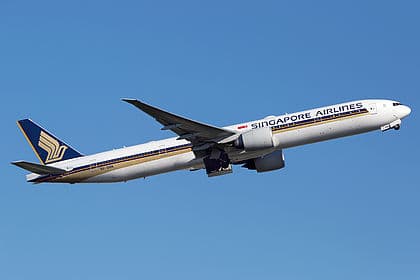
The 777-300ER is a very long twin-engine widebody with a perfectly round fuselage and two enormous engines. The clearest identifier of the 777 family is the main landing gear: each main leg carries six wheels on three axles, unlike the four-wheel bogies of the A330, A340, and 767. Among 777s, the -300ER is one of the longest at nearly 74 metres and wears raked, swept-back wingtips; the original 777-200 and 777-300 have plain, rounded tips. A flattened, tapered tailcone runs behind the rear fuselage. To separate it from the 777-9, look at the wingtips: the 777-9 folds its tips upward on the ground and is longer still. Against the 787, note that the 777 is far larger and its engine nacelles lack the sawtooth chevrons of the Dreamliner.
Frequently asked
How is the 777-300ER different from the original 777-300?
The -300ER adds extended range through a strengthened structure, extra fuel, and more powerful GE90-115B engines, so it can fly intercontinental sectors the earlier -300 could not. Externally the surest cue is the wingtips: the -300ER has raked, swept tips, while the standard -300 has plain rounded ones. The -300ER also uses a semi-levered main gear to aid rotation.
How do you tell a 777-300ER from an Airbus A350?
Both are large twin-engine widebodies, but the A350 has a distinctive black mask around its cockpit windows and a curved, upswept wingtip, while the 777 has a lighter windshield surround and raked tips. The 777 also sits on six-wheel main bogies versus four on the A350. Up close, the 777's GE90 engines are visibly larger.
Why does the 777-300ER have only one engine option?
Boeing offered the extended-range 777s exclusively with the General Electric GE90-115B, unlike the earlier 777-200, which could be fitted with engines from three manufacturers. The GE90-115B produces around 115,000 lbf of thrust and is among the most powerful jet engines ever built. Standardising on one engine simplified the high-thrust certification needed for the heavier, longer-range models.
Is the 777-300ER still in production?
Yes, though at a much reduced rate as Boeing transitions to the larger 777-9. The -300ER remains the best-selling 777 variant and is still delivered in small numbers, but the line is winding down in favour of the 777X. Large fleets will remain in service well into the 2030s.
Did the 777-300ER replace the 747?
For many carriers it did. It carries a broadly comparable passenger load to the 747-400 but with two engines instead of four, cutting fuel and maintenance costs. That economic advantage led a number of airlines to retire four-engine jumbos in its favour.
In-depth comparisons
Compare with
Specs are approximate, compiled from public sources. See our editorial policy.