Embraer ERJ 145 (E145)
Embraer · Regional · Production ended
E145 is the ICAO aircraft type code for the Embraer ERJ 145, an Embraer regional jet that first flew in 1995 and entered service in 1997. It typically carries 50 passengers in a two-class layout, cruises at Mach 0.78, and has a range of about 1,550 nautical miles (2,871 km).

Loading live positions…
In the wild
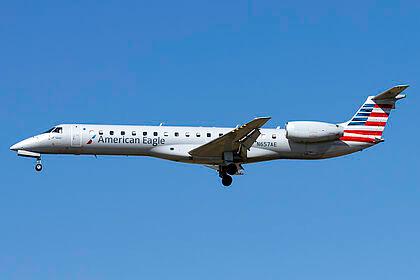
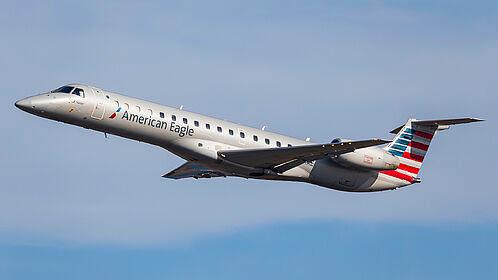
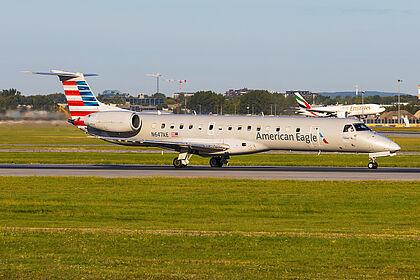
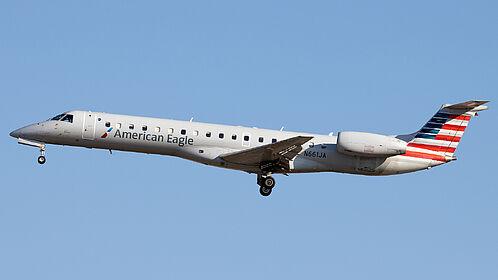
History
The ERJ 145 is the airplane that turned Embraer from a state-owned maker of turboprops into one of the world's big three jet builders. In the late 1980s the Brazilian company proposed a jet derived from its EMB 120 Brasilia, keeping the turboprop's narrow fuselage cross-section and adding a new wing and two rear-mounted turbofans. The project nearly died when Embraer ran out of money, and it was only after privatization in 1994 that the design was finished, with Rolls-Royce's AE 3007 engine chosen for its low fuel burn.
The first ERJ 145 flew on August 11, 1995, and the type entered service with Continental Express in April 1997, flying from Houston and Cleveland. Its timing was perfect. American airlines were replacing 19- and 30-seat turboprops with jets that passengers preferred, and the 50-seat ERJ 145, with a list price far below any mainline jet, let regional carriers open routes that could never have supported a 737. Continental Express, American Eagle and ExpressJet each bought more than a hundred. Embraer added the shorter 37-seat ERJ 135 in 1999 and the 44-seat ERJ 140 in 2001, the latter built specifically to fit US pilot contracts that capped the size of jets regional airlines could fly, and a long-range ERJ 145XR with winglets in 2002.
Embraer built 1,231 of the family, including a batch assembled in China with Harbin Aircraft, before delivering the last one in 2020. By then the 50-seat jet had fallen out of favor: fuel prices made the economics marginal, passengers disliked the cramped cabin, and airlines moved up to 70- and 76-seat jets as scope clauses loosened. Large numbers were parked after 2008 and again after 2020. Yet the ERJ 145 remains surprisingly common on US trackers, flown by Piedmont for American Eagle, CommuteAir for United Express and a few others, and many retired airframes have become freighters, corporate shuttles or Legacy 600 business jets, which share the airframe. The E-Jets that followed in 2004 were a clean-sheet design, not a stretch, and owe the ERJ 145 their customer base rather than their fuselage.
Specifications
- First flight
- 1995
- Entered service
- 1997
- Engines
- 2 × Rolls-Royce AE 3007A
- Typical seating
- 50 (2-class)
- Cruise speed
- Mach 0.78
- Range
- 1,550 nm
- MTOW
- 22,000 kg
- Length
- 29.87 m
- Wingspan
- 20.04 m
- Status
- Production ended
Design notes
The ERJ 145 is best understood as a jet version of a turboprop. Its fuselage cross-section comes from the EMB 120 Brasilia, 2.28 meters wide, which is why the cabin seats passengers 1-2 across a single aisle: a row of single seats on the left and pairs on the right. The cabin is 1.8 meters high, low enough that tall passengers stoop.
The engines are two Rolls-Royce AE 3007A turbofans mounted on the rear fuselage, each in the 7,000- to 8,000-pound-thrust class. Rear mounting keeps the cabin forward of the engines quiet, leaves the wing clean and lets the airplane sit low to the ground, so it can be loaded without stairs or a jet bridge. The wing is a straight-tapered supercritical design with a 20-meter span; the 145XR added winglets and more fuel. The tail is a T-tail, necessary with rear engines.
The flight deck is a Honeywell Primus 1000 suite with five screens, and the airplane is flown by two pilots with conventional controls. Maximum takeoff weight ranges from 20.6 tons for the basic version to 22 tons for the LR and 24.1 tons for the XR, with range growing from about 1,300 to 2,000 nautical miles. The ERJ 135 and 140 are shortened versions of the same airframe, which is why all three share spares, pilots and, mostly, the same looks.
Notable facts
- The 50-seat jet that made Embraer a major airliner builder. First flight August 11, 1995; first airline service April 1997 in the United States.
- Its narrow cabin, inherited from the EMB 120 Brasilia turboprop, seats passengers 1-2 with no middle seat, and its rear-mounted engines give the type its slim, pointed look.
- 1,231 of the ERJ 135/140/145 family were built before the line closed in 2020, and for two decades they were the backbone of US regional flying.
- The figures here are for the ERJ 145LR, the most common version. The longer-range 145XR has its own code, E45X.
Who flies it
The ERJ 145's home is the United States. Piedmont Airlines flies the largest remaining fleet as American Eagle from Charlotte, Philadelphia and Dallas; CommuteAir operates them as United Express, largely from Houston, Denver and Washington Dulles; and a few charter and sports-team operators keep others busy. Outside the US the type is scattered: regional carriers in Mexico, Brazil, Nigeria and parts of Europe fly small fleets, and several air forces use ERJ 135/145 airframes as VIP transports or, in Brazil, as the R-99 radar and surveillance aircraft. Hundreds are in storage in the American desert. The Legacy 600 and 650 business jets, built on the same airframe with extra fuel and a luxury cabin, are still flying worldwide and show up on trackers under their own code.
Flying on one
The ERJ 145 is honest about what it is: a small jet with a small cabin. Seats are 1-2 across, so a seat on the left side of the aisle is a single with a window and an aisle and no neighbor, the best seat on the airplane; the right-side pairs are fine for couples. Seat width is around 17 inches and pitch typically 31, comparable to a mainline jet, but the ceiling is low and the walls curve in at shoulder height on the window seats. Overhead bins fit a backpack or small bag only; any roll-aboard will be valet-checked at the jet bridge and returned on the ramp at the other end, so pack medicines and electronics in a bag that fits under the seat. The engines are behind the cabin, so the front rows are quiet and the last two rows are loud. There is a single lavatory at the rear. Flights are short by design, usually under two hours, which is the right length for this cabin.
Variants
- ERJ 135 — Shortened 37-seat version, code E135
- ERJ 140 — 44-seat version built for US scope clauses
- ERJ 145XR — Extended range with winglets, code E45X
- Legacy 600/650 — Business-jet version of the same airframe
How to spot it
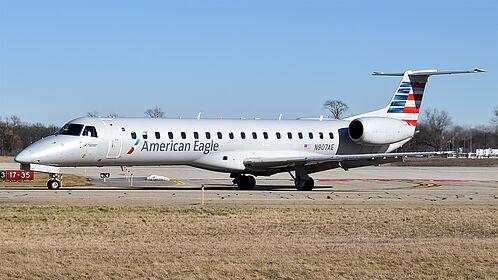
The ERJ 145 looks like a pencil: a long, very slim fuselage with a pointed nose, two small engines on the rear fuselage and a T-tail. The wing is straight-tapered and low, and the airplane sits close to the ground on short gear. Against the CRJ200, its only real rival, the ERJ is slimmer with a more pointed nose and a less bulged cockpit, and its windows sit lower; the CRJ has a fatter fuselage and a cockpit windshield with a distinct peak. The ERJ 135 and 140 are shorter versions with the same features, so count windows: about 17 per side on the 145, fewer on the others. A 145 with winglets is a 145XR, which carries the separate code E45X. The Legacy 600 business jet is the same shape with winglets, fewer windows and a different paint job.
Frequently asked
Is the ERJ 145 the same as an Embraer E-Jet?
No. The ERJ 135/140/145 family came first and uses a narrow, turboprop-derived fuselage with rear engines and 1-2 seating. The E170/E175/E190/E195 E-Jets are a later clean-sheet design with underwing engines and a wider 2-2 cabin. They share a manufacturer, not an airframe.
Is the ERJ 145 still in production?
No. Embraer delivered the last ERJ 145 in 2020 after building 1,231 of the ERJ 135/140/145 family. Hundreds remain in service, mostly in the United States, and many more are stored.
What is the ERJ 145XR?
An extended-range version with winglets, more fuel and a 24-ton takeoff weight, built for ExpressJet and Continental Express to fly longer thin routes. It has its own ICAO code, E45X; the standard ERJ 145 and 145LR are E145.
Can I bring a carry-on bag on an ERJ 145?
Only a small one. The overhead bins hold a backpack or briefcase; standard roll-aboards are checked at the aircraft door and returned on arrival. Keep anything you need in flight in a bag that fits under the seat.
Which seats are best on the ERJ 145?
The single seats on the left side of the aisle, which are both window and aisle. The front rows are quietest because the engines are at the back.
What aircraft is E145?
E145 is the ICAO type designator for the Embraer ERJ 145, a Embraer regional that first flew in 1995. It is the code flight trackers and air traffic control use.
What is the wingspan of the Embraer ERJ 145?
The Embraer ERJ 145 has a wingspan of 20.04 m (66 ft) and is 29.87 m (98 ft) long.
What engines does the Embraer ERJ 145 have?
Two Rolls-Royce AE 3007A.
What is the MTOW and range of the Embraer ERJ 145?
Maximum takeoff weight is 22,000 kg (48,501 lb) and maximum range is about 1,550 nautical miles (2,871 km) at a cruise of Mach 0.78.
How many passengers does the Embraer ERJ 145 carry?
Typically 50 passengers in a two-class layout; dense single-class layouts seat more and premium-heavy layouts fewer.
Compare with
Specs are approximate, compiled from public sources. See our editorial policy.