Cessna Citation Longitude (C700)
Cessna · Business jet · In production
C700 is the ICAO aircraft type code for the Cessna Citation Longitude, a Cessna business jet that first flew in 2016 and entered service in 2019. It typically carries 8 people, cruises at Mach 0.83, and has a range of about 3,500 nautical miles (6,482 km).

Loading live positions…
In the wild
History
The Longitude is Cessna's second attempt at a flagship above the midsize class. The first, the Citation Columbus, was launched in February 2008 as the biggest Citation yet: a $27 million Model 850 with Pratt & Whitney Canada PW810 engines and a planned 4,000 nm range. The recession hit business aviation hard, and Cessna suspended the Columbus in April 2009 and canceled it that July. When Cessna tried again, it started from a fuselage it was already developing for the Latitude.
The Longitude was announced at the EBACE show in Geneva in May 2012, seven months after the Latitude. It took the Latitude's round fuselage, reinforced it, stretched it by one row of seats, and added a new swept wing and a T-tail. The first plan called for Snecma Silvercrest engines. By NBAA 2015 Cessna had switched the production design to Honeywell's HTF7700L and moved the Silvercrest to a larger design announced at the same show, the Citation Hemisphere.
The first Longitude flew at Wichita on October 8, 2016. Production began in March 2017 and the test fleet grew to five aircraft. The fourth, which flew in May 2017, carried a full interior so that the cabin, air-conditioning and pressurization systems could be evaluated. When the first production airplane was rolled out on June 13, 2017, Textron still expected certification later that year. It slipped. AIN reported in 2018 that Textron was working through a new FAA certification process that had roughly doubled the testing and the paperwork. The company also needed a temporary exemption from fuel-tank flammability rules to stay on schedule. A provisional type certificate on December 20, 2018 let customer training flights begin. Full FAA type certification followed on September 21, 2019, after close to 6,000 flight hours, 11,000 test points and a 31,000 nm world tour. The first customer airplane was handed over in early October 2019.
The program's biggest customer had already signed. On October 15, 2018 NetJets announced options for up to 175 Longitudes and up to 150 Hemispheres, a deal it said could be worth nearly $10 billion. It received its first Longitude on December 31, 2019. The Hemisphere never followed. In July 2019 Textron suspended it because the Silvercrest had not met its objectives, which left the Longitude as the largest business jet Cessna builds.
EASA certified the Longitude on July 13, 2021, and the 100th was delivered in May 2023. Government buyers arrived too. Japan's Civil Aviation Bureau took a Longitude equipped to calibrate navigation aids in June 2022, and Turkish Aerospace ordered one the same year for DHMI, Turkey's state airports authority. In 2024 Textron announced a Garmin G5000 update for the Longitude, due in 2026, adding a synthetic vision guidance system and 3D taxi views.
Specifications
- First flight
- 2016
- Entered service
- 2019
- Engines
- 2 × Honeywell HTF7700L
- Typical seating
- 8 seats
- Cruise speed
- Mach 0.83
- Range
- 3,500 nm
- MTOW
- 17,917 kg
- Length
- 22.3 m
- Wingspan
- 21.01 m
- Status
- In production
Design notes
Only the cross-section ties the Longitude to the Latitude. The parts that set its performance are new.
The wing is moderately supercritical, swept 26.8 degrees at the quarter-chord inboard and 28.6 degrees outboard, and ends in upturned winglets. Its area of 537 sq ft is slightly less than the Latitude's, yet it lifts a maximum takeoff weight of 39,500 lb, against the Latitude's 30,800. The fuselage is contoured along area-rule lines to reduce transonic drag, the stabilizer sits on top of the fin, and both wing and fuselage are aluminum.
Power comes from two rear-mounted Honeywell HTF7700L turbofans of 7,665 lb thrust each. They belong to the HTF7000 family that also powers the Challenger 300 series, the Gulfstream G280 and Embraer's Legacy 450 and 500. Textron quotes a maximum cruise of 483 knots true airspeed and a 3,500 nm range. AIN's 2018 pilot report recorded Mach 0.83 at 43,000 ft with each engine burning 860 to 880 lb an hour. The airplane is limited to Mach 0.84.
Inside, the cabin is 72 in high and 77 in wide, the Latitude's numbers, but 25 ft 2 in long. Textron gives a 5,950 ft cabin altitude, and the 112 cu ft baggage hold can be reached during flight. The Garmin G5000 flight deck has fully integrated autothrottles, and a head-up display with an enhanced flight vision system is optional. The extra weight shows on the runway: Textron lists 4,810 ft for takeoff and 3,170 ft for landing.
Notable facts
- Cessna's largest business jet: the bigger Citation Hemisphere was suspended in 2019 when its Silvercrest engine missed its targets, and the earlier Citation Columbus was canceled in 2009.
- Seven years passed between its May 2012 announcement and FAA type certification on September 21, 2019.
- Keeps the Citation Latitude's fuselage cross-section but has its own swept wing, T-tail, engines and FAA type certificate, T00015WI.
- NetJets signed options for up to 175 Longitudes in October 2018 and accepted its first on December 31, 2019.
- Japan's Civil Aviation Bureau and Turkey's state airports authority (DHMI) fly special-mission Longitudes to calibrate navigation aids.
Who flies it
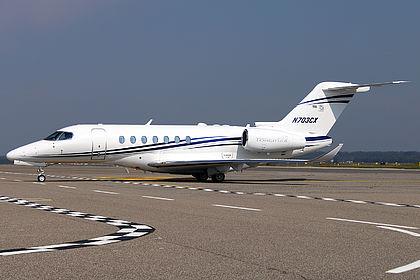
NetJets is the Longitude's anchor operator. Its US aircraft carry registrations ending in QS, and they fly well beyond North America; NetJets Longitudes have been photographed at London Stansted, for example. Most of the other US-registered aircraft belong to companies, from grocery chains and logistics firms to oil producers and manufacturers. Cessna's parent, Textron Inc., keeps one of the earliest airframes, N703CX (serial 700-0003), on its own corporate registration.
The type has also found government work. Japan's Civil Aviation Bureau flies a Longitude with UNIFIS 3000-G2 equipment to check ILS, GBAS and VOR navigation aids, and Turkey's DHMI uses another to inspect navaids at Turkish airports, a job DHMI began in 1993 with two Citation Vs and continued from 2009 with Citation XLS aircraft.
Flying on one
A Longitude cabin has the same 6 ft of headroom and 6 ft 5 in of width as the Latitude, over a flat floor, but with 25 ft 2 in of length to fill. That length matches the Challenger 3500's cabin, and so does the 6 ft height; the Challenger is 9 in wider. The standard layout is a double club, two groups of four facing seats. In NetJets aircraft all eight seats are fully berthable, so they can be made into beds on overnight flights. With an optional crew jump seat, Textron quotes up to 12 occupants.
Textron makes two comfort claims for its double-club cabin: 11 percent more legroom than the nearest competitor, and sound levels "nearly twice as quiet" as that competitor's. Both come from the manufacturer, not from independent measurement. Passengers can reach the 112 cu ft baggage compartment in flight, which helps on long legs when a coat or laptop ends up in the wrong bag. Cabin altitude tops out at 5,950 ft.
Since NetJets and company flight departments account for most of the US registry, passengers usually meet a Longitude through a fractional share or card or through their employer. Textron sells the 3,500 nm range as transcontinental, and AOPA's 2018 review put the payload with full tanks at 1,600 lb.
Variants
- Citation Longitude (Model 700) — Executive model delivered since October 2019; HTF7700L engines, Garmin G5000 with autothrottles, 3,500 nm range
- Special-mission Longitude — Flight-inspection aircraft carrying navaid calibration systems, delivered to Japan's JCAB in 2022 and ordered for Turkey's DHMI
How to spot it
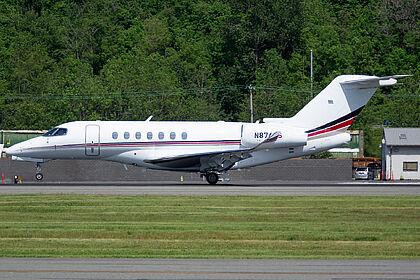
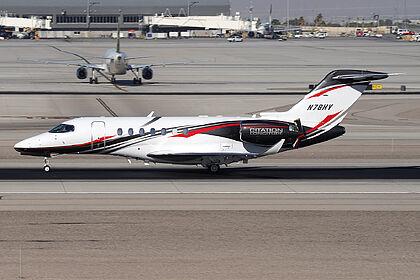
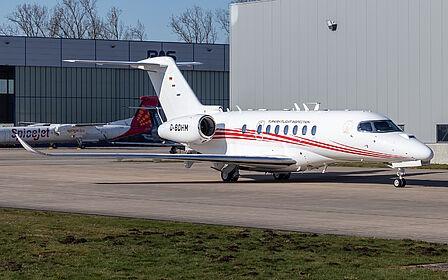
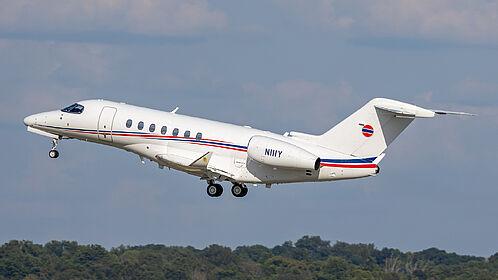
In the air, look for a T-tail, a moderately swept wing with upturned winglets and a long, round fuselage. The Citation Latitude shares that fuselage cross-section, but it is about 11 ft shorter, has a cruciform tail and lacks winglets. The Citation X also has a T-tail, but its wing is swept much harder, at 37 degrees, its slimmer fuselage sits on top of the wing, and its big engine nacelles ride high, close to the tail.
The hardest match is Bombardier's Challenger 350 and 3500. They are close in size and also have a T-tail, winglets and rear engines from the same Honeywell family. When the angle is poor, the registration or the tracker code settles it: the Longitude shows as C700 and the Challengers as CL35.
Frequently asked
How far can a Citation Longitude fly?
Textron quotes a maximum range of 3,500 nm, about 800 nm more than the Citation Latitude. On paper that exceeds the roughly 2,990 nm great-circle distance between New York and London, and it comfortably covers any US coast-to-coast trip. Headwinds, payload and reserve rules decide what a real flight can do.
Is the Citation Longitude Cessna's biggest jet?
Yes. The larger Citation Columbus was canceled in 2009 before it flew, and the Citation Hemisphere was suspended in 2019 after its engine fell short. That leaves the Longitude, at 73 ft 2 in long with a 39,500 lb maximum takeoff weight, as the largest business jet Cessna has put into service.
Why did the Citation Longitude take so long to certify?
Cessna announced it in 2012 with Silvercrest engines, then switched to Honeywell HTF7700L engines in 2015, and the first one flew in October 2016. Certification was planned for 2017. Under a new FAA process the testing and documentation roughly doubled, and the program needed a fuel-tank flammability exemption. A provisional certificate came in December 2018 and full FAA type certification on September 21, 2019.
Is the Citation Longitude just a stretched Latitude?
Only the fuselage cross-section is shared, stretched by one seat row. The Longitude has a new swept wing with winglets, a T-tail instead of a cruciform tail, Honeywell engines in place of Pratt & Whitney Canada units, and a maximum takeoff weight almost 9,000 lb higher. The FAA certified it separately, on type certificate T00015WI.
Why does the Citation Longitude show as C700?
Cessna's model number for the Longitude is 700, and the ICAO designator C700 is taken from it. The family numbering is not chronological: the Latitude is the Model 680A (C68A) and the older Citation X is the Model 750 (C750).
How much does a Citation Longitude cost?
Flight International put the Longitude at about $27 million in 2018, before certification. Business & Commercial Aviation's 2023 Purchase Planning Handbook listed a typically equipped price of about $30 million.
What aircraft is C700?
C700 is the ICAO type designator for the Cessna Citation Longitude, a Cessna business jet that first flew in 2016. It is the code flight trackers and air traffic control use.
What is the wingspan of the Cessna Citation Longitude?
The Cessna Citation Longitude has a wingspan of 21.01 m (69 ft) and is 22.3 m (73 ft) long.
What engines does the Cessna Citation Longitude have?
Two Honeywell HTF7700L.
What is the MTOW and range of the Cessna Citation Longitude?
Maximum takeoff weight is 17,917 kg (39,500 lb) and maximum range is about 3,500 nautical miles (6,482 km) at a cruise of Mach 0.83.
How many passengers does the Cessna Citation Longitude carry?
Typically 8 people including the pilot.
Compare with
Specs are approximate, compiled from public sources. See our editorial policy.