Boeing 767-200/200ER (B762)
Boeing · Widebody · Production ended
B762 is the ICAO aircraft type code for the Boeing 767-200/200ER, a Boeing widebody airliner that first flew in 1981 and entered service in 1982. It typically carries 214 passengers in a two-class layout, cruises at Mach 0.8, and has a range of about 6,590 nautical miles (12,205 km).

Loading live positions…
In the wild
History
The 767-200 is the airplane that started the 767 family and, with it, the era of twin-engine ocean crossings. Boeing launched the 767 in July 1978, the same month United ordered it, as a widebody for routes too thin for a 747 or DC-10. It was developed alongside the narrowbody 757, and the two were given a common two-crew glass cockpit so pilots could hold a single type rating for both, a first that saved airlines real money on training.
The first 767-200 flew on September 26, 1981 and entered service with United on September 8, 1982, initially on domestic routes between Chicago and Denver. The original airplane had modest range, about 3,900 nautical miles, and Boeing quickly offered the 767-200ER with more fuel and higher weights, which El Al put into service in 1984. The ER is the version that mattered historically. In 1985 TWA flew the first transatlantic service under the new ETOPS rules, which allowed twins to be up to two hours from a diversion airport, and the 767-200ER proved reliable enough that the limit was extended to three hours. That regulatory change, earned largely by the 767, is why almost every long-haul airliner built since has two engines.
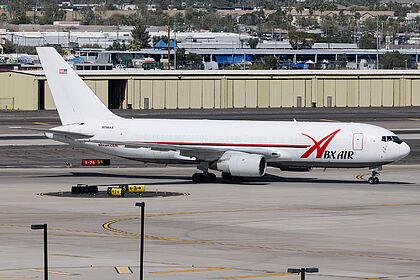
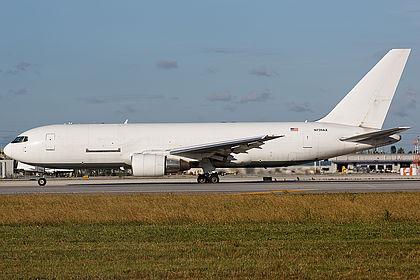
Boeing built 249 767-200s and -200ERs, far fewer than the stretched 767-300ER that followed in 1988 and took over most of the market. Passenger -200s served American, Delta, United, Air Canada, Qantas, ANA, JAL and many others, often for twenty-five years or more, before the type drifted into freight and charter work. Several were converted to freighters; ABX Air and Cargojet flew them for DHL and Amazon.
The fuselage lived on in uniform. Japan's E-767 airborne early-warning aircraft carries a rotating radar on a 767-200 airframe, and the KC-46 Pegasus tanker, based on a 767-200ER fuselage with a 767-300F wing and gear, entered US Air Force service in 2019 and is still being built at Everett. Because the KC-46 broadcasts the same B762 code, the "767-200s" on a tracker today are at least as likely to be tankers as airliners.
Specifications
- First flight
- 1981
- Entered service
- 1982
- Engines
- 2 × Pratt & Whitney JT9D or PW4000, or GE CF6-80
- Typical seating
- 214 (2-class)
- Cruise speed
- Mach 0.8
- Range
- 6,590 nm
- MTOW
- 179,170 kg
- Length
- 48.51 m
- Wingspan
- 47.57 m
- Status
- Production ended
Design notes
The 767 was designed around a new fuselage cross-section about five meters wide, deliberately narrower than the 747, DC-10 and L-1011. That width allows a twin-aisle cabin with seven seats abreast in a 2-3-2 layout, which puts almost every passenger within one seat of an aisle, and it gives the airplane a tall, narrow look on the ground. Below the floor it carries LD2 containers, a size unique to the 767.
The wing is a conventional aluminum design with a 47.6-meter span and a supercritical airfoil, large enough that the later stretches kept it unchanged. Engines were a choice of Pratt & Whitney JT9D-7R4 or, later, PW4000, and General Electric CF6-80A and -80C2; a few customers took Rolls-Royce RB211s on the -300. The main gear has four wheels per leg.
The flight deck was the 767's most forward-looking feature: six cathode-ray-tube displays replaced the engineer's panel, and the airplane was certified for a two-pilot crew after a long argument with pilot unions over whether a third crew member was needed. The 767-200ER differs from the basic -200 in its fuel capacity, up to about 91,000 liters with center-tank options, and in structural reinforcement for a maximum takeoff weight of 179 tons against 143. The KC-46 adds a boom, hose-and-drogue pods, a cargo door and a cockpit based on the 787's.
Notable facts
- Boeing's first widebody twin and the first of the 767 family: first flight September 26, 1981, and into service with United Airlines in September 1982.
- It shared a two-crew glass cockpit and a common type rating with the narrowbody 757, developed at the same time.
- A 767-200ER flew the first ETOPS-approved transatlantic airline service in 1985, the beginning of twin-engine ocean crossings.
- Few passenger 767-200s remain; most survivors are freighters or charter jets. The KC-46 Pegasus tanker and the E-767 radar aircraft are built on the 767-200 fuselage, and KC-46s usually show up on trackers under this same B762 code.
Who flies it
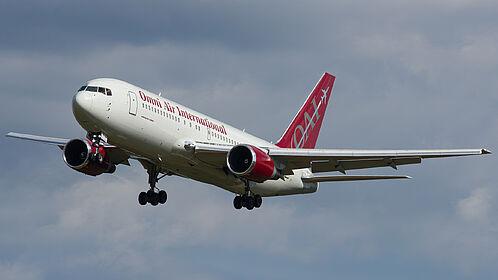
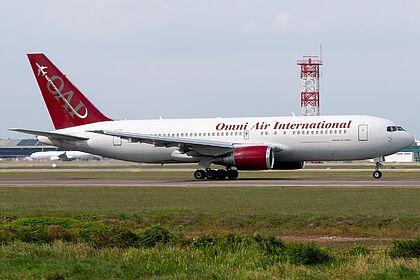
Passenger 767-200s are nearly gone from scheduled service. The type's remaining airline-style work is charter: Omni Air International flies 767-200ERs on US government and military passenger contracts, and a few other operators use them for sports teams and group travel. Converted freighters fly for cargo airlines in the Americas, often on behalf of DHL, UPS or Amazon, though many have been replaced by converted 767-300s. The largest active fleet of the type is the US Air Force's KC-46A Pegasus, which refuels fighters, bombers and transports from bases across the United States; Japan and Israel have ordered KC-46s too. Japan's air force also flies four E-767 radar aircraft. On a tracker, a B762 with a military callsign is one of these.
Flying on one
If you find yourself on a passenger 767-200 today it will almost certainly be a charter, and the cabin will be whatever the operator inherited. The good news is the layout itself: 2-3-2 economy, seven across, means only one seat in each row of the center section is a true middle, and the side pairs are ideal for couples. Seats are typically 17.5 to 18 inches wide, comparable to a modern narrowbody. The ride is smooth and the airplane is reasonably quiet, though the cabin pressure and humidity are 1980s standard and the overhead bins are small; large roll-aboards may not fit and end up gate-checked. Best seats are the window pairs on either side, ideally forward of the engines for noise. Avoid the last rows, which sit beside the rear galleys and lavatories and get the most turbulence.
Variants
- 767-200 — The 1982 original, 142-ton takeoff weight and about 3,900 nmi of range
- 767-200ER — Extended range; the figures above
- 767-2C / KC-46 Pegasus — US Air Force tanker, also flown by Japan and Israel; broadcasts as B762
How to spot it
The 767 has a distinctive shape: a tall, narrow widebody with a pointed nose it shares with the 757 and four-wheel main gear. The -200 is the short one, 48.5 meters long, so it looks stubby next to a 767-300 and much more so next to a 767-400ER, which also has raked wingtips. Telling a -200 from a -200ER is not possible from outside. Against the Airbus A310, its closest rival and about the same size, the 767 has a longer, more pointed nose and lacks the A310's wingtip fences. The KC-46 is easy once you know it: gray paint, a refueling boom under the tail, pods under each wingtip and a large cargo door on the left side forward of the wing. E-767s carry a rotating radar dish on struts above the rear fuselage.
Frequently asked
Why does a KC-46 tanker show up as a Boeing 767-200?
The KC-46A Pegasus is built on a 767-200ER fuselage, and ICAO assigned it the same type designator, B762. Trackers therefore label it a 767-200 even though it has a refueling boom, a cargo door and a military paint scheme. Look at the callsign and operator to tell them apart.
What is the difference between the 767-200 and the 767-200ER?
The ER carries more fuel and has a higher maximum takeoff weight, 179 tons against 143, which stretches range from about 3,900 to about 6,600 nautical miles. Externally they are the same airplane.
Are any airlines still flying passenger 767-200s?
Very few. The type has left most scheduled fleets; the passenger examples still active are mostly charter aircraft such as Omni Air International's, flown on government and sports contracts. Freighter conversions and the KC-46 account for most of the 767-200s in the air.
Was the 767 the first ETOPS airliner?
The 767-200ER flew the first scheduled transatlantic service under ETOPS rules in 1985 with TWA, and the type's reliability led regulators to extend twin-engine diversion limits from 120 to 180 minutes. That change made long-haul twins the industry standard.
What aircraft is B762?
B762 is the ICAO type designator for the Boeing 767-200/200ER, a Boeing widebody that first flew in 1981. It is the code flight trackers and air traffic control use.
What is the wingspan of the Boeing 767-200/200ER?
The Boeing 767-200/200ER has a wingspan of 47.57 m (156 ft) and is 48.51 m (159 ft) long.
What engines does the Boeing 767-200/200ER have?
Two Pratt & Whitney JT9D or PW4000, or GE CF6-80.
What is the MTOW and range of the Boeing 767-200/200ER?
Maximum takeoff weight is 179,170 kg (394,998 lb) and maximum range is about 6,590 nautical miles (12,205 km) at a cruise of Mach 0.8.
How many passengers does the Boeing 767-200/200ER carry?
Typically 214 passengers in a two-class layout; dense single-class layouts seat more and premium-heavy layouts fewer.
Compare with
Specs are approximate, compiled from public sources. See our editorial policy.