Boeing 787-9
B789Boeing · Widebody · In production
In the wild
History
The Boeing 787-9 is the second and best-selling member of the 787 Dreamliner family. The 787 programme grew out of Boeing's early-2000s studies, which first explored a near-sonic aircraft called the Sonic Cruiser before airlines signalled they wanted lower operating cost rather than higher speed. Boeing redirected the effort into a conventional-speed but highly efficient twin, then called the 7E7, and formally launched it in 2004. The central bet was extensive use of carbon-fibre composites and a more electrical systems architecture to cut fuel burn and maintenance, enabling long, thin point-to-point routes that larger widebodies could not serve economically.
The first variant, the 787-8, suffered well-documented delays during development, driven partly by an ambitious global supply chain and by the challenge of building large composite structures. It finally entered service in 2011, roughly three years late. In 2013 the entire in-service fleet was briefly grounded worldwide after two lithium-ion battery incidents, until Boeing redesigned the battery containment. Uniquely among modern Boeing widebodies, the 787 is offered with engines from two manufacturers, the General Electric GEnx and the Rolls-Royce Trent 1000, which are interchangeable at the airframe level.
The 787-9 is a stretch of about six metres over the -8, with a higher maximum weight, more powerful engines, and greater range and capacity. It first flew in 2013 and entered service with Air New Zealand in 2014. The extra size made it the family's commercial centre of gravity: it offered meaningfully more seats and cargo than the -8 for little additional cost, and most customers gravitated to it. In service it opened long, thin routes such as smaller European cities to Asia and the US west coast to Australia, a segment its efficiency made viable. In 2019 Qantas used a 787-9 for non-stop research flights from New York and London to Sydney, probing the limits of ultra-long-haul operations. Boeing later added a further stretch, the 787-10, optimised for shorter ranges.
The 787-9 became the most ordered Dreamliner variant and one of the definitive long-haul aircraft of the 2010s and 2020s, widely used to launch new nonstop routes between secondary cities. Production has faced later disruptions, including a lengthy pause in deliveries during 2021 and 2022 while Boeing and regulators addressed fuselage manufacturing quality issues, but the type remains in strong demand. It competes principally with the Airbus A330neo and the smaller A350 models, and its blend of range, efficiency, and mid-size capacity has made it a mainstay for both legacy carriers and long-haul low-cost operators.
Specifications
- First flight
- 2013
- Entered service
- 2014
- Engines
- 2 × General Electric GEnx-1B or Rolls-Royce Trent 1000
- Typical seating
- 290 (2-class)
- Cruise speed
- Mach 0.85
- Range
- 7,565 nm
- MTOW
- 254,011 kg
- Length
- 62.81 m
- Wingspan
- 60.12 m
- Status
- In production
Design notes
The 787 introduced several firsts for a Boeing airliner. Its fuselage and wing are built primarily from carbon-fibre-reinforced plastic, around half the airframe by weight, which allows a higher cabin pressure and humidity than aluminium structures typically permit; the cabin is pressurised to a lower equivalent altitude, intended to reduce passenger fatigue. Larger windows use electrochromic dimming instead of pull-down shades.
The systems architecture is described by Boeing as bleedless: instead of drawing hot air from the engines to run air conditioning and anti-icing, the 787 relies far more on electrical power, with large generators and electrically driven compressors. This more-electric approach is one of the type's most significant technical departures.
The wing is long, thin, and highly flexible, with raked wingtips that blend smoothly upward; in flight the tips can rise substantially, giving a characteristic gull-wing look. The engines, whether GEnx or Trent 1000, feature chevrons, the sawtooth pattern on the nacelle trailing edge that reduces jet noise. The 787-9 seats around 290 passengers in two classes, typically nine-abreast in economy. The flight deck uses large displays and a head-up display and shares a common type rating with the 777 to ease crew crossover. Structurally and systemically, the 787 served as the technology testbed for much of what later appeared on the 777X.
Notable facts
- The best-selling member of the 787 Dreamliner family.
- The 787 was the first airliner with an airframe built primarily from composite materials (around 50%).
- Uses a bleedless, largely electrical systems architecture, with a lower cabin altitude and higher humidity for comfort.
- Entered service with Air New Zealand in 2014.
- The global 787 fleet was briefly grounded in 2013 after lithium-ion battery incidents.
Who flies it
The 787-9 is flown by a broad global mix of operators, reflecting its versatility. Major users include All Nippon Airways and Japan Airlines, United Airlines, American Airlines, British Airways, Qatar Airways, Etihad, Air Canada, Qantas, and Air New Zealand, alongside several long-haul low-cost carriers. It typically serves medium- to long-haul international routes in two- or three-class layouts, and its range lets it fly ultra-long sectors such as Australia to Europe and the US to Asia. Because it is smaller than a 777 or A350 but shares much of their range, airlines favour it for opening new nonstop city pairs where a larger aircraft would struggle to fill seats year-round. It also serves as a fuel-efficient replacement for older widebodies such as the 767, A330, and 777-200. The 787-9 is likely to remain a core long-haul type for decades.
Flying on one
The 787-9's headline comfort features are real, but so is a catch. On the plus side, the composite airframe is pressurised to a lower cabin altitude and kept more humid than older metal jets, which genuinely reduces fatigue on long flights, and the large windows dim electronically rather than with pull-down shades. The cabin is quiet and the pivoting overhead bins are big. The catch is width: Boeing designed the 787 cross-section for eight-abreast economy, yet nearly every airline flies it nine-abreast in a 3-3-3 layout, which brings seat width down to about seventeen inches — tighter than an A350 or A330 in their usual layouts. So the Dreamliner can feel simultaneously modern and a little snug. For the best seat, choose a window to enjoy the dimmable glass and the view, aim for a bulkhead or exit row for legroom if you can, and avoid the last rows near the rear galleys where the nine-abreast squeeze is least forgiving.
Who flies it, and how
2 airline cabin layouts of the Boeing 787-9 in our dataset — expand any to see the cabin breakdown and seat map.
Air Canada787-9298 seats30J · 21W · 247Y
- Business (Signature Class): 30 seats, 1-2-1 across
- Premium Economy (Premium Economy): 21 seats, 2-3-2 across, 38″ pitch
- Economy (Economy): 247 seats, 3-3-3 across
United787-9257 seats48J · 21W · 188Y
- Business (Polaris): 48 seats, 1-2-1 across
- Premium Economy (United Premium Plus): 21 seats, 2-3-2 across
- Economy (Economy Plus): 39 seats, 3-3-3 across
- Economy (United Economy): 149 seats, 3-3-3 across
Dominant 787-9 layout (aeroLOPA 78P, ~51 aircraft). A newer high-J config (aeroLOPA 78L) with 64 Polaris / 35 Premium Plus / 33 Economy Plus / 90 Economy = 222 is entering service on newly delivered frames.
Variants
- 787-8 (B788) — Shorter original variant
- 787-10 (B78X) — Longest variant; shorter range
How to spot it
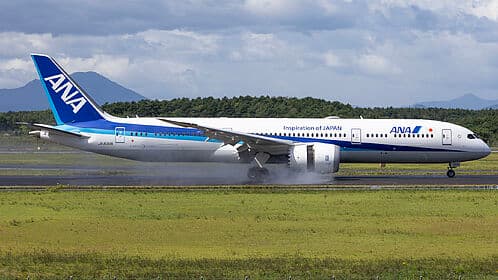
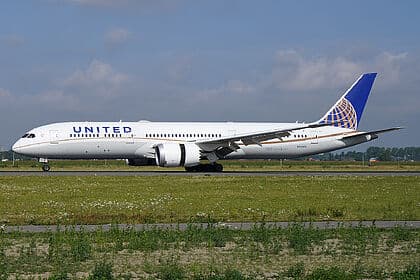
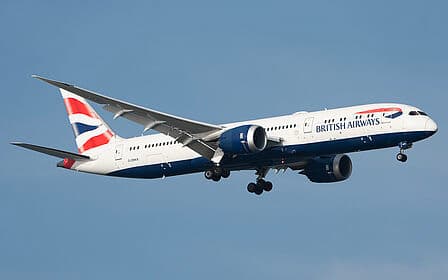
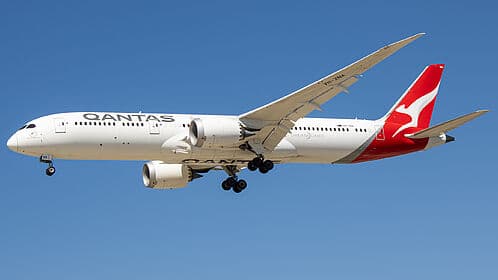
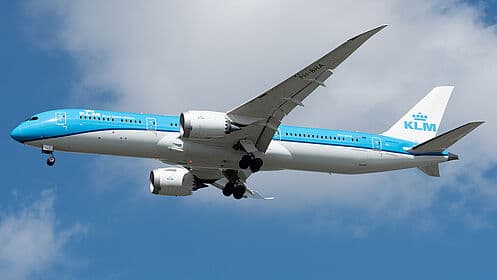
The 787 is a twin-engine widebody with a smooth, pointed nose, a four-panel windshield, and no eyebrow windows. Its clearest signatures are the engine nacelles, whose trailing edges are cut into a sawtooth chevron pattern, and its long, thin wing with raked tips that flex markedly upward in flight into a gull-wing shape. Telling the 787-9 from the shorter 787-8 comes down mainly to length: the -9 is about six metres longer, with more windows and a greater distance between the forward doors and the wing. The longest variant, the 787-10, is longer again. Against the Airbus A350, note that the A350 has a black mask around its cockpit windows and a curved, upswept wingtip, and its nacelles lack chevrons.
Frequently asked
How do you tell a 787 from an Airbus A350?
Both are modern composite twin-engine widebodies with raked wingtips, but the A350 has a distinctive black surround, often called a mask or raccoon eyes, around its cockpit windows, while the 787 has a plain four-panel windshield. The 787's engine nacelles have sawtooth chevrons on the trailing edge; the A350's do not. The A350's wingtip curves smoothly upward, whereas the 787's is more sharply raked.
How is the 787-9 different from the 787-8?
The -9 is a stretch of about six metres, with higher weight, more range, and more seats, typically around 290 in two classes versus roughly 240 on the -8. Externally the difference is mainly length and window count. The -9 has become far more popular than the original -8.
Why was the 787 fleet grounded in 2013?
Two separate lithium-ion battery incidents in early 2013, including a battery fire on a parked aircraft, led regulators to ground the worldwide fleet. Boeing redesigned the battery system with better containment and venting, and the aircraft returned to service after several months. No fatalities resulted from the incidents.
What does bleedless or more-electric mean on the 787?
Most jets tap hot compressed air from the engines to run cabin air conditioning and wing anti-icing. The 787 instead uses electrical power for most of these functions, with large generators and electric compressors, which Boeing says improves efficiency. It is one of the aircraft's most notable technical departures from earlier designs.
What routes is the 787-9 used for?
It is a long-haul aircraft used to connect city pairs that would be hard to fill with a larger widebody, including ultra-long sectors such as Australia to Europe. Its mix of range and mid-size capacity lets airlines open new nonstop routes and replace older jets like the 767 and A330. Both full-service and long-haul low-cost carriers operate it.
In-depth comparisons
Compare with
Specs are approximate, compiled from public sources. See our editorial policy.