Boeing 747-8
B748Boeing · Four-Engine · Production ended
History
The Boeing 747-8 is the final and largest development of the 747 family, launched by Boeing on 14 November 2005. It was offered in two versions: the 747-8 Intercontinental passenger aircraft, commonly abbreviated 747-8I, and the 747-8 Freighter, or 747-8F. The -8 designation was chosen partly to signal shared technology with the then-new 787 Dreamliner, including a version of the same engine.
Compared with the preceding 747-400, the 747-8 introduced a stretched fuselage, a redesigned wing with raked wingtips, and new General Electric GEnx-2B engines derived from the 787's powerplant. At 76.3 metres it became the longest airliner built up to that point. Boeing aimed the aircraft at operators wanting more capacity and improved economics than the 747-400 while retaining the four-engine layout and the familiar upper-deck hump.
The freighter flew first, on 8 February 2010, with the passenger 747-8I following on 20 March 2011. Certification and delivery were delayed by development problems, including issues found during flight testing and slower-than-planned production. The 747-8F entered service with the Luxembourg cargo carrier Cargolux in late 2011, and the 747-8I entered passenger service with Lufthansa in June 2012.
Passenger sales proved limited. By the time the 747-8I arrived, airlines were increasingly favouring large twin-engine widebodies such as the Boeing 777 and Airbus A350, which offered comparable range with lower fuel and maintenance costs than a four-engine jet. Only a small number of airlines took the passenger version, chiefly Lufthansa, Korean Air and Air China, supplemented by a batch of VIP and head-of-state aircraft. The 747-8 also competed at the very top of the market with the Airbus A380, and combined orders for these very-large aircraft remained modest as the industry shifted toward twins. The freighter fared better, winning orders from cargo operators who valued its payload, range and the nose-loading capability carried over from earlier 747 freighters.
Boeing delivered the last 747, a 747-8F for Atlas Air, on 31 January 2023, closing the production line after more than five decades of 747 manufacturing. The 747-8 thus marked the end of the line for a design that had been in airline service since 1970. Two 747-8 airframes are being converted into the next US presidential transports, designated VC-25B, extending the type's service in a specialised role well beyond the end of commercial production. In its final years the 747-8's story was largely one of a successful freighter and a passenger variant that never found a wide market. Even so, the aircraft extended the 747's long production history, and its freighters remain a familiar part of global cargo fleets.
Specifications
- First flight
- 2010
- Entered service
- 2012
- Engines
- 4 × General Electric GEnx-2B67
- Typical seating
- 410 (2-class)
- Cruise speed
- Mach 0.855
- Range
- 7,730 nm
- MTOW
- 447,700 kg
- Length
- 76.3 m
- Wingspan
- 68.4 m
- Status
- Production ended
Design notes
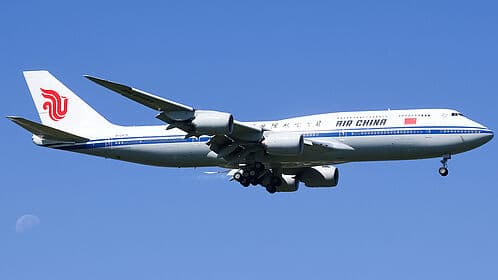
The 747-8's most visible changes over the 747-400 are its stretched fuselage and its new wing. The wing was redesigned with a new airfoil and raked wingtips in place of the 747-400's upturned winglets, increasing span and improving aerodynamic efficiency. Power comes from four General Electric GEnx-2B67 turbofans, a variant of the engine developed for the 787, which are quieter and more fuel-efficient than the engines they replaced and carry distinctive chevron, or sawtooth, trailing edges on their nacelles.
The aircraft retains the 747's characteristic partial upper deck, giving the extended hump familiar from the 747-400, rather than the full-length double deck of the Airbus A380. The flight deck is derived from the 747-400 with updates, and the passenger cabin adopted a Boeing Sky Interior with curved sidewalls and LED lighting similar to the 787.
While the 747-8 uses modern engines and aerodynamics, its structure remains predominantly aluminium rather than the composite-heavy construction of the 787, reflecting its heritage as a development of an existing design rather than a clean-sheet aircraft. The freighter version keeps the hinged nose door that allows straight-in loading of outsize cargo, a feature that helped sustain demand for the cargo variant. In broad terms, the 747-8 blended proven 747 architecture with newer propulsion, aerodynamics and cabin technology.
Notable facts
- The final and largest development of the Boeing 747, and the longest passenger aircraft in service at 76.3 m.
- Powered by four General Electric GEnx-2B engines with a new raked wing.
- Built in passenger (747-8I) and freighter (747-8F) versions; the freighter dominated sales.
- Two are being converted into the next U.S. presidential aircraft (VC-25B).
- Production ended in 2023, closing the 747 line after 54 years.
Who flies it
In passenger service the 747-8 Intercontinental has always been operated by only a handful of airlines. Lufthansa is the largest passenger operator, using it on long-haul routes from Frankfurt and Munich, while Korean Air and Air China also fly the type. A number of 747-8s serve in VIP and government configurations for several states and private owners.
The freighter is the more widespread version and is flown by cargo specialists and combination carriers around the world, including operators such as UPS, Cargolux, Cathay Cargo and Atlas Air. Today the passenger fleet remains small but active with its three main airlines, while the freighters continue to form part of the global air-cargo network. Two aircraft are also being converted for use as future US presidential transports.
Flying on one
Passenger 747-8s are rare — only a few airlines fly the -8 Intercontinental — so a flight on one is a treat, and the aircraft rewards it. As with every 747, the star is the upper deck: a quieter, more intimate cabin reached by the famous staircase, with useful side stowage bins by the windows, and it is the seat enthusiasts seek out. The long main deck typically runs ten-abreast in a 3-4-3 economy layout at around seventeen inches a seat, so economy width is ordinary, but the four engines and vast size make for an exceptionally smooth, quiet ride. The distinctive nose and the sense of occasion are part of the appeal. Cabin altitude and humidity are of the aircraft's era rather than class-leading, and premium products vary by operator. For the best seat, get upstairs to the upper deck if you can; on the main deck choose a window forward of the wing, away from the galleys and the boarding doors.
Who flies it, and how
1 airline cabin layout of the Boeing 747-8 in our dataset — expand any to see the cabin breakdown and seat map.
Lufthansa747-8364 seats8F · 80J · 32W · 244Y
- First (First): 8 seats, 1-2-1 across
- Business (Business): 80 seats, 2-2-2 across
- Premium Economy (Premium Economy): 32 seats, 2-4-2 across
- Economy (Economy): 244 seats, 3-4-3 across
LEGACY (pre-Allegris) config: 8F/80J/32W/244Y = 364. Business is 2-2-2 on the main deck plus 2-2 on the upper deck. Allegris retrofit config is 8F/80J/40W/220Y = 348; a denser 8F/92J/32W/208Y = 340 also exists. Fleet mid-transition.
Variants
- 747-8 Intercontinental (747-8I) — Passenger version
- 747-8F — Freighter; the majority of 747-8 orders
How to spot it
The 747-8 is a four-engined widebody with the 747's unmistakable partial upper-deck hump, so the first task is telling it from the earlier 747-400. The clearest cue is the wingtip: the 747-8 has smooth, swept raked wingtips, whereas the 747-400 carries tall, upturned winglets. The 747-8 is also noticeably longer, with a stretched upper deck and fuselage.
The GEnx engines have chevron, or sawtooth, edges on the rear of their nacelles, a trait shared with the 787 and a useful confirmation. Against the Airbus A380, the difference is obvious: the A380 is a full double-decker along its whole length, while the 747 has only the partial hump forward. Its four engines rule out the twin-engine 777 and A350.
Frequently asked
Is the Boeing 747-8 still in production?
No. Boeing delivered the final 747, a 747-8 Freighter for Atlas Air, on 31 January 2023, ending 747 production after more than 50 years. No further 747s of any variant are being built.
Why did so few airlines buy the passenger 747-8?
By the time the 747-8 Intercontinental entered service in 2012, most airlines were shifting to large twin-engine widebodies such as the 777 and A350, which offered similar range at lower operating cost than a four-engine aircraft. As a result only a few carriers, chiefly Lufthansa, Korean Air and Air China, ordered the passenger version, while the freighter sold more widely.
What is the difference between the 747-8I and the 747-8F?
The 747-8I, or Intercontinental, is the passenger version, while the 747-8F is the freighter. The freighter retains the hinged nose door for straight-in loading of large cargo and accounted for the majority of 747-8 orders. The two share the same wing, engines and basic structure.
What engines does the 747-8 use?
It is powered by four General Electric GEnx-2B67 turbofans, a variant of the engine family developed for the Boeing 787. These engines are quieter and more fuel-efficient than those on the 747-400 and have distinctive chevron edges on their nacelles.
Will the next Air Force One be a 747-8?
Two 747-8 airframes are being converted into presidential transports designated VC-25B, which are intended to replace the current VC-25A aircraft based on the older 747-200. This will keep the 747-8 in specialised US government service beyond the end of commercial production.
In-depth comparisons
Compare with
Specs are approximate, compiled from public sources. See our editorial policy.