Bombardier CRJ700 (CRJ7)
Bombardier · Regional · Production ended
CRJ7 is the ICAO aircraft type code for the Bombardier CRJ700, a Bombardier regional jet that first flew in 1999 and entered service in 2001. It typically carries 70 passengers in a two-class layout, cruises at Mach 0.78, and has a range of about 1,400 nautical miles (2,593 km).
Loading live positions…
In the wild
History
The Bombardier CRJ700 was the aircraft that let the regional jet grow up. Its predecessor, the 50-seat CRJ100/200, had been a huge success through the 1990s as US airlines replaced turboprops with jets, but it was built around the fuselage of the Challenger business jet and was cramped, short-legged and limited to 50 seats. Bombardier launched the CRJ700 in January 1997 as a stretch with a new, larger wing, more powerful CF34-8 engines and a cabin 33 cm longer than a simple stretch would need, with a lower floor, taller windows and real overhead bins.
The first CRJ700 flew on 27 May 1999 and Brit Air, the Air France regional, put it into service in February 2001; Horizon Air and then the big US regionals followed. Its timing was good. US pilot contracts, the scope clauses that limit how many large regional jets a mainline carrier's affiliates can fly, had begun to allow 70-seaters, and SkyWest, Mesa, PSA, GoJet and ExpressJet ordered hundreds to fly for United, Delta and American.
Bombardier used the CRJ700 as the base for a family: the CRJ900 of 2003 stretched it to about 76–90 seats, the CRJ1000 of 2010 to around 100, and in 2019 the CRJ550 reversed the process, reconfiguring CRJ700s to 50 seats with three cabins and more bin space so that United could fly a premium-friendly aircraft within its scope limits. Around 330 CRJ700s were built.
The programme's end came with Bombardier's exit from commercial aviation. It sold the CRJ line to Mitsubishi Heavy Industries in 2020, and the last CRJ900 was delivered that year; MHI RJ now supports the fleet. With Embraer's E175 having won most recent US orders, the CRJ700 is slowly retiring, though hundreds remain in daily service.
Specifications
- First flight
- 1999
- Entered service
- 2001
- Engines
- 2 × General Electric CF34-8C5
- Typical seating
- 70 (2-class)
- Cruise speed
- Mach 0.78
- Range
- 1,400 nm
- MTOW
- 34,019 kg
- Length
- 32.3 m
- Wingspan
- 23.25 m
- Status
- Production ended
Design notes
The CRJ700's wing is new rather than stretched, with greater span, a supercritical aerofoil and leading-edge slats, which the CRJ200 lacked; that gave the larger aircraft better field performance and a higher cruise altitude. The fuselage keeps the Challenger's cross-section but Bombardier lowered the cabin floor by about 5 cm and raised the windows, so the cabin feels less tube-like than the CRJ200's, though it remains narrow with a 2-2 layout and small bins.
The engines are GE CF34-8C1s or -8C5s at the rear of the fuselage, mounted on pylons beneath a T-tail, which keeps the wing clean and the cabin ahead of the engines quiet but makes the rear rows the noisiest. The cockpit is a Rockwell Collins Pro Line 4 suite, and the CRJ700, 900 and 1000 share a common type rating. Weight options (ER and LR) add range up to roughly 1,700 nautical miles.
Notable facts
- A stretched, re-winged development of the 50-seat CRJ200, itself derived from the Challenger business jet.
- Brit Air of France flew the first services in 2001; US regionals such as SkyWest, Mesa and PSA became the big operators.
- The CRJ550 is a CRJ700 reconfigured to 50 seats with more premium space, created for United's scope-clause limits.
- Introduced the longer cabin, taller windows and larger bins that distinguish the CRJ700/900/1000 from the cramped CRJ200.
- Many are now flown by GoJet, SkyWest and Endeavor for the US majors; others serve Lufthansa CityLine and Air France's HOP!
Who flies it
SkyWest is the world's largest CRJ700 operator, flying the type for United, Delta and American; GoJet and PSA operate it for United Express and American Eagle, and the CRJ550 conversions fly for United and, more recently, Delta Connection. In Europe, Lufthansa CityLine and Air France's HOP! have reduced their fleets but still operate some; SA Express in South Africa and Air Nostrum in Spain are other long-standing users. Typical missions are short hub feeder routes of 45 minutes to two and a half hours linking small cities to major hubs.
Flying on one
The CRJ700 is a better experience than the CRJ200 it grew from, and a worse one than an E175 of similar size. The 2-2 cabin means no middle seats, but it is narrow: seats are about 17 inches wide, the ceiling is low, and the overhead bins are too small for most roll-aboards, so expect to gate-check anything bigger than a backpack and collect it on the jet bridge. The rear rows sit beside the engines and are noticeably louder; the front of the cabin is quiet. Legroom is usually 30–31 inches, with a little more at the overwing exit. United's and Delta's CRJ550 conversions are the exception, with 50 seats, a first-class cabin, extra legroom throughout and a dedicated bag closet. For the best seat, take a window as far forward as you can; avoid the last three rows unless you like engine noise.
Variants
- CRJ700ER / LR — Higher-weight, longer-range options
- CRJ550 — 50-seat premium-heavy conversion for United Express
- CRJ900 (CRJ9) — Stretched 76–90 seat sibling
- CRJ1000 — The longest CRJ, seating around 100
How to spot it
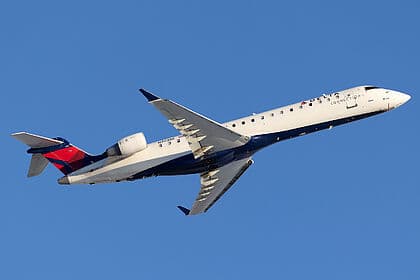
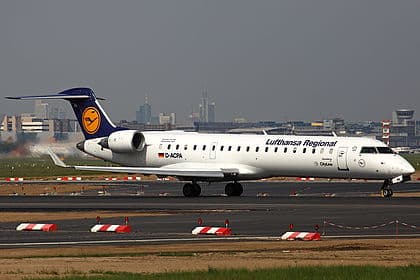
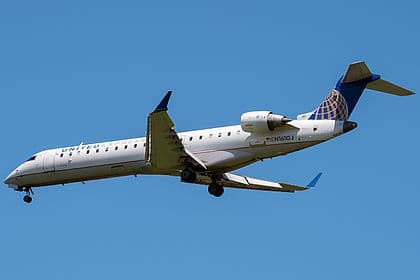
The CRJ family is the regional jet with engines on the rear fuselage and a T-tail, where the Embraer E-Jets have underwing engines and a conventional tail. Against the CRJ200 the CRJ700 is 5 m longer, with a taller fin, leading-edge slats and winglets, and a cabin with larger, taller windows. Against the CRJ900 and CRJ1000 the differences are length only: the CRJ700 has a short fuselage with two full-size doors per side (one forward, one aft) and a single overwing exit, where the CRJ900 adds a second overwing exit and the CRJ1000 is longer still. The CRJ550 is externally identical to a CRJ700.
Frequently asked
What is the difference between the CRJ700 and CRJ900?
The CRJ900 is 3.9 m longer, seats about 76–90 against the CRJ700's 66–78, and has a second overwing exit per side. Wing, engines (at higher thrust) and cockpit are common, so the two share a type rating and most parts.
What is a CRJ550?
A CRJ700 reconfigured to 50 seats in three cabins, with 10 first-class seats, extra legroom and a self-service snack area, developed in 2019 for United Express to fly a premium-friendly aircraft within pilot scope-clause limits on 50-seat jets. Delta Connection later added them too.
Can I bring a carry-on on a CRJ700?
You can bring it to the gate, but the bins are small and most roll-aboards are gate-checked on the jet bridge and returned there on arrival. Soft bags and backpacks that fit under the seat or in the shallow bins avoid that.
Is the CRJ700 still being built?
No. Bombardier sold the CRJ programme to Mitsubishi in 2020 and the final CRJ900 was delivered that year. MHI RJ supports the in-service fleet, and several hundred CRJ700s remain in use, mainly with US regional airlines.
What aircraft is CRJ7?
CRJ7 is the ICAO type designator for the Bombardier CRJ700, a Bombardier regional that first flew in 1999. It is the code flight trackers and air traffic control use.
What is the wingspan of the Bombardier CRJ700?
The Bombardier CRJ700 has a wingspan of 23.25 m (76 ft) and is 32.3 m (106 ft) long.
What engines does the Bombardier CRJ700 have?
Two General Electric CF34-8C5.
What is the MTOW and range of the Bombardier CRJ700?
Maximum take-off weight is 34,019 kg (74,998 lb) and maximum range is about 1,400 nautical miles (2,593 km) at a cruise of Mach 0.78.
How many passengers does the Bombardier CRJ700 carry?
Typically 70 passengers in a two-class layout; dense single-class layouts seat more and premium-heavy layouts fewer.
Compare with
Specs are approximate, compiled from public sources. See our editorial policy.