Boeing 717-200 (B712)
Boeing · Narrowbody · Production ended
B712 is the ICAO aircraft type code for the Boeing 717-200, a Boeing narrowbody airliner that first flew in 1998 and entered service in 1999. It typically carries 110 passengers in a two-class layout, cruises at Mach 0.77, and has a range of about 2,060 nautical miles (3,815 km).
Loading live positions…
In the wild
History
The Boeing 717 is the last of the DC-9 line and the only airliner to have been designed by one manufacturer and sold by another. McDonnell Douglas conceived it in the early 1990s as the MD-95, a 100-seat modernisation of the DC-9-30 aimed at replacing the hundreds of ageing DC-9s, 737-200s and Fokker 100s in short-haul service. It kept the DC-9's rear-engined, T-tailed layout and fuselage but added new Rolls-Royce BR715 engines, a glass cockpit derived from the MD-11's, and a new interior. The launch customer in 1995 was ValuJet, which became AirTran.
Boeing acquired McDonnell Douglas in 1997 and, after reviewing the programme, decided to keep it, renaming the MD-95 the 717-200 to slot it into the Boeing family. The first 717 flew on 2 September 1998 and AirTran took delivery in October 1999. Boeing marketed it hard as a dedicated 100-seater with regional-jet economics, and it won orders from TWA, Hawaiian, Midwest, Qantas's QantasLink, Olympic and Bangkok Airways, but the market it targeted was being squeezed from both sides by 70-seat regional jets and 120-seat A319s and 737-700s, and total sales reached only 156.
Boeing closed the Long Beach line in 2006, ending more than sixty years of Douglas airliner production in California, and the 717 became an orphan with no direct successor. That turned out not to matter much to its operators. Its engines proved exceptionally reliable, its DC-9 heritage made it rugged, and when AirTran merged into Southwest in 2011, Delta took the entire 88-aircraft fleet, replacing its own DC-9s and 50-seat regional jets with a mainline 110-seater.
As of 2026 Delta still operates the largest fleet, Hawaiian uses its 717s for the world's busiest inter-island network, and QantasLink has retired its fleet in favour of A220s. A replacement for the Delta aircraft has been discussed for years; none has arrived.
Specifications
- First flight
- 1998
- Entered service
- 1999
- Engines
- 2 × Rolls-Royce BR715
- Typical seating
- 110 (2-class)
- Cruise speed
- Mach 0.77
- Range
- 2,060 nm
- MTOW
- 54,885 kg
- Length
- 37.81 m
- Wingspan
- 28.45 m
- Status
- Production ended
Design notes
The 717 is a DC-9-30 airframe with new engines, systems and cockpit. The Rolls-Royce BR715 turbofans, mounted on the rear fuselage under a T-tail, deliver about 18,500 lb of thrust each with far lower noise and fuel burn than the DC-9's JT8Ds, and their position keeps the wing clean and the forward cabin quiet. The wing itself is the DC-9's, which limits cruise speed to Mach 0.77 and fuel capacity to a range of around 2,000 nautical miles in the high-gross-weight version.
The flight deck uses six liquid-crystal displays and systems architecture adapted from the MD-11, so the 717 shares little with other Boeings and nothing with the 737; crews are rated on it alone. The cabin seats five abreast in a 2-3 layout, a DC-9 tradition that leaves one middle seat per row. Only one fuselage length was built; proposed shorter and longer versions never found customers.
Notable facts
- Designed by McDonnell Douglas as the MD-95, a modernised DC-9, and renamed 717 after Boeing's 1997 takeover.
- AirTran launched it in 1999 and flew the largest fleet; Delta later took those aircraft and remains the biggest operator.
- Hawaiian Airlines has used it for inter-island flying since 2001, some airframes making a dozen sectors a day.
- Only 156 were built before the Long Beach line closed in 2006, the last airliner ever assembled there.
- Its BR715 engines and glass cockpit made it the quietest, most modern DC-9 derivative; it has no direct Boeing successor.
Who flies it
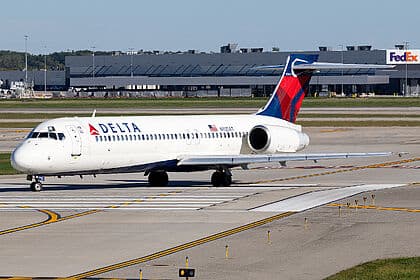
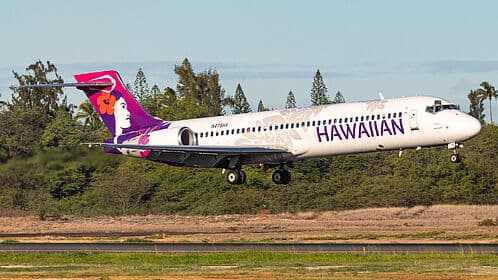
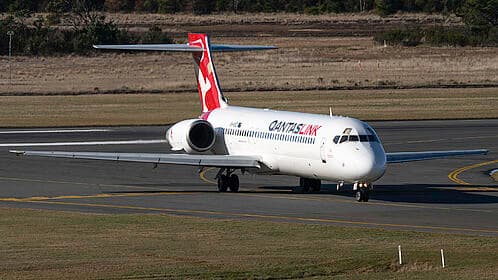
Delta Air Lines flies the largest 717 fleet, around 80 aircraft, on short domestic routes out of Atlanta, Detroit, Minneapolis and New York, typically with 110 seats including first class and Comfort+. Hawaiian Airlines operates 19 on its Honolulu–Maui–Kauai–Big Island network, where flights last 25–45 minutes and some aircraft make a dozen sectors a day. QantasLink retired the last of its 20 in 2024 as Airbus A220s arrived. Earlier operators included AirTran, TWA, Midwest, Olympic, Bangkok Airways and Spanish and Turkish charter carriers.
Flying on one
A 717 flight is usually short and surprisingly pleasant. The 2-3 cabin means the left side has pairs with no middle seat, a quirk worth knowing when you pick a seat, and Delta's layout gives 31–32 inches of pitch in economy with a proper first-class cabin of 12 seats. Because the engines sit at the back, the front two-thirds of the cabin are quiet and the last few rows are loud; the BR715 is far quieter than the old DC-9 and MD-80 engines, so even the rear is tolerable. Overhead bins are small, as on any DC-9 derivative, so larger roll-aboards often get gate-checked. The ride is firm but stable, and the aircraft climbs briskly out of short fields. For the best seat, take a window in the two-seat side ahead of the wing; avoid the last three rows.
Variants
- 717-200 BGW — Basic gross weight
- 717-200 HGW — High gross weight with more range
- MD-80 (MD83) — The stretched DC-9 family it descends from
How to spot it
The 717 looks like a DC-9 because it is one: two engines on the rear fuselage, a T-tail, and the DC-9's pointed nose with small, rounded cockpit windows. It is shorter and stubbier than an MD-80, with just two overwing exits close together and large, round BR715 nacelles with no exhaust mixer. The engine pylons are angled slightly upward, unlike the MD-80's horizontal mounts. In practice livery narrows it down fast: Delta's and Hawaiian's are the ones you will see, and Hawaiian's inter-island 717s carry a distinctive Pualani tail.
Frequently asked
Is the Boeing 717 really a DC-9?
In essence, yes. It was designed by McDonnell Douglas as the MD-95, a modernised DC-9-30 with new BR715 engines, a glass cockpit and a new interior, and renamed 717 after Boeing bought McDonnell Douglas in 1997. The fuselage and wing are DC-9.
Why did Boeing stop building the 717?
Sales were weak: only 156 were sold because 70-seat regional jets undercut it from below and the A319 and 737-700 squeezed it from above. Boeing closed the Long Beach line in 2006 with no successor.
Who still flies the Boeing 717?
Delta (around 80 aircraft) and Hawaiian Airlines (19) as of 2026. QantasLink retired its fleet in 2024; AirTran's went to Delta when it merged with Southwest.
How many seats does a 717 have?
Typically 106–117. Delta fits 110 in three classes, Hawaiian 128 in two; the certified maximum is 134.
What aircraft is B712?
B712 is the ICAO type designator for the Boeing 717-200, a Boeing narrowbody that first flew in 1998. It is the code flight trackers and air traffic control use.
What is the wingspan of the Boeing 717-200?
The Boeing 717-200 has a wingspan of 28.45 m (93 ft) and is 37.81 m (124 ft) long.
What engines does the Boeing 717-200 have?
Two Rolls-Royce BR715.
What is the MTOW and range of the Boeing 717-200?
Maximum take-off weight is 54,885 kg (120,999 lb) and maximum range is about 2,060 nautical miles (3,815 km) at a cruise of Mach 0.77.
How many passengers does the Boeing 717-200 carry?
Typically 110 passengers in a two-class layout; dense single-class layouts seat more and premium-heavy layouts fewer.
Compare with
Specs are approximate, compiled from public sources. See our editorial policy.