Aérospatiale/BAC Concorde (CONC)
Aérospatiale / British Aircraft Corporation · Narrowbody · Production ended
CONC is the ICAO aircraft type code for the Aérospatiale/BAC Concorde, an Aérospatiale / British Aircraft Corporation narrowbody airliner that first flew in 1969 and entered service in 1976. It typically carries 100 passengers in a two-class layout, cruises at Mach 2.02, and has a range of about 3,900 nautical miles (7,223 km).
Loading live positions…
In the wild
History
Concorde was the product of a 1962 treaty between Britain and France to build a supersonic airliner together, pooling the Bristol 223 and Sud Aviation Super-Caravelle studies into one programme shared by the British Aircraft Corporation and Sud Aviation, later Aérospatiale. The ambition was a 100-seat aircraft cruising at twice the speed of sound across the Atlantic, and at the time of launch most of the world's major airlines took options on it, assuming supersonic travel would become the norm.
The French prototype, 001, flew from Toulouse on 2 March 1969, and the British 002 followed from Filton a month later; 001 exceeded Mach 2 in November 1970. The programme then met the 1970s. The 1973 oil crisis quadrupled fuel prices, environmental objections to the sonic boom barred supersonic flight over land in the United States and elsewhere, and every option except those of British Airways and Air France evaporated. Twenty aircraft were built, including six development airframes; fourteen production Concordes went to the two national carriers, and the governments wrote off the development cost.
Commercial service began on 21 January 1976, with simultaneous departures from London to Bahrain and Paris to Rio de Janeiro via Dakar. The New York route, delayed by a legal fight over noise at JFK, opened in November 1977 and became the aircraft's reason for existing: London or Paris to New York in around three and a half hours, with the aircraft leaving at 10:30 and landing, by local time, an hour and a half before it took off. British Airways turned the service into a profitable premium product in the 1980s; Air France ran it more thinly.
The end came quickly. On 25 July 2000 Air France Flight 4590 crashed after take-off from Paris when a tyre, burst by debris on the runway, ruptured a fuel tank; all 109 on board and four on the ground died, and the fleet was grounded for modifications. Services resumed in November 2001, into the post-9/11 collapse in premium travel and with Airbus announcing it could no longer support the type economically. Air France flew its last Concorde service on 31 May 2003 and British Airways on 24 October 2003. Every surviving aircraft is preserved in a museum.
Specifications
- First flight
- 1969
- Entered service
- 1976
- Engines
- 4 × Rolls-Royce/Snecma Olympus 593 Mk 610 afterburning turbojets
- Typical seating
- 100 (2-class)
- Cruise speed
- Mach 2.02
- Range
- 3,900 nm
- MTOW
- 185,070 kg
- Length
- 61.66 m
- Wingspan
- 25.6 m
- Status
- Production ended
Design notes
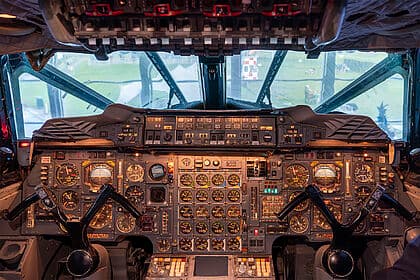
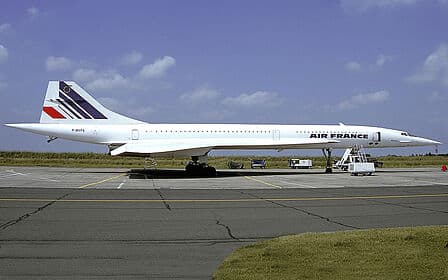
Everything about Concorde followed from sustained flight at Mach 2. The slender ogival delta wing, with its curved leading edge, generated lift through vortices at the high angles of attack needed for landing while keeping drag low at supersonic speed; it had no flaps or slats, only elevons, and the aircraft landed at a nose-high 11 degrees. That attitude is why the nose drooped: it lowered 5 degrees for take-off and 12.5 for landing so the pilots could see the runway, and a retractable visor streamlined the windscreen in cruise.
Four Olympus 593 turbojets, developed by Rolls-Royce and Snecma from the Vulcan bomber's engine, sat in paired nacelles under the wing with variable-geometry intakes that slowed the airflow from Mach 2 to subsonic speeds before it reached the compressors; afterburners were used for take-off and for the transonic acceleration. The airframe was aluminium alloy, limited to Mach 2.04 by skin temperatures that reached 127°C at the nose, and the fuselage stretched by around 20 cm in cruise. Fuel was pumped between tanks in flight to move the centre of gravity as the aerodynamic centre shifted with speed, a system that doubled as trim.
Notable facts
- The only supersonic airliner to sustain commercial service, cruising at Mach 2.02 and up to 60,000 ft for 27 years.
- Twenty were built — six development aircraft and fourteen production airframes, flown only by British Airways and Air France.
- London–New York in about three and a half hours; the record crossing, in February 1996, took 2 hours 52 minutes and 59 seconds.
- Its ogival delta wing and droop nose were unique; the fuselage stretched by around 20 cm in flight from kinetic heating.
- Retired in 2003 after the 2000 Air France crash near Paris, rising costs and falling post-9/11 demand; every survivor is now in a museum.
Who flies it
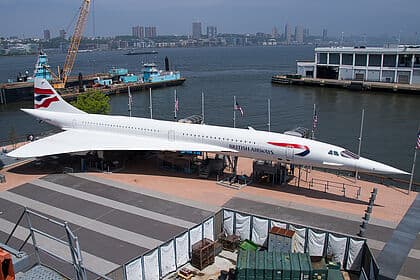
Only two airlines ever flew Concorde in revenue service: British Airways, with seven production aircraft, and Air France, also with seven, both from 1976 to 2003. Braniff operated a brief interchange service between Washington and Dallas in 1979–80 using BA and Air France aircraft at subsonic speed, and Singapore Airlines shared a BA aircraft on a London–Bahrain–Singapore route for a short period. The core network was London and Paris to New York, with seasonal services to Barbados and charters around the world. All eighteen surviving airframes are now museum exhibits, from Heathrow and Manchester to Le Bourget, Toulouse, New York's Intrepid Museum and Seattle's Museum of Flight.
Flying on one
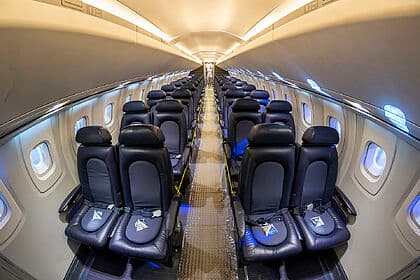
Flying Concorde was a premium experience built around speed rather than space. The cabin was narrow, with 100 seats in a 2-2 layout at about 38 inches of pitch, seats roughly the size of today's domestic first class, and small windows the size of a hand. What passengers remember is the take-off, with afterburners lit and an acceleration unlike any other airliner, the push of the transonic reheat over the ocean, and the cabin display climbing past Mach 2 at 55,000 to 60,000 feet, where the sky is dark blue and the curvature of the Earth is visible. The fuselage grew warm to the touch in cruise. Service was fine dining and champagne compressed into three hours. Tickets cost around £6,000 to £8,000 return in the final years, roughly twice first class. The best seats were at the front, away from the engines; everyone wanted a window regardless of the view.
Variants
- Prototypes 001 and 002 — The French and British first-flight aircraft of 1969
- Pre-production 101 and 102 — Longer fuselage and the definitive wing and intakes
- Production (16 built) — Seven each delivered to British Airways and Air France, plus two unsold development aircraft
How to spot it
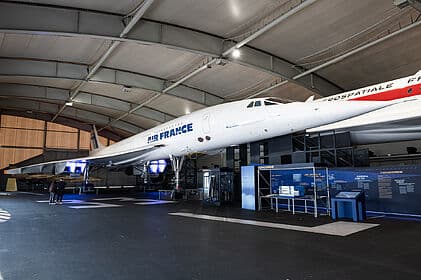
You will not see one fly, but you may well see one on the ground: Concordes are preserved at Heathrow, Manchester, Filton (Aerospace Bristol), Duxford, East Fortune, Brooklands, Le Bourget, Toulouse, Sinsheim, the Intrepid Museum in New York, Washington's Udvar-Hazy Center, Seattle's Museum of Flight and Grantley Adams Airport in Barbados. It is unmistakable: a long, needle-thin fuselage on a delta wing with a drooping nose, four engines in two underwing boxes, and a tall fin with no horizontal tailplane. The British aircraft carried the G-BOA* registrations and the French F-BV** and F-BTS*; the development aircraft are at Duxford, Orly, Yeovilton and Toulouse.
Frequently asked
How fast did Concorde fly?
It cruised at Mach 2.02, about 1,350 mph (2,180 km/h), at altitudes between 50,000 and 60,000 feet, roughly twice the speed and nearly twice the height of a subsonic airliner. The record New York to London crossing, in February 1996, took 2 hours 52 minutes and 59 seconds.
Why did Concorde stop flying?
A combination of the July 2000 Air France crash and the costly modifications that followed, the collapse in premium travel after September 2001, rising maintenance costs for a 30-year-old fleet, and Airbus's decision to end support. Both airlines retired the type in 2003.
How many Concordes were built?
Twenty: two prototypes, two pre-production aircraft and sixteen production aircraft, of which fourteen entered airline service, seven each with British Airways and Air France. Eighteen survive in museums.
Why did Concorde's nose droop?
Its delta wing needed a very nose-high attitude at low speed, so the pilots could not see the runway with the nose level. The nose lowered 5 degrees for take-off and 12.5 degrees for landing, and a visor retracted to give a clear view; both were raised in cruise for streamlining.
Will there be another supersonic airliner?
Several companies are developing one, most prominently Boom Supersonic with its Overture design aimed at Mach 1.7 and service in the 2030s, but as of 2026 no supersonic airliner has flown in commercial service since Concorde's retirement.
What aircraft is CONC?
CONC is the ICAO type designator for the Aérospatiale/BAC Concorde, a Aérospatiale / British Aircraft Corporation narrowbody that first flew in 1969. It is the code flight trackers and air traffic control use.
What is the wingspan of the Aérospatiale/BAC Concorde?
The Aérospatiale/BAC Concorde has a wingspan of 25.6 m (84 ft) and is 61.66 m (202 ft) long.
What engines does the Aérospatiale/BAC Concorde have?
Four Rolls-Royce/Snecma Olympus 593 Mk 610 afterburning turbojets.
What is the MTOW and range of the Aérospatiale/BAC Concorde?
Maximum take-off weight is 185,070 kg (408,005 lb) and maximum range is about 3,900 nautical miles (7,223 km) at a cruise of Mach 2.02.
How many passengers does the Aérospatiale/BAC Concorde carry?
Typically 100 passengers in a two-class layout; dense single-class layouts seat more and premium-heavy layouts fewer.
Compare with
Specs are approximate, compiled from public sources. See our editorial policy.