Bombardier CRJ200 (CRJ2)
Bombardier · Regional · Production ended
CRJ2 is the ICAO aircraft type code for the Bombardier CRJ200, a Bombardier regional jet that first flew in 1991 and entered service in 1992. It typically carries 50 passengers in a two-class layout, cruises at Mach 0.74, and has a range of about 1,700 nautical miles (3,148 km).

Loading live positions…
In the wild
History
The CRJ200 is the airplane that created the regional-jet boom, and it started as a business jet. In the 1980s Canadair, then newly bought by Bombardier, built the Challenger 600, a wide-cabin corporate jet, and noticed that its fuselage was big enough to seat passengers four abreast. The company launched the Canadair Regional Jet in 1989 as a 50-seat stretch of the Challenger with the same wing profile, engines and cockpit lineage. The CRJ100 first flew on May 10, 1991, and Lufthansa CityLine put it into service on October 19, 1992 between Frankfurt and other German cities, the first jet airliner designed and built in Canada.
The CRJ200, which appeared in 1995, is the same airplane with General Electric's more efficient CF34-3B1 engines, and it is the version that sold. Its market was the United States, where airlines were replacing 30-seat turboprops on hub feeder routes and passengers had decided they preferred jets, and where pilot-contract scope clauses capped regional jets at 50 seats. Comair, SkyWest, Atlantic Southeast, Mesa, Pinnacle and Air Wisconsin bought them by the hundred; Bombardier delivered 1,021 CRJ100s, CRJ200s and CRJ440s, the last a 44-seat version built for a specific scope clause, before production ended in 2006.
The CRJ200 had rivals, chiefly Embraer's ERJ 145, and the two shaped a decade of American air travel: jets on routes that had never had them, more frequencies between hubs and small cities, and a public that came to dislike the cramped 50-seat cabin. When fuel prices rose after 2005 the economics of flying 50 seats collapsed, and the 2008 downturn sent hundreds to the desert. Airlines moved up to the 70-seat CRJ700 and 76-seat CRJ900, which share the CRJ200's fuselage width and cockpit, and later to Embraer E175s.
Hundreds of CRJ200s are still flying. SkyWest operates the largest fleet for United Express and Delta Connection, and the type is used by charter operators, by cargo airlines in converted form and by regional carriers across the world. Bombardier sold the CRJ program to Mitsubishi in 2020, which supports the fleet but builds no new aircraft.
Specifications
- First flight
- 1991
- Entered service
- 1992
- Engines
- 2 × GE CF34-3B1
- Typical seating
- 50 (2-class)
- Cruise speed
- Mach 0.74
- Range
- 1,700 nm
- MTOW
- 24,041 kg
- Length
- 26.77 m
- Wingspan
- 21.21 m
- Status
- Production ended
Design notes
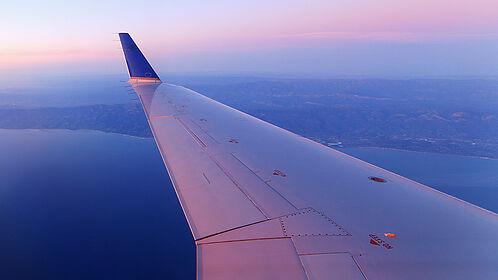
The CRJ200 keeps the Challenger's fuselage cross-section, 2.69 meters wide, which allows 2-2 seating with a narrow aisle, and the Challenger's general arrangement: two rear-mounted engines, a T-tail and a low wing. The wing is a supercritical design with a 21.2-meter span and small winglets, and it was strengthened and fitted with leading-edge slats for the airliner, a change the Challenger never needed.
The engines are two General Electric CF34-3B1 turbofans of about 9,200 pounds of thrust each, the same family that powers the larger CRJs and the E-Jets. Rear mounting leaves the wing clean and the cabin quiet forward of the engines; it also means the airplane sits low on its gear and has a long, straight fuselage with the engines' weight at the back.
The flight deck is a Rockwell Collins Pro Line 4 suite with six displays, flown by two pilots with conventional controls. Maximum takeoff weight is 23.1 tons for the ER and 24 tons for the LR, giving the LR about 1,700 nautical miles of range. Cruise is normally Mach 0.74, with a high-speed cruise of Mach 0.81, fast for a regional jet and a legacy of the business-jet design. The cabin is 1.85 meters high at the aisle, lower than any other regional jet, which is the single thing most passengers remember about the CRJ200.
Notable facts
- Canada's first jet airliner, developed from the Challenger 600 business jet. The CRJ100 first flew on May 10, 1991 and entered service with Lufthansa CityLine in 1992; the CRJ200 is the same airplane with more efficient CF34-3B1 engines.
- 1,021 CRJ100/200/440s were built before production ended in 2006, and with the ERJ 145 they created the US regional-jet boom of the 1990s and 2000s.
- Passengers know it for the low cabin and small windows; airlines kept it for its economics on thin routes. Many have now been retired, converted to freighters or parked, but SkyWest still flies a large fleet.
- The CRJ440 is a 44-seat version built to fit US pilot-contract scope clauses. Figures above are for the CRJ200LR.
Who flies it
The CRJ200's remaining stronghold is the United States, where SkyWest flies a large fleet as United Express and Delta Connection from hubs such as Denver, Salt Lake City, Chicago and Minneapolis, on routes to small cities that no larger jet could serve. Air Wisconsin and Endeavor retired theirs in the 2020s. Charter operators such as Contour Airlines and Southern Skyways fly CRJ200s in 30-seat layouts under rules that let them use smaller crews, and several cargo conversions fly packages for FedEx and others. Outside the US the type serves regional carriers in Mexico, Canada, Europe and Africa in small numbers, and a few governments use them as VIP transports. Many more are stored.
Flying on one
The CRJ200 is the regional jet that gave regional jets a bad name, and the complaints are fair. The cabin is 2-2 with no middle seats, which is good, but the ceiling is low enough that anyone over about six feet stoops in the aisle, the window seats lose shoulder room to the curved wall, and the seats are around 17 inches wide at a typical 31-inch pitch. Overhead bins hold only a small bag; roll-aboards are valet-checked at the aircraft door and returned on the ramp, so keep essentials in an under-seat bag. The engines are at the rear, so the front rows are quiet and the last two rows loud. There is one lavatory, at the back. Charter operators flying 30-seat CRJ200s offer far more legroom. The airplane's redeeming feature is that it flies short routes: most sectors are well under two hours, which is as long as this cabin should be endured.
Variants
- CRJ100 — Original CF34-3A1 engines, code CRJ1
- CRJ200 — CF34-3B1 engines; ER and LR weights
- CRJ440 — 44-seat scope-clause version, same code
How to spot it
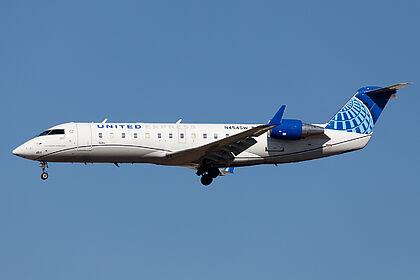
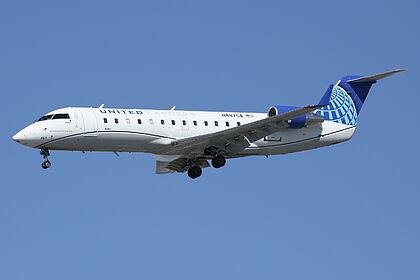
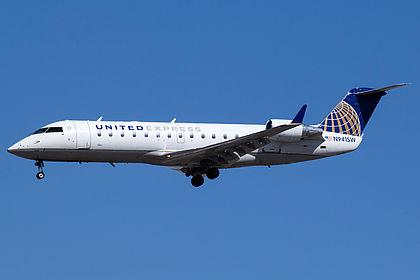
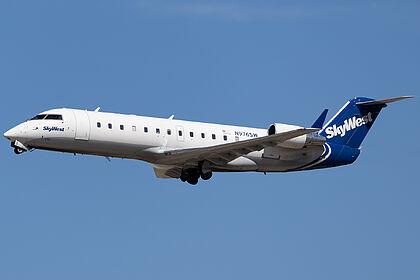
The CRJ200 is a low, long jet with two engines on the rear fuselage and a T-tail, like a business jet that has been stretched, which is what it is. The wing is low with small winglets, and the main gear is short, so the fuselage sits close to the ground. Against its rival the ERJ 145, the CRJ has a fatter, rounder fuselage, a cockpit windshield with a distinct peak in the center and larger windows set higher on the body; the ERJ is slimmer with a more pointed nose. Against the CRJ700 and CRJ900 the 200 is clearly shorter, with no leading-edge extension on the wing root and a different, shorter nose. Count windows: about 12 per side on the CRJ200, 17 or more on the larger ones.
Frequently asked
What is the difference between the CRJ100 and the CRJ200?
Only the engines. The CRJ200 has General Electric CF34-3B1 turbofans with better fuel economy than the CRJ100's CF34-3A1; the airframe, cabin and performance are otherwise the same. The CRJ100 carries the code CRJ1, the CRJ200 and 44-seat CRJ440 the code CRJ2.
Is the CRJ200 still flying?
Yes, though in falling numbers. SkyWest still operates a large fleet for United and Delta, charter airlines fly it in 30-seat layouts, and converted freighters carry packages. Production ended in 2006 and many airframes are in storage.
Why is the CRJ200 so cramped?
Its fuselage comes from the Challenger business jet, which was designed for a dozen passengers, not fifty. The cabin is 1.85 meters high and about 2.5 meters wide, less than any other regional jet, and the overhead bins are too small for roll-aboards.
What is a CRJ440?
A CRJ200 with 44 seats instead of 50, built so that Northwest Airlink could fly it under a pilot contract that limited regional jets to 44 seats. It is the same airplane with a different cabin and shares the CRJ2 code.
What aircraft is CRJ2?
CRJ2 is the ICAO type designator for the Bombardier CRJ200, a Bombardier regional that first flew in 1991. It is the code flight trackers and air traffic control use.
What is the wingspan of the Bombardier CRJ200?
The Bombardier CRJ200 has a wingspan of 21.21 m (70 ft) and is 26.77 m (88 ft) long.
What engines does the Bombardier CRJ200 have?
Two GE CF34-3B1.
What is the MTOW and range of the Bombardier CRJ200?
Maximum takeoff weight is 24,041 kg (53,001 lb) and maximum range is about 1,700 nautical miles (3,148 km) at a cruise of Mach 0.74.
How many passengers does the Bombardier CRJ200 carry?
Typically 50 passengers in a two-class layout; dense single-class layouts seat more and premium-heavy layouts fewer.
Compare with
Specs are approximate, compiled from public sources. See our editorial policy.