Embraer E195 (E195)
Embraer · Regional · Production ended
E195 is the ICAO aircraft type code for the Embraer E195, an Embraer regional jet that first flew in 2004 and entered service in 2006. It typically carries 118 passengers in a two-class layout, cruises at Mach 0.78, and has a range of about 2,200 nautical miles (4,074 km).
Loading live positions…
In the wild
History
The Embraer E195 is the largest of the first-generation E-Jets, a 2.4 m stretch of the E190 that took the family to around 120 seats and put it squarely against the smallest Airbus and Boeing narrowbodies. Embraer launched it in 2001 alongside the E190, and the first E195 flew on 7 December 2004. The British regional carrier flybe was the launch customer, taking its first in September 2006 for routes from Birmingham, Manchester and Southampton.
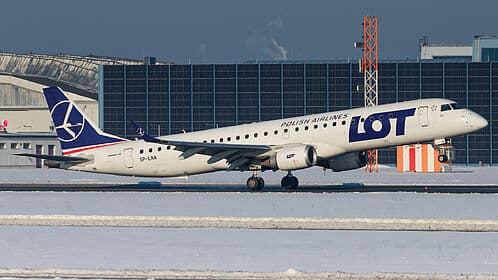
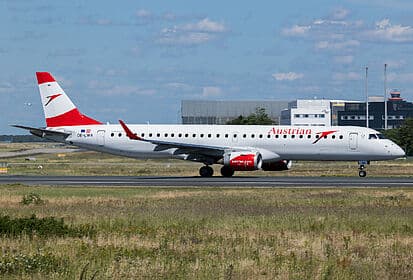
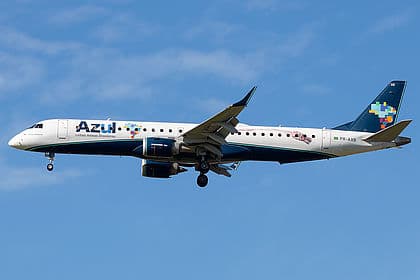
The logic was that many routes flown by 737-500s, A319s and ageing BAe 146s and Fokker 100s needed 110–125 seats, and a stretched E-Jet could carry them with the regional jet's lower costs and the family's single type rating. It worked best in markets with dense regional networks: Azul, the Brazilian airline founded by JetBlue's David Neeleman, built its network on E195s and became the largest operator; LOT Polish Airlines, Austrian, Lufthansa CityLine, Aeroméxico Connect and, in Africa, Air Burkina and Kenya Airways all flew it. Royal Jordanian and Montenegro Airlines used it on longer thin routes.
The E195 also exposed a limit. At 120 seats it competed directly with the A319 and 737-700, which carried more and flew further for similar trip costs, and in the 2010s the Bombardier C Series (later the A220) arrived with a wider cabin and new-generation engines in the same size. Embraer's response was the E195-E2, launched in 2013 and stretched a further 2.85 m to seat up to 146, with Pratt & Whitney geared turbofans and a new wing. First-generation E195 deliveries wound down in the early 2020s after around 170 aircraft.
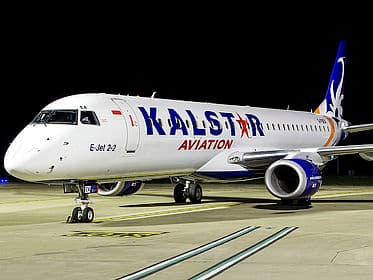
Many E195s have since moved to second owners, where their 2-2 cabin and jet speeds on short sectors remain attractive, and lessors continue to place them in Europe, Africa and Latin America.
Specifications
- First flight
- 2004
- Entered service
- 2006
- Engines
- 2 × General Electric CF34-10E
- Typical seating
- 118 (2-class)
- Cruise speed
- Mach 0.78
- Range
- 2,200 nm
- MTOW
- 52,290 kg
- Length
- 38.65 m
- Wingspan
- 28.72 m
- Status
- Production ended
Design notes
The E195 adds two fuselage plugs to the E190 and nothing else fundamental: the 28.7 m wing, the GE CF34-10E engines at 18,500 lb thrust, the Honeywell Primus Epic cockpit and the hybrid fly-by-wire system are common across the two, as is the type rating. The extra length brings a modestly higher maximum take-off weight, 52.3 tonnes in the AR version, and a slightly shorter range because the fuel capacity is unchanged.
The cabin is the E-Jet 'double-bubble' cross-section, 2-2 across with seats close to 18 inches wide, and the E195 has 30 to 31 rows depending on the layout. Overhead bins take a standard roll-aboard wheels-first, which, with the absence of middle seats, is the type's main selling point to passengers. The E195-E2 successor keeps the fuselage cross-section but is otherwise a different aircraft, with a new wing, engines and systems.
Notable facts
- The longest first-generation E-Jet, a 2.4 m stretch of the E190 seating up to 124 in a single class.
- Flybe was the launch customer in 2006; Azul in Brazil built the largest fleet and LOT, Austrian and Aeroméxico flew it in numbers.
- Shares the E190's wing, engines, cockpit and type rating; the two are often flown interchangeably.
- Succeeded by the E195-E2 (E295), which is longer still and seats up to 146.
- Its 2-2 cabin with no middle seats and real overhead bins made it a passenger favourite at the 120-seat size.
Who flies it
Azul in Brazil built the largest E195 fleet and still flies many alongside its E2s; in Europe LOT, Austrian, Lufthansa CityLine (now largely retired), Helvetic and KLM Cityhopper have operated it, with Marathon Airlines, Air Serbia and Montenegro Airlines among the smaller users. In the Americas Aeroméxico Connect and Conviasa fly it, and in Africa Kenya Airways and Air Peace. Typical duties are regional and short mainline routes of one to three hours, often replacing older 100-seat jets, and increasingly leased to carriers in secondary markets as the original operators move to the E2.
Flying on one
The E195 is the E190 with a few more rows, and it keeps everything passengers like about the family: a 2-2 cabin with no middle seats, roughly 18-inch seats, bins that actually hold a roll-aboard, and engines under the wing rather than beside the rear cabin, so it is quiet throughout. With 30 rows the cabin is longer than an E190's but boarding is still quick. Pitch varies from 29 inches on dense leisure layouts to 32 or more with a business cabin up front. The ride is good for a jet of its size, though the long, light fuselage feels gusts on approach. For the best seat, take a window ahead of the wing on the side with the view on arrival; the rows beside the two overwing exits have extra legroom, and the final row is beside the rear lavatory.
Variants
- E195AR — Advanced-range weight option
- E190 (E190) — Shorter sibling seating about 100
- E195-E2 (E295) — Second-generation successor with geared turbofans
How to spot it
The E195 is the longest first-generation E-Jet, so against an E190 look for the extra length and a third pair of overwing exits: the E195 has two overwing exits per side, the E190 one. Both share the E-Jet nose, the double-bubble fuselage and underwing CF34 engines with winglets on the wingtips. Against the E195-E2 that replaced it, the E2 has a longer, more slender wing with raked tips instead of winglets, much larger geared-turbofan nacelles, and is longer still. Against an A319 of similar capacity, the E-Jet is slimmer, lower to the ground and has a more pointed nose.
Frequently asked
What is the difference between the E190 and E195?
The E195 is 2.4 m longer and seats about 20 more passengers (up to 124 against 114), with a second pair of overwing exits. Wing, engines, cockpit and type rating are the same, and range is slightly shorter because the fuel load is unchanged.
Is the E195 the same as the E195-E2?
No. The E195-E2 (ICAO E295) is a second-generation aircraft with Pratt & Whitney geared turbofans, a new high-aspect-ratio wing, full fly-by-wire and a longer fuselage seating up to 146. Only the cabin cross-section carries over.
How many seats does an E195 have?
Typically 108–118 in two classes and up to 124 in a single class; Azul uses 118 and LOT 112.
Who flies the E195?
Azul, LOT, Austrian, Helvetic, KLM Cityhopper, Aeroméxico Connect, Kenya Airways, Air Peace and a growing number of lessee carriers; flybe, the launch customer, and Lufthansa CityLine have retired theirs.
What aircraft is E195?
E195 is the ICAO type designator for the Embraer E195, a Embraer regional that first flew in 2004. It is the code flight trackers and air traffic control use.
What is the wingspan of the Embraer E195?
The Embraer E195 has a wingspan of 28.72 m (94 ft) and is 38.65 m (127 ft) long.
What engines does the Embraer E195 have?
Two General Electric CF34-10E.
What is the MTOW and range of the Embraer E195?
Maximum take-off weight is 52,290 kg (115,279 lb) and maximum range is about 2,200 nautical miles (4,074 km) at a cruise of Mach 0.78.
How many passengers does the Embraer E195 carry?
Typically 118 passengers in a two-class layout; dense single-class layouts seat more and premium-heavy layouts fewer.
In-depth comparisons
Compare with
Specs are approximate, compiled from public sources. See our editorial policy.