Cessna Citation CJ3 / CJ3+ / CJ3 Gen2 (C25B)
Cessna · Business jet · In production
C25B is the ICAO aircraft type code for the Cessna Citation CJ3 / CJ3+ / CJ3 Gen2, a Cessna business jet that first flew in 2003 and entered service in 2004. It typically carries 6 people, cruises at Mach 0.73, and has a range of about 2,040 nautical miles (3,778 km).

Loading live positions…
In the wild
History
The Citation CJ3 is Cessna's Model 525B, the third size in the CJ family and the first to carry the line past 2,000 nautical miles of range. Cessna unveiled it at the National Business Aviation Association convention in September 2002 as a further stretch of the CJ2, with a longer cabin, a bigger wing, more fuel and a more powerful engine, the Williams FJ44-3A, rated at 2,820 lb of thrust.
That engine set the pace of the program. The prototype first flew on April 17, 2003, but Flight International reported in September 2004 that certification had slipped largely because of development problems with the FJ44-3A, and that the test team had also reprofiled the aileron leading edges to cure heavy roll forces. The FAA issued the type certificate on October 15, 2004, after a final 150 hours of function-and-reliability flying, and Cessna handed over the first customer jet on December 1, 2004. Like the smaller CJs, it was certified to be flown by one pilot, under the Part 23 commuter category rules.
The CJ3 became a steady seller. Aviation Week's Business & Commercial Aviation counted nearly 500 CJ3s and CJ3+s delivered by spring 2018 and called it Textron's best-selling light jet then in production. The magazine also reported that it could cruise at its Mach 0.737 limit at 45,000 ft for 1,900 nautical miles with four passengers, or beyond 2,000 nautical miles at a slower setting, which was better than the factory had promised.
When the bigger CJ4 arrived in 2010 with a swept wing, the CJ3 kept its straight one and stayed in production below it. Its next big change came in the cockpit. Cessna introduced the CJ3+ in March 2014, replacing the Collins Pro Line 21 avionics with Garmin's G3000 and fitting the folding-armrest seats of the Citation M2. The first production CJ3+ flew on July 28, 2014, and the FAA approved it on September 4, less than six months after the launch.
Textron Aviation has since renewed the jet twice more without changing its shape. The CJ3 Gen2, shown at the NBAA show in Las Vegas in October 2023, added Garmin autothrottles, 4.5 inches of extra pilot legroom, a reworked lavatory and USB-C power at every seat. It earned FAA type certification on October 13, 2025, after 445 hours of flight testing, and the first customer aircraft left Wichita in January 2026. One step further, the CJ3 Gen3 was unveiled in October 2024 with Garmin Emergency Autoland, a system that can fly the jet to a suitable airport and land it if the pilot becomes incapacitated, either when a passenger presses a button or automatically when the pilot stops responding. The Gen3 prototype first flew from Wichita's Eisenhower National Airport in late July 2026, and Textron expects it to enter service in 2027.
Two decades on, the CJ3 is the middle child of the family: longer-legged than the M2 and the out-of-production CJ2, more than 3,000 lb lighter at takeoff than the swept-wing CJ4, and still a current model.
Specifications
- First flight
- 2003
- Entered service
- 2004
- Engines
- 2 × Williams FJ44-3A
- Typical seating
- 6 seats
- Cruise speed
- Mach 0.73
- Range
- 2,040 nm
- MTOW
- 6,291 kg
- Length
- 15.59 m
- Wingspan
- 16.26 m
- Status
- In production
Design notes
The CJ3 keeps the CJ formula of a low, unswept wing, a T-tail and two small turbofans on pylons high on the rear fuselage, but scales it up. The wing spans 53 ft 4 in with 294 square feet of area, the largest of the straight-winged CJs, and the tanks hold 4,710 lb of usable fuel, enough for Textron's quoted maximum range of 2,040 nautical miles. The fuselage measures 51 ft 2 in overall. Inside, the cabin keeps the series' circular cross-section, 57 inches high and 58 inches wide, and stretches it to 15 ft 8 in.
Each FJ44-3A delivers 2,820 lb of thrust for a maximum takeoff weight of 13,870 lb, and the jet climbs at up to 4,478 ft per minute to a 45,000-ft ceiling. Plane & Pilot reported a maximum pressure differential of 8.9 psi, enough to hold the cabin below 8,000 ft at that altitude. Speed is limited to Mach 0.737, and maximum cruise is 416 knots true, so swept-wing rivals are faster. The payoff is field performance: Textron quotes a 3,180-ft takeoff at maximum weight and a 2,770-ft landing.
The avionics have changed more than the airframe. Early CJ3s used a Collins Pro Line 21 suite. The CJ3+ and later aircraft use Garmin G3000 with synthetic vision, and the Gen2 adds full-regime Garmin autothrottles, a GDL 60 datalink and an optional enhanced vision system. The Gen3 keeps the G3000 and adds Garmin Emergency Autoland.
Notable facts
- The Model 525B, a further stretch of the CJ2, first flew on April 17, 2003 and received its FAA type certificate on October 15, 2004.
- Introduced the 2,820 lb thrust Williams FJ44-3A, and was certified for single-pilot operation under the Part 23 commuter category.
- Its straight wing spans 53 ft 4 in, more than the swept wing of the longer Citation CJ4.
- About 500 CJ3s and CJ3+s had been delivered by spring 2018, when it was Textron's best-selling light jet in production.
- The CJ3 Gen3, with Garmin Emergency Autoland, began flight testing in July 2026 and is expected to enter service in 2027.
Who flies it
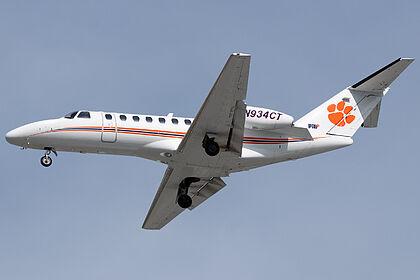
Single-pilot certification makes the CJ3 a natural next step for owners who fly themselves, and the FAA register shows many CJ3s held by operating businesses as their company airplane. Charter and management firms run them too, such as Capital City Jet Center in Ohio, Avalair Aircraft Management in Texas and Capital Jet Charter in Australia. flyExclusive, based in North Carolina, flies the CJ3+ in its own fleet for jet-club and fractional customers. Public bodies use the type as well: Clemson University and Kansas State University both have CJ3s on the US register, and the Kansas Highway Patrol registered one built in 2024. Outside North America, CJ3s have flown with the Luxembourg fractional operator Jetfly Aviation and the Thai charter company MJets.
Flying on one
The CJ3 cabin is longer than a small jet's but no taller. Textron lists it at 57 inches high and 58 inches wide, a few inches lower and narrower than a Phenom 300's, so you duck in through the airstair door and stay bent over until you sit down. Its length is the gain: 15 ft 8 in leaves room for a four-seat club, two more seats behind it and a fully enclosed lavatory at the very back. A folding side-facing seat is an option. The CJ3+ and later jets have seats with folding armrests that open up the aisle, and on the Gen2 the seats slide on tracks and can be ordered to swivel.
Bags travel outside the cabin. Plane & Pilot lists a 15-cubic-foot nose bay for up to 400 lb and a 50-cubic-foot tailcone hold for up to 600 lb, which together match Textron's 65 cubic feet and 1,000 lb. With full fuel, Textron quotes a payload of only 820 lb, so long legs mean fewer passengers or lighter bags. The Gen2 cabin adds USB-C power at every seat, wireless charging in the main cabin, colored accent lighting and CoolView skylights in a lavatory serviced from outside, with a sink and vanity as options. Above 40,000 ft the cabin stays below 8,000 ft, and the engines sit well behind the last row.
Variants
- Citation CJ3 — Original model, first delivered December 1, 2004, with Collins Pro Line 21 avionics
- Citation CJ3+ — FAA approved September 4, 2014, with Garmin G3000 avionics and new cabin seats
- Citation CJ3 Gen2 — FAA certified October 13, 2025; Garmin autothrottles, 4.5 in more pilot legroom, deliveries from January 2026
- Citation CJ3 Gen3 — First flew in July 2026 with Garmin Emergency Autoland; service entry expected in 2027
How to spot it
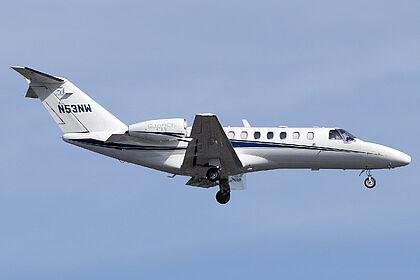
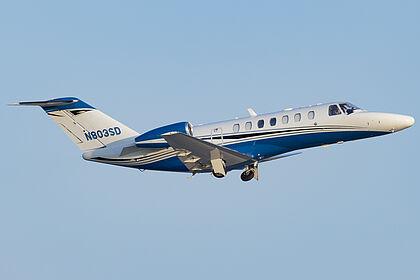
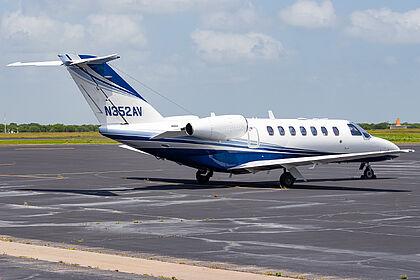
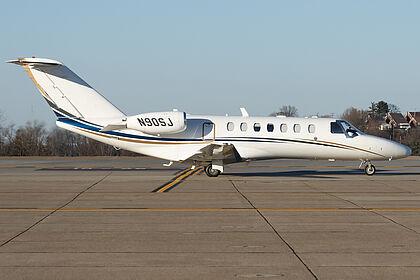
Every CJ has a straight wing, a T-tail and two small engines perched on the rear fuselage, so length is what gives a CJ3 away. At 51 ft 2 in it is about 3.5 ft longer than a CJ2+ and about 8.5 ft longer than an M2, and on its right side it shows seven cabin windows ahead of the overwing exit. The CJ4 is longer still, but its wing is swept back 12.5 degrees and spans less than the CJ3's 53 ft 4 in, which is the quickest way to tell them apart in the air. Some CJ3s carry the model name on the engine nacelle. Next to a Phenom 300, the Embraer's swept wing and tall winglets stand out against the Citation's plain, unswept wing.
Frequently asked
Is the Citation CJ3 single-pilot certified?
Yes. The CJ3 was certified in 2004 for single-pilot operation under the FAA's Part 23 commuter category, and Textron still lists the current model as single-pilot certified. The cockpit seats two, so operators can also fly it with a full crew. The Gen2's autothrottles and the Gen3's Emergency Autoland are aimed at reducing the load on a pilot flying alone.
What is the difference between the CJ3, CJ3+ and CJ3 Gen2?
They share one airframe and the C25B type code. The original CJ3 of 2004 had Collins Pro Line 21 avionics; the CJ3+, certified in September 2014, switched to Garmin G3000 and new seats; and the CJ3 Gen2, certified in October 2025, added Garmin autothrottles, 4.5 inches more pilot legroom and a reworked cabin. The CJ3 Gen3, still in flight test in 2026, adds Garmin Emergency Autoland.
How far can a Citation CJ3 fly?
Textron quotes a maximum range of 2,040 nautical miles at a top cruise speed of 416 knots true. Business & Commercial Aviation reported 1,900 nautical miles with four passengers at the Mach 0.737 limit, or more than 2,000 nautical miles flown more slowly. Full tanks leave only 820 lb of payload, so the longest trips are flown lightly loaded.
What is the difference between the Citation CJ3 and CJ4?
The CJ4 (C25C) is a further stretch with a cabin 21 inches longer, a wing swept 12.5 degrees, and more powerful FJ44-4A engines of 3,621 lb thrust each. It cruises faster, at up to 451 knots, and reaches about 2,165 nautical miles. The CJ3 is lighter and simpler, keeps a straight wing that actually spans more than the CJ4's, and comes within about 125 nautical miles of the bigger jet's range.
What does Emergency Autoland do on the CJ3 Gen3?
Garmin Emergency Autoland can take control if the pilot is incapacitated, pick a suitable airport, fly the approach and land the jet, braking to a stop on the runway. A passenger can start it with a button, or it can start itself if the pilot stops interacting with the avionics. Textron says Autoland will be standard on the CJ3 Gen3, which began flight testing in July 2026 and is due to enter service in 2027.
What aircraft is C25B?
C25B is the ICAO type designator for the Cessna Citation CJ3 / CJ3+ / CJ3 Gen2, a Cessna business jet that first flew in 2003. It is the code flight trackers and air traffic control use.
What is the wingspan of the Cessna Citation CJ3 / CJ3+ / CJ3 Gen2?
The Cessna Citation CJ3 / CJ3+ / CJ3 Gen2 has a wingspan of 16.26 m (53 ft) and is 15.59 m (51 ft) long.
What engines does the Cessna Citation CJ3 / CJ3+ / CJ3 Gen2 have?
Two Williams FJ44-3A.
What is the MTOW and range of the Cessna Citation CJ3 / CJ3+ / CJ3 Gen2?
Maximum takeoff weight is 6,291 kg (13,869 lb) and maximum range is about 2,040 nautical miles (3,778 km) at a cruise of Mach 0.73.
How many passengers does the Cessna Citation CJ3 / CJ3+ / CJ3 Gen2 carry?
Typically 6 people including the pilot.
Compare with
Specs are approximate, compiled from public sources. See our editorial policy.