Cessna 208 Caravan
C208Cessna · Turboprop · In production
In the wild
History
The Cessna 208 Caravan was designed to fill a gap that had opened up in the general-aviation market. By the late 1970s the fleet of rugged single-engine utility aircraft that carried freight and passengers into small and remote airfields, types such as the classic de Havilland Beaver and Otter, was ageing, and there was no modern replacement. Cessna set out to build a new, simple, turbine-powered single that could take over that work. The prototype first flew in 1982, and the Caravan entered service in the mid-1980s.
The design was deliberately straightforward and tough. It combined a high wing and fixed tricycle undercarriage, unusual for an aircraft of its size and weight, with a single Pratt & Whitney Canada PT6 turboprop, one of the most trusted engines in aviation. That gave it turbine reliability and the ability to run on jet fuel, while keeping the airframe rugged and cheap to operate and maintain. A large cargo door and a boxy, capacious cabin made it easy to load with freight or passengers.
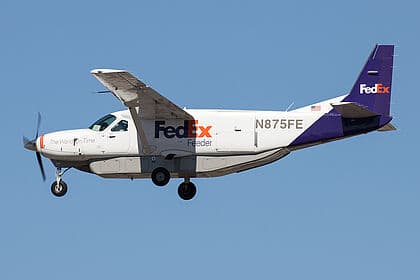
A crucial early boost came from FedEx, which ordered windowless freighter versions in large numbers to build its feeder network, flying small packages from outlying airports into hubs. That launch order helped establish the Caravan, and package-feeder work remains one of its core roles. Cessna soon offered a stretched version, the 208B Grand Caravan, with a longer cabin and greater capacity, which became the best-selling model.
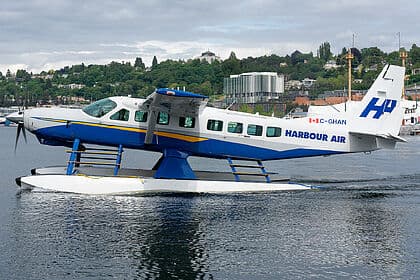
Over the decades the Caravan proved endlessly adaptable. It has been fitted with amphibious floats for water operations, used for skydiving thanks to its large door and strong climb, flown on short commuter routes, and pressed into humanitarian, medical and military service around the world. A more powerful Grand Caravan EX, with an uprated PT6, improved its performance further. Military and government operators adopted armed and surveillance-equipped versions for light-strike and reconnaissance duties, and the type has been assembled or delivered in large numbers, underlining its reach well beyond civilian cargo and passenger work.
As of 2026 the Caravan remains in production and is one of the most widely used utility turboprops in the world, valued for its ability to operate from rough, short strips with heavy loads at low cost. For enthusiasts it is significant as the aircraft that revived the single-engine turbine-utility class and as a genuine modern workhorse, a type more likely to be found hauling freight into a remote strip or dropping skydivers than gracing an airline schedule.
Specifications
- First flight
- 1982
- Entered service
- 1984
- Engines
- 1 × Pratt & Whitney Canada PT6A-114A / PT6A-140 (turboprop)
- Typical seating
- 12 seats
- Cruise speed
- Mach 0.28
- Range
- 960 nm
- MTOW
- 3,995 kg
- Length
- 12.67 m
- Wingspan
- 15.88 m
- Status
- In production
Design notes
The Cessna 208 Caravan is built around ruggedness and simplicity rather than speed. It has a high, strut-braced wing and, unusually for an aircraft of its size and weight, a fixed tricycle undercarriage, chosen to keep the design simple, tough and cheap to maintain, and to survive operations from rough, unprepared strips. The structure is conventional all-metal.
At its heart is a single Pratt & Whitney Canada PT6 turboprop, one of aviation's most trusted engines, giving turbine reliability and the ability to burn jet fuel. Power ranges from around 675 to over 850 horsepower depending on the variant, with the Grand Caravan EX using an uprated engine for better performance.
The cabin is boxy and capacious, with a large cargo door that makes loading freight, seats or passengers straightforward, and many aircraft carry an underbelly cargo pod for extra volume. Configurations range from windowless freighters to commuter passenger layouts.
As of 2026 the stretched 208B Grand Caravan is the most common version, offering a longer cabin than the original 208. The type is also offered on amphibious floats. Every element of the design serves utility work: the fixed gear, the tough airframe, the reliable turbine and the big door all point to an aircraft meant to carry useful loads into demanding places at low cost.
Notable facts
- A single PT6 turboprop workhorse used for cargo, commuter, skydiving, bush and utility flying.
- High-wing with fixed tricycle landing gear, unusual for an aircraft of its size and weight.
- Often flown with an underbelly cargo pod for extra baggage or freight.
- A mainstay of feeder-cargo networks such as FedEx Feeder operations.
- Available on amphibious floats and in a stretched 208B Grand Caravan version.
Who flies it
As of 2026 the Cessna 208 Caravan is a true utility workhorse rather than a private aircraft. Its biggest single role is feeder cargo: operators such as FedEx Feeder fly large fleets of windowless Caravans to move packages between small airports and sorting hubs. Regional and commuter airlines also use passenger versions on short, thin routes, often into airfields too small or too rough for larger types.
Beyond scheduled work, the Caravan is a favourite of skydiving operations, which value its big door, strong climb and turbine reliability. It is widely used for humanitarian and missionary flying in remote regions, for medical evacuation, aerial survey and sightseeing, and by a number of military and government operators for light transport and surveillance. On amphibious floats it serves island-hopping and bush routes. In short, the Caravan turns up wherever rugged, low-cost single-turbine capability is needed.
Flying on one
The Cessna 208 Caravan is the aircraft that turns a single turboprop into a small airliner, and many people meet it on short island or regional hops flown by small carriers, as well as on skydiving and utility work. It is a big high-wing single that can seat roughly nine to fourteen passengers depending on layout, so it feels more like a minibus of the sky than a light aircraft. The high wing gives excellent downward views — ideal over islands and coastlines — and the turboprop up front produces a steady hum rather than the buzz of a piston engine. There are no overhead bins; bags usually travel in an underbelly cargo pod or a rear compartment, and boarding is often through an airstair door. The cabin is unpressurised, so it flies low, which keeps the scenery close. For the best experience, take a window seat forward of the wing for the clearest view. It is honest, rugged, workaday flying with a great outlook.
Variants
- 208 Caravan — Original shorter-fuselage model
- 208B Grand Caravan — Stretched, higher-capacity fuselage
- 208B Grand Caravan EX — More powerful PT6A-140 engine
- Cargomaster / Super Cargomaster — Windowless freighter versions
- Caravan Amphibian — Float-equipped variant
How to spot it
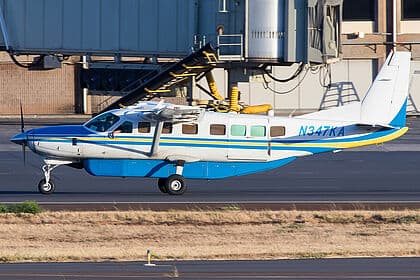
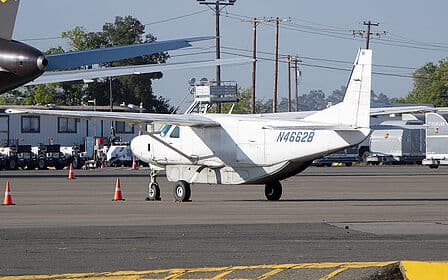
The Cessna 208 Caravan is a large, boxy, high-wing single with a single turboprop up front, and that combination makes it fairly easy to identify. Look for the tall, purposeful stance, the strut-braced high wing, and the fixed tricycle undercarriage on long, sturdy legs, often with substantial wheel fairings, unusual on an aircraft this size. Many carry a long cargo pod slung under the belly.
The nose is the key turboprop cue: instead of a piston engine's spinner and cowling, the Caravan has the slim, pointed profile of a PT6 turboprop, with its exhaust stacks and a large multi-blade propeller. Against its main rival, the Pilatus PC-12, the Caravan is easy to separate: the Cessna has a high wing and fixed gear, whereas the PC-12 is a low-wing aircraft with retractable landing gear and a sleeker, pressurised fuselage.
Frequently asked
What is the Cessna Caravan used for?
The Caravan is a utility aircraft, so it does a huge variety of jobs rather than one. Its most prominent role is feeder cargo, flying packages between small airports and hubs for operators such as FedEx, but it is also widely used for short commuter passenger flights, skydiving, humanitarian and medical work, and survey and sightseeing. Its ability to carry useful loads from short, rough strips at low cost is what makes it so versatile.
Why does the Cessna Caravan have fixed landing gear?
The fixed undercarriage is a deliberate choice to keep the aircraft simple, tough and cheap to maintain. Retractable gear would add weight, cost and complexity, and would be more vulnerable when operating from the rough, unprepared strips the Caravan is designed to use. The modest speed penalty is an acceptable trade for a utility aircraft. It is unusual for an aeroplane of this size and weight, which helps make the Caravan recognisable.
How is the Cessna Caravan different from the Pilatus PC-12?
Both are single-engine PT6 turboprops, but they are aimed at different jobs. The Caravan is a rugged, fixed-gear, high-wing utility aircraft with an unpressurised cabin, built for cargo and rough-field work at low cost. The PC-12 is a faster, low-wing, retractable-gear aircraft with a pressurised cabin, better suited to comfortable executive and passenger transport. As a rule the Caravan hauls, and the PC-12 travels.
Is the single-engine Caravan safe?
The Caravan uses a Pratt & Whitney Canada PT6 turboprop, one of the most reliable engines ever built, which is a large part of why single-turbine utility aircraft are trusted for demanding work. As with any single-engine aircraft, an engine failure requires the pilot to glide to a landing, so operators mitigate the risk through training, careful route planning and maintenance. Its record in commercial service is generally regarded as strong. Nonetheless, single-engine operations carry inherent considerations that operators manage carefully.
How many passengers can a Cessna Caravan carry?
It depends on the version and configuration. The stretched 208B Grand Caravan can be fitted for up to around 12 to 14 occupants including crew in a commuter layout, while shorter or cargo-oriented aircraft carry fewer. Many Caravans fly as pure freighters with no passenger seats at all. Operators choose the interior to suit the mission, from dense passenger seating to an empty cargo hold.
Compare with
Specs are approximate, compiled from public sources. See our editorial policy.