Boeing 767-300ER
B763Boeing · Widebody · Production ended
In the wild

History
The Boeing 767-300ER is the extended-range version of the stretched 767-300, part of a family Boeing launched in the late 1970s to serve medium- to long-haul routes below the 747. Developed in parallel with the narrow-body 757, with which it shares a common cockpit and pilot type rating, the 767 introduced a semi-widebody, twin-aisle cabin seven seats across in a 2-3-2 layout. The original 767-200 first flew in 1981 and entered service with United Airlines in 1982.
Boeing stretched the fuselage by about 6.4 metres to create the 767-300, which first flew in 1986. To exploit the larger cabin on longer routes, the company then developed the 767-300ER, adding fuel capacity and higher weights for intercontinental range. It entered service in 1988, with American Airlines as launch customer. Offered with engines from General Electric, Pratt and Whitney, and Rolls-Royce, the -300ER could cross the North Atlantic and fly many trans-Pacific and Asian sectors, with typical capacity of roughly 210 to 270 passengers. Boeing rounded out the family with the shorter-range 767-200ER and, later, a further stretch, the 767-400ER, but the -300ER remained the volume seller by a wide margin.
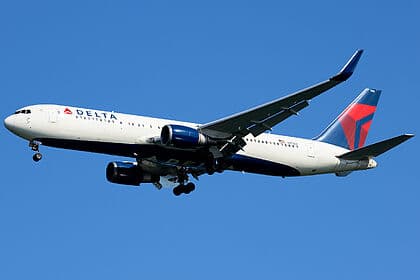
The 767 was central to the rise of extended-range twin-engine operations, which allowed twin-engine aircraft to fly long overwater routes previously reserved for three- and four-engine types. Together with the Airbus A310, it helped make the twin-engine widebody the standard tool for transatlantic flying in the 1980s and 1990s. The 767-300ER became the best-selling 767 variant and a workhorse on both sides of the Atlantic, and it was also a fixture of Japanese domestic networks and North American transcontinental flying. A handful of passenger operators, including Delta Air Lines and United Airlines, kept it on transatlantic and leisure routes far longer than most, some fitting aftermarket blended winglets to improve efficiency.
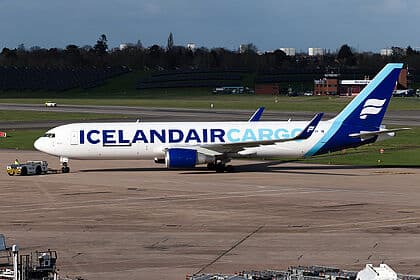
Passenger sales tapered in the 2000s as the larger, more efficient 777 and later the 787 took over long-haul growth, and Boeing eventually ended new passenger 767 deliveries. The line did not close, however. Boeing continued to build the 767-300F freighter and adapted the airframe into the KC-46 Pegasus military tanker, keeping production active well into the 2020s. Meanwhile many retired passenger 767-300ERs found second careers as converted freighters, and express and e-commerce operators became major users. Total 767 output across all versions runs well over a thousand aircraft. The result is a type that faded from passenger fleets but remains commercially relevant decades after its debut.
Specifications
- First flight
- 1986
- Entered service
- 1988
- Engines
- 2 × GE CF6, Pratt & Whitney PW4000, or Rolls-Royce RB211
- Typical seating
- 245 (2-class)
- Cruise speed
- Mach 0.8
- Range
- 5,980 nm
- MTOW
- 186,880 kg
- Length
- 54.94 m
- Wingspan
- 47.57 m
- Status
- Production ended
Design notes
The 767-300ER occupies an unusual middle ground between narrow-body and full widebody. Its fuselage is about five metres wide, enough for a twin-aisle, seven-abreast cabin in a 2-3-2 arrangement, but narrower than the eight-abreast A330 or ten-abreast 777. That relatively slim cross-section gives the aircraft a distinctive tall, narrow look on its landing gear.
The wing is a conventional aluminium swept design without the winglets seen on many later types, though some operators retrofitted blended winglets to cut fuel burn. Power comes from a choice of large high-bypass turbofans: the General Electric CF6-80C2, the Pratt and Whitney PW4000, or the Rolls-Royce RB211. Each main landing gear leg carries four wheels on two axles.
The flight deck was, for its era, advanced, using electronic instrument displays, and it was deliberately made common with the smaller 757 so airlines could train and roster crews across both types on a single rating. That commonality was a significant selling point in the 1980s. Structurally the aircraft is largely aluminium, from an era before composite primary structures. Its combination of twin-aisle comfort, transoceanic range, and modest size suited thinner long-haul markets, a niche later inherited by the 787. The extended-range tankage and strengthened structure are what separate the -300ER from the shorter-range base 767-300.
Notable facts
- The extended-range 767-300ER became a transatlantic workhorse from the late 1980s.
- Its seven-abreast, twin-aisle cabin is narrower than most widebodies.
- Passenger production has wound down, but the 767-300F freighter and KC-46 tanker keep the line alive.
- Helped pioneer long over-water twin-engine (ETOPS) operations.
Who flies it
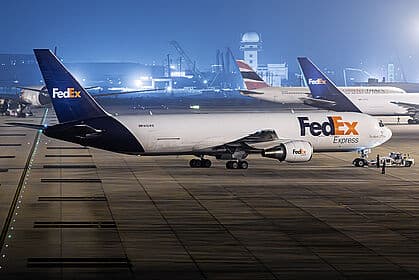
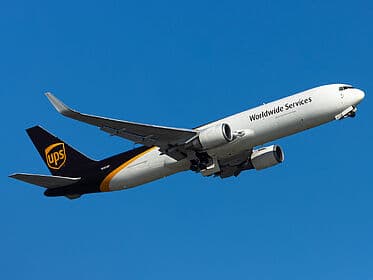
Once a mainstay of transatlantic passenger flying, the 767-300ER has largely left front-line passenger service, though some carriers still operate it. Delta Air Lines and United Airlines have been among the last major passenger users, flying it on transatlantic and leisure routes, and several other airlines retain small fleets. Its more visible role today is as a freighter. Express and e-commerce operators, including FedEx, UPS, and the Amazon Air network, fly large numbers of 767-300F and converted 767-300ER freighters on cargo routes. In addition, the airframe lives on in military service as the KC-46 Pegasus aerial-refuelling tanker. Between passenger sunset fleets, dedicated and converted freighters, and the tanker, the 767 remains a common sight, but increasingly at cargo ramps and air-force bases rather than passenger terminals.
Flying on one
The 767 is quietly one of the most passenger-friendly widebodies ever, and the reason is its cross-section: economy is laid out seven-abreast in a 2-3-2 pattern, so no seat is more than one place from an aisle except the single centre seat. Couples love the side pairs and solo travellers rarely feel boxed in. It is an older design, so cabin altitude and humidity are ordinary and the overhead bins are smaller than on modern twins — larger roll-aboards can be a squeeze, and some can end up gate-checked on full flights. The ride is smooth and reasonably quiet. Many 767-300ERs are now well into their careers, so seats and finishes range from tired to recently refreshed depending on the operator. For the best seat, take one of the 2-3-2 window pairs on the A/B or J/K side for a window and an aisle with only one neighbour; the middle of the centre three is the seat to avoid, and the very back sits close to the aft galleys.
Who flies it, and how
2 airline cabin layouts of the Boeing 767-300ER in our dataset — expand any to see the cabin breakdown and seat map.
Delta767-300ER (76W)216 seats26J · 18W · 172Y
- Business (Delta One): 26 seats, 1-2-1 across
- Premium Economy (Delta Premium Select): 18 seats, 2-2-2 across
- Economy (Delta Comfort+): 21 seats, 2-3-2 across
- Economy (Main Cabin): 151 seats, 2-3-2 across
International 767-300ER, the ~30-aircraft majority config and the ONLY 767-300ER config with a Delta Premium Select cabin. aeroLOPA codes this 76K (also seen as 76T/76W). Fleet to be retired by 2030.
Delta767-300ER (76L)211 seats36J · 175Y
- Business (Delta One): 36 seats, 1-2-1 across
- Economy (Delta Comfort+): 32 seats, 2-3-2 across
- Economy (Main Cabin): 143 seats, 2-3-2 across
Differs from 76W: NO Delta Premium Select cabin, and a larger 36-seat Delta One cabin (vs 26). ~4-5 airframes; economy 175 total (32 Comfort+ + 143 Main). aeroLOPA code 76L. Fleet to be retired by 2030.
Variants
- 767-300F — Freighter, still in production
- 767-200ER — Shorter, long-range early variant
How to spot it
The 767 is a twin-engine, twin-aisle widebody, but a notably slim one: its fuselage is narrow for a widebody, giving a tall, tube-like look, and it seats only seven abreast. Each main gear has four wheels. It shares its pointed nose and cockpit with the narrow-body 757, so the two look alike from the front, but the 767 is far wider with two aisles. The stretched -300 and -300ER are noticeably longer than the 767-200; telling the -300ER from the plain -300 by eye is difficult, as the difference is range rather than shape. Against the larger Airbus A330, the 767 is smaller, lacks wingtip fences or winglets on most examples, and is seven-abreast rather than eight. Against the 777, it is much smaller, with four-wheel rather than six-wheel main gear.
Frequently asked
How do you tell a Boeing 767 from a 757?
They share a nose and cockpit and were designed with a common pilot type rating, so from the front they look similar. The difference is the body: the 757 is a single-aisle narrow-body with a long, slim tube, while the 767 is a wider twin-aisle widebody seating seven abreast. Seen together, the 767 is clearly the fatter of the two.
What is the difference between the 767-300 and the 767-300ER?
The -300ER, for extended range, adds fuel capacity and higher operating weights so it can fly intercontinental routes, whereas the base 767-300 was aimed at shorter domestic and regional sectors. Externally they are almost identical, so the distinction is about capability rather than appearance. The -300ER was by far the more popular version.
Why are there so many 767 freighters?
The 767's size and range suit express and e-commerce cargo networks well, so Boeing kept building the 767-300F long after passenger sales faded, and many retired passenger -300ERs have been converted to freighters. FedEx, UPS, and Amazon Air operate large 767 cargo fleets. This freighter demand is a major reason the line has stayed open for decades.
Is the 767 still in production?
Yes. Although new passenger deliveries have ended, Boeing continues to build the 767-300F freighter and the closely related KC-46 Pegasus tanker for military customers. That has kept the production line active well into the 2020s, long after most 767 passenger aircraft were ordered.
How is the 767 different from an Airbus A330?
Both are twin-engine, twin-aisle widebodies, but the A330 is larger, seats eight abreast to the 767's seven, and has prominent wingtip fences, which most 767s lack. The 767 has a slimmer fuselage and shorter range in its common versions. On the ground the A330 also looks visibly bigger and wider.
Compare with
Specs are approximate, compiled from public sources. See our editorial policy.