Pilatus PC-24 (PC24)
Pilatus · Business jet · In production
PC24 is the ICAO aircraft type code for the Pilatus PC-24, a Pilatus business jet that first flew in 2015 and entered service in 2018. It typically carries 6 people, cruises at Mach 0.74, and has a range of about 2,040 nautical miles (3,778 km).

Loading live positions…
In the wild
History
The PC-24 grew out of a question Pilatus put to its PC-12 customers about what they wanted next. Many, the company says, asked for more speed and range without losing the turboprop's ability to use short, rough strips. Work on a twin-engine jet began in 2007, paid for from Pilatus's own money, and the program first appeared in the company's annual report in May 2011.
Pilatus showed the design at EBACE in Geneva on May 21, 2013. Chairman Oscar Schwenk argued that it fit no existing class, combining a turboprop's versatility with the cabin of a medium light jet and the performance of a light jet, and Pilatus later coined the label "Super Versatile Jet" for it. When orders opened at EBACE a year later, the first production run of 84 aircraft sold out in 36 hours, and Pilatus closed the order book until it had final performance data.
The first of three prototypes, P01, was rolled out on August 1, 2014, Switzerland's national day, and made a 55-minute first flight from Buochs on May 11, 2015, a few months behind the original plan. P02 joined in November 2015 to work on avionics and autopilot integration, and the production-standard P03 followed in March 2017. Together the three flew about 2,200 hours, including icing, hot-weather, bird-strike and noise tests, before EASA and the FAA granted type certification on December 7, 2017.
Pilatus chief executive Markus Bucher handed the first customer jet, serial 101, to PlaneSense of New Hampshire on February 7, 2018, at a ceremony in Colorado. In November 2018 Australia's Royal Flying Doctor Service took the first of its PC-24s for long-distance patient transfers.
The next two years went into proving the unpaved-runway promise. Approval for dry gravel, dirt and sand came in 2018. Pilatus then flew trials on grass, wet earth and snow-covered gravel in England, France, the Czech Republic and at Kuujjuaq in northern Quebec, and in February 2020 announced that every PC-24 could also use wet and snow-covered unpaved strips. By then the order book had reopened, at EBACE 2019, with steep-approach approval for London City Airport already in hand, and the 100th PC-24 was delivered by January 2021.
Pilatus has kept changing the jet since. A 2021 package brought lighter quick-release seats, an optional galley in place of the forward coat closet and touchscreen avionics control. In October 2023 the company announced a "new PC-24" with more than 1,000 modifications, 600 lb more payload and 200 nautical miles more range with six passengers, for deliveries from 2024. Pilatus delivered 51 PC-24s in 2024 and 50 in 2025, and in 2026 Jet Aviation began handing over PC-24s it leases to the French Navy for pilot training and urgent cargo flights.
Specifications
- First flight
- 2015
- Entered service
- 2018
- Engines
- 2 × Williams FJ44-4A-QPM
- Typical seating
- 6 seats
- Cruise speed
- Mach 0.74
- Range
- 2,040 nm
- MTOW
- 8,500 kg
- Length
- 16.8 m
- Wingspan
- 17 m
- Status
- In production
Design notes
Almost every unusual feature of the PC-24 serves its runway performance. The wing has a moderately swept leading edge and a straight trailing edge carrying large double-slotted flaps, which bring the stall speed down to 83 knots at maximum landing weight and the takeoff distance at maximum weight to 3,090 ft. The flaps have a replaceable, abradable surface and help screen the engines, mounted high on the rear fuselage, from stones thrown up by the wheels. Each main leg is a long-stroke trailing link carrying two wheels on tires inflated to about 72 psi, so the jet does not sink into soft ground.
The two Williams FJ44-4A-QPM turbofans are rated at 3,420 lb of thrust each, and an automatic thrust reserve can raise that to 3,600 lb. Their Quiet Power Mode runs the right engine at sub-idle on the ground to power the electrics, heating and air conditioning, which lets Pilatus do without the weight and cost of an auxiliary power unit.
The pressure vessel is 23 ft long from cockpit partition to aft bulkhead, 5 ft 7 in wide and 5 ft 1 in high, with a flat floor and a 4 ft 1 in by 4 ft 3 in cargo door at the left rear. Pilatus and Honeywell developed the Advanced Cockpit Environment, based on Primus Epic 2, with four large displays. The jet is certified under EASA CS-23 and FAR Part 23 in the commuter category, with a design life of 30,000 hours.
Notable facts
- Pilatus's first jet, revealed at EBACE in Geneva on May 21, 2013, and sold as a "Super Versatile Jet" for paved and unpaved runways.
- EASA and the FAA certified it on December 7, 2017; serial 101 went to the US fractional operator PlaneSense on February 7, 2018.
- Approved for gravel, dirt, sand, grass, wet earth and snow-covered strips, on dual-wheel main gear with low-pressure tires.
- A 4 ft 1 in by 4 ft 3 in cargo door is standard, which Pilatus calls a first for a business jet.
- Single-pilot certified, and its Quiet Power Mode idles the right engine on the ground to power the cabin instead of an APU.
Who flies it
PC-24 customers fall into two broad groups: fleets that sell private flying, and organizations that need to reach awkward places quickly. PlaneSense, the New Hampshire fractional operator that took the first delivery, flies it alongside its PC-12s, and European charter companies such as Platoon Aviation in Germany and FlyingGroup in Belgium operate it too.
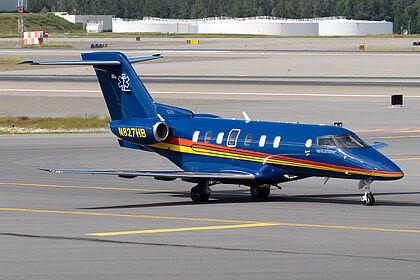
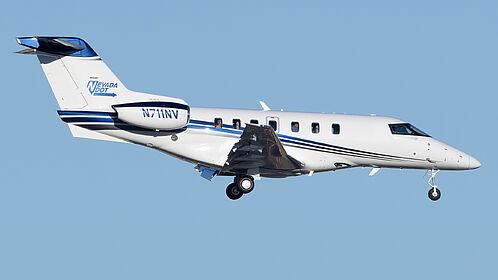
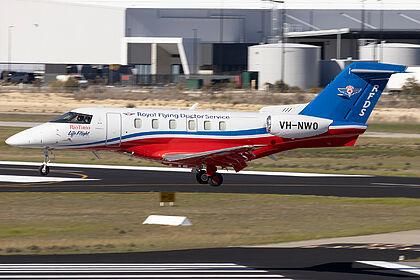
Medical flying is the other pillar. The Royal Flying Doctor Service uses PC-24s in Western Australia, where they took over from a Hawker 800XP, and NSW Ambulance, Svenskt Ambulansflyg in Sweden, Keewatin Air in Nunavut and US hospital systems in New York and North Carolina fly it as an air ambulance. Government users include the Qatar Emiri Air Force, the North Slope Borough's search and rescue department in Alaska, the Nevada Department of Transportation and the French Navy.
Flying on one
Inside, the PC-24 is roomier than most light jets. Pilatus quotes a cabin 5 ft 7 in wide and 5 ft 1 in high, about 6 inches wider and 2 inches taller than a Phenom 300's and 9 inches wider than a Citation CJ3's, on a completely flat floor with no dropped aisle. Most adults still stoop to walk through. The usual executive layout has six seats, with the second row able to swivel 180 degrees to face the first, and jets built since 2024 can have a side-facing divan 6 ft 6 in long that turns into a bed in flight. Commuter layouts carry up to ten passengers.
Two details set it apart from other light jets. The lavatory is at the front of the cabin, fully enclosed and serviced from outside, which keeps the rear free for luggage. The baggage area behind the seats holds 90 cubic feet with its movable partition forward, stays heated and pressurized, and can be reached during the flight, while bulky items go in through the cargo door instead of up the passenger stairs. Pilatus quotes about two and a half hours for a 1,000-nautical-mile trip at maximum cruise speed, and at the 45,000-ft ceiling the cabin sits near 8,000 ft. Because the jet can use short and unpaved strips, passengers may land much closer to where they are going.
Variants
- PC-24 (initial production) — Deliveries from February 2018; maximum takeoff weight raised to 8,300 kg from the 31st aircraft in late 2018
- PC-24 2021 update — Lighter quick-release seats, optional forward galley, touchscreen avionics control and lithium-ion batteries; retrofittable
- New PC-24 (2024 on) — Announced October 2023: 600 lb more payload, 3,100 lb maximum, 2,000 nm with six passengers and an optional divan bed
How to spot it
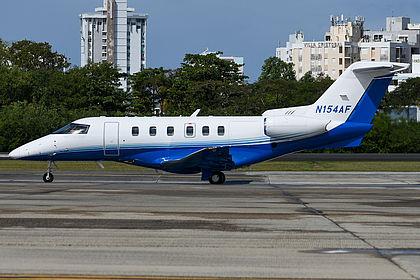
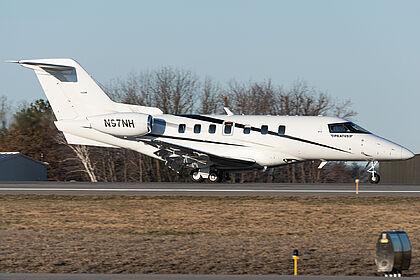
Seen from below, the PC-24 gives itself away: the leading edge of the wing is swept but the trailing edge is straight, and the retracted main wheels stay partly exposed. On the ground, look for two wheels on each main leg, which neither the Phenom 300 nor the Citation CJs have, and for the large cargo door on the left side behind the wing. The engines sit high and close to the fuselage beneath a T-tail, and the wing has no winglets. The Phenom 300 has a swept wing with tall winglets, and the Citation CJ4 has a swept wing on a slimmer fuselage with the pointed Citation nose. Against Pilatus's own PC-12, the twin jet engines and the absence of a propeller settle it at once.
Frequently asked
Can the PC-24 land on grass or gravel?
Yes. The PC-24 was approved for dry gravel, dirt and sand runways in 2018, and in February 2020 Pilatus announced approval for grass, wet earth and snow-covered surfaces after trials in Europe and northern Quebec. Pilatus quotes a balanced field length of 3,090 ft at maximum weight on a dry paved runway, and the twin-wheel main gear and low-pressure tires spread the load on soft ground.
Is the PC-24 single-pilot certified?
Yes. Pilatus certifies all its aircraft for single-pilot operation, and the PC-24 can be flown by one pilot or two under both private and commercial rules. Its Advanced Cockpit Environment, developed with Honeywell, was designed to keep the workload manageable for a pilot flying alone.
How far can a PC-24 fly?
Pilatus quotes 2,000 nautical miles with six passengers and 2,040 nautical miles with four for jets built since the 2024 update, which added 200 nautical miles. With the maximum payload of 3,100 lb the range falls to 1,154 nautical miles. Maximum cruise speed is 440 knots true at 28,000 ft.
Why does the PC-24 not need an APU?
Its Williams FJ44-4A-QPM engines have a Quiet Power Mode in which the right engine runs at sub-idle on the ground. In that mode it powers the electrical system, heating and air conditioning, so the cabin can be cooled or warmed before passengers board without a ground power cart. Leaving out an auxiliary power unit saves weight and maintenance cost.
Why do air ambulance services fly the PC-24?
It combines jet speed with short and unpaved runway capability, so a medical crew can reach remote strips and fly patients long distances quickly. The standard cargo door, 4 ft 1 in wide and 4 ft 3 in high, makes loading stretchers and equipment easier than through a passenger door. Australia's Royal Flying Doctor Service, NSW Ambulance and Sweden's Svenskt Ambulansflyg all fly it.
What aircraft is PC24?
PC24 is the ICAO type designator for the Pilatus PC-24, a Pilatus business jet that first flew in 2015. It is the code flight trackers and air traffic control use.
What is the wingspan of the Pilatus PC-24?
The Pilatus PC-24 has a wingspan of 17 m (56 ft) and is 16.8 m (55 ft) long.
What engines does the Pilatus PC-24 have?
Two Williams FJ44-4A-QPM.
What is the MTOW and range of the Pilatus PC-24?
Maximum takeoff weight is 8,500 kg (18,739 lb) and maximum range is about 2,040 nautical miles (3,778 km) at a cruise of Mach 0.74.
How many passengers does the Pilatus PC-24 carry?
Typically 6 people including the pilot.
Compare with
Specs are approximate, compiled from public sources. See our editorial policy.