Diamond DA40
DA40Diamond Aircraft · Piston single · In production
In the wild
History
The Diamond DA40 comes from an Austrian and Canadian company that made its name building modern, composite light aircraft. Diamond Aircraft grew out of a motor-glider manufacturer, and that heritage of clean, efficient, composite airframes runs through all its designs. The DA40, a four-seat single, was developed in the 1990s as a larger companion to Diamond's two-seat DA20, and it first flew in 1997, entering service around the turn of the decade.
The DA40 was conceived as a safe, efficient and pleasant-to-fly touring and training aircraft, and it leaned heavily on Diamond's glider background. It has a composite airframe with long, slender, high-aspect-ratio wings that give it efficient cruise and gentle handling, and a large bubble canopy over the front seats that provides an excellent view. From the outset it was aimed at a modern market that valued fuel efficiency, safety and up-to-date avionics. The type was later joined by a twin-engine development, the DA42, with which it shares much of its design language, and Diamond built the DA40 at facilities in both Austria and Canada to serve markets on either side of the Atlantic.
A defining thread in the DA40's story is its engine options. Early aircraft used a conventional Lycoming petrol engine, but Diamond became a pioneer of aircraft diesel engines, which burn widely available jet fuel rather than the increasingly scarce and expensive avgas used by most piston aircraft. The current DA40 NG uses an Austro diesel engine, and this jet-fuel capability has made the type especially popular outside North America, where avgas can be costly or hard to find.
The DA40 also earned a strong reputation for safety. Independent studies have repeatedly found it to have one of the lowest accident rates in general aviation, a quality Diamond attributes to its docile handling, sturdy composite structure and good visibility. That record has made it a favourite of safety-conscious flight schools and private owners alike.
As of 2026 the DA40 remains in production and is widely used as both a trainer and a personal touring aircraft, frequently operated alongside its twin-engine sibling, the DA42. For enthusiasts it stands out as a leading example of the modern composite single: efficient, safe and pleasant to fly, and part of the broader shift away from the traditional metal Cessnas and Pipers toward newer materials and jet-fuel-burning engines. It occupies a middle ground between the simple trainer and the fast, parachute-equipped Cirrus, prized above all for its efficiency and benign character.
Specifications
- First flight
- 1997
- Entered service
- 2000
- Engines
- 1 × Austro AE300 turbo-diesel (168 hp) or Lycoming IO-360 (180 hp)
- Typical seating
- 4 seats
- Cruise speed
- Mach 0.23
- Range
- 900 nm
- MTOW
- 1,280 kg
- Length
- 8.06 m
- Wingspan
- 11.94 m
- Status
- In production
Design notes
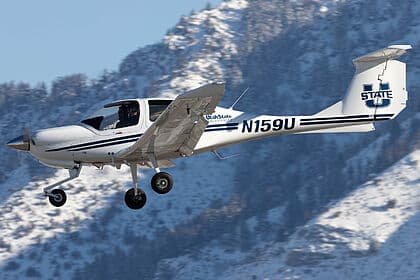
The Diamond DA40 wears its glider ancestry openly. Its most distinctive features are its long, slender, high-aspect-ratio wings, which look closer to a sailplane's than to the stubbier wings of a Cessna or Piper, and which give the aircraft efficient cruise and gentle, forgiving handling. The airframe is built from composite materials, allowing smooth, aerodynamically clean surfaces.
Visibility is another signature. The front occupants sit under a large bubble canopy that opens forward and gives an exceptional all-round view, while rear passengers board through a separate door on the side. The undercarriage is fixed, keeping things simple and reducing maintenance.
The DA40's engine options set it apart. Petrol versions use a Lycoming engine, but the current DA40 NG is built around an Austro diesel engine that burns jet fuel, offering good fuel economy and freeing operators from dependence on avgas. Modern examples carry Garmin glass-cockpit avionics.
As of 2026 the DA40 is frequently cited as having one of the lowest accident rates in general aviation, a reputation Diamond credits to its sturdy composite structure, docile stall behaviour and good visibility. The overall design intent is a safe, efficient four-seater equally suited to training and touring, favouring economy and benign handling over outright speed or load-carrying.
Notable facts
- A composite-airframe four-seater with long, slender, glider-like wings.
- Often cited as having one of the lowest accident rates in general aviation.
- The DA40 NG uses an Austro Jet-A (diesel) engine, popular where avgas is scarce or costly.
- Features a large bubble canopy over the front seats plus a separate rear passenger door.
- Widely used by flight schools alongside its twin-engine sibling, the DA42.
Who flies it
As of 2026 the Diamond DA40 is used heavily by both flight schools and private owners. Training organisations, including airline-pathway academies, value its benign handling, strong safety record and, in the diesel DA40 NG, its low fuel burn and ability to run on widely available jet fuel. It is often operated as part of a Diamond fleet alongside the twin-engine DA42 for multi-engine training.
Private owners choose the DA40 as an efficient, comfortable touring aircraft, attracted by its economy, good visibility and reassuring reputation for safety. Its jet-fuel capability makes it particularly popular in Europe, and in other regions where avgas is expensive or hard to obtain. Flying clubs and partnerships also operate the type to share costs. While built in smaller numbers than the Cessna and Piper singles, the DA40 has become a familiar sight at training airfields around the world.
Flying on one
The Diamond DA40 is one of the nicest light singles to fly in as a passenger, largely because of how you see out of it. Built from composite and fitted with a large canopy, it offers an almost panoramic view — closer to a glider than a traditional trainer — which makes it a delight for sightseeing. It is also unusually quiet and smooth for a piston aircraft, sips fuel, and has a reputation for being docile and forgiving. Four seats are fitted; the front pair sit under the canopy while rear passengers board through a separate door. As with any light aircraft there are no overhead bins, luggage goes in a small compartment, and headsets are worn, though the DA40's cabin is calmer than most. For the best experience, sit up front under the canopy for that wraparound view. Efficient, easygoing and modern, it is a popular choice for both training and personal touring, and an easy aircraft to enjoy from any seat.
Variants
- DA40 — Original Lycoming IO-360 gasoline version
- DA40 XLS — Updated Lycoming-powered model
- DA40 NG — Current Austro AE300 turbo-diesel version
- DA40 TDI — Early Thielert-diesel variant
- DA40 Tundra — Rugged/utility version
How to spot it
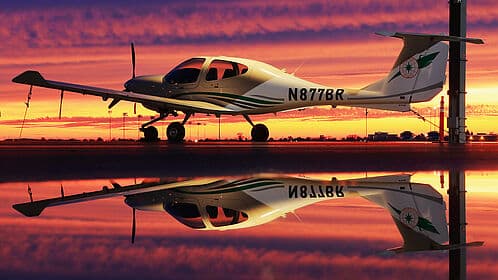
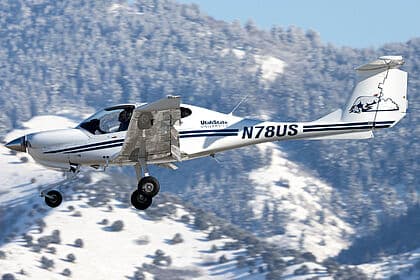
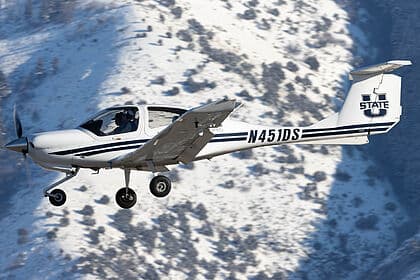
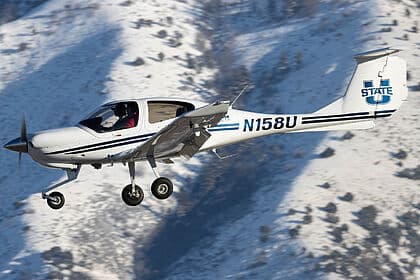
The Diamond DA40 is one of the more distinctive light singles to spot. Look first at the wings: they are long, slender and tapered, much more like a glider's than the shorter wings of a Cessna or Piper, and they mark the aircraft out immediately. The whole airframe is smooth composite, with clean, rounded surfaces rather than riveted metal panels.
The canopy is the next clue. The two front occupants sit under a large, clear bubble canopy that gives a fishbowl-like view, while rear passengers have a separate side door. The undercarriage is fixed. Against a Cirrus SR22, which is also composite, the Diamond looks narrower and more glider-like, with those long wings and the bubble canopy, whereas the Cirrus is broader, has side-stick controls and carries its parachute housing in the rear fuselage.
Frequently asked
What makes the Diamond DA40 special?
Two things stand out: efficiency and safety. Its long, glider-like composite wings make it economical and pleasant to fly, and independent studies have repeatedly found it to have one of the lowest accident rates in general aviation. The diesel DA40 NG also burns widely available jet fuel rather than avgas, which is a significant advantage in many parts of the world.
Does the Diamond DA40 run on jet fuel?
The current DA40 NG does. It uses an Austro diesel engine that burns Jet-A, the same broad category of fuel used by turbine aircraft, rather than the avgas required by most piston singles. This gives good fuel economy and frees operators from dependence on avgas, which can be scarce or expensive outside North America. Older DA40s, however, use a conventional Lycoming petrol engine.
Is the Diamond DA40 a good trainer?
Yes; it is widely used for training and is well regarded for the role. Its docile handling, good visibility from the bubble canopy and strong safety record make it forgiving for students, and its modern glass cockpit prepares them for advanced avionics. Its fuel efficiency also helps keep the cost of flying down, which matters to busy flight schools.
How does the DA40 compare with a Cessna 172?
Both are four-seat singles used for training and touring, but they take different approaches. The DA40 has a modern composite airframe, long efficient wings and, in current form, a jet-fuel diesel engine, whereas the 172 is a traditional metal high-wing design. The Cessna offers a huge global support network and lower purchase prices, while the Diamond counters with better fuel economy and an outstanding safety reputation.
How many people can the DA40 carry?
The DA40 is a four-seat aircraft, with two in front under the canopy and two in the rear. In practice, as with most light singles, carrying four adults together with full fuel and baggage is not always possible, so pilots must balance passengers, fuel and load. For typical trips with two or three aboard it is a comfortable and capable tourer.
Compare with
Specs are approximate, compiled from public sources. See our editorial policy.