Embraer E170 (E170)
Embraer · Regional · Production ended
E170 is the ICAO aircraft type code for the Embraer E170, an Embraer regional jet that first flew in 2002 and entered service in 2004. It typically carries 70 passengers in a two-class layout, cruises at Mach 0.78, and has a range of about 2,150 nautical miles (3,982 km).

Loading live positions…
In the wild
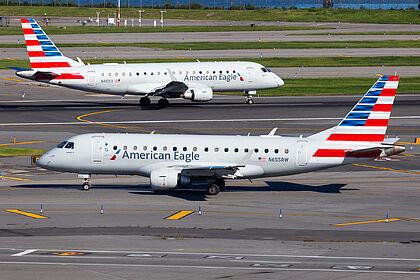
History
The E170 is the airplane with which Embraer stopped building small jets and started building small airliners. By 1999 the company had sold hundreds of 50-seat ERJ 145s, but it could see the regional market moving up to 70 and 100 seats and knew the ERJ's narrow, turboprop-derived fuselage could not stretch that far. Rather than adapt it, Embraer launched a clean-sheet family at the Paris Air Show that year: the 70-seat E170, a stretched E175, and the larger-winged E190 and E195.
The E170 first flew on February 19, 2002 and, after a certification program that took longer than planned, entered service with LOT Polish Airlines on March 17, 2004, flying Warsaw to Vienna. Its selling points were a wide four-abreast cabin with no middle seats, underwing engines that kept the floor low and the cabin quiet, and fly-by-wire controls, none of which the 50-seaters had. In the United States, where airline pilot contracts limited the size of jets regional partners could fly, the E170 arrived just as those limits rose to 70 seats, and US Airways, United and Delta contractors ordered it in volume.
The stretched E175, 1.8 meters longer with 76 seats, first flew in 2003 and gradually became the preferred version, especially after US scope clauses moved to 76 seats. Embraer kept the E170 in production into the 2010s but built fewer than 200 against more than 700 E175s, and the line effectively closed as the E175 took every order. The larger E190 and E195 sold into mainline fleets at JetBlue, KLM, Lufthansa and Air Canada.
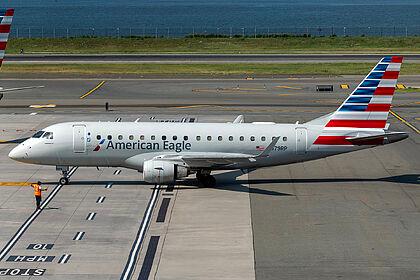
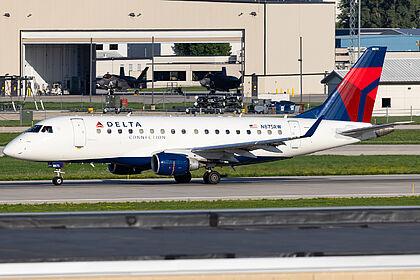
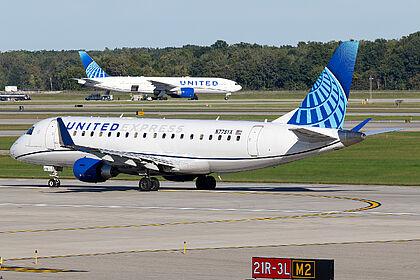
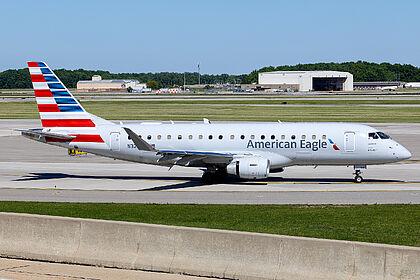
Most E170s are still flying. Republic Airways operates the largest fleet, under the American Eagle, Delta Connection and United Express brands, and the type remains at LOT, in Latin America and with a few European regionals. The second-generation E2 jets that followed in 2018 did not include a new E170; the E175-E2 was built as a prototype but never certified for airline use, so the original E170 and E175 soldier on with no direct replacement.
Specifications
- First flight
- 2002
- Entered service
- 2004
- Engines
- 2 × GE CF34-8E
- Typical seating
- 70 (2-class)
- Cruise speed
- Mach 0.78
- Range
- 2,150 nm
- MTOW
- 38,600 kg
- Length
- 29.9 m
- Wingspan
- 26.01 m
- Status
- Production ended
Design notes
The E-Jet's defining feature is its "double-bubble" fuselage: two intersecting circles rather than one, which gives a wide cabin at shoulder height and a tall underfloor hold without a huge cross-section. The result is a 2-2 cabin 2.74 meters wide, with seats about 18.25 inches wide and no middle seat, and overhead bins big enough for a standard roll-aboard. That cabin, more than anything, is why airlines moved from the ERJ to the E-Jet.
The E170 and E175 share a wing with a 26-meter span and two General Electric CF34-8E engines of about 14,200 pounds of thrust each, mounted under the wing in pods. The E190 and E195 have a larger wing, a longer fuselage and the bigger CF34-10E, so the family is really two pairs. Later E175s gained tall winglets; the E170's wing kept the original short ones.
The flight deck uses a Honeywell Primus Epic suite with five large displays and a fly-by-wire system for the elevator, rudder and spoilers, with conventional cable controls for the ailerons, an unusual mixed arrangement. Takeoff weight ranges from about 35.9 tons for the standard E170 to 38.6 tons for the long-range and advanced-range versions, with range up to about 2,150 nautical miles. The airplane sits low enough for its own airstairs but high enough for jet bridges, which suits both hub airports and small outstations.
Notable facts
- The first of the E-Jet family: first flight February 19, 2002, and into service with LOT Polish Airlines in March 2004.
- A clean-sheet design, not a stretch of the ERJ: a wider 2-2 cabin with no middle seats, underwing engines and a double-bubble fuselage shared with the E175, E190 and E195.
- Embraer stopped building the E170 once the slightly longer E175 became the version US regional airlines wanted; the E175 is still in production for them.
- Typical seating is 66 to 76; the figure above is a common US two-class layout.
Who flies it
The E170 is mostly an American regional jet today. Republic Airways flies the largest fleet from hubs such as Washington, Chicago, Philadelphia and New York as American Eagle, Delta Connection and United Express, and Envoy Air operates some as American Eagle. LOT, the launch customer, still flies E170s on short European routes, and small fleets serve in Brazil, Mexico, Argentina and parts of Europe and Africa. The type is also used by a few governments and charter operators. Because the E175 is so similar, airlines treat the two as one fleet, and on a tracker the E170 appears alongside far larger numbers of E75L and E75S aircraft doing the same work.
Flying on one
For a regional jet the E170 is a comfortable airplane, and the reason is the 2-2 cabin: every seat is a window or an aisle, seats are about 18 inches wide, and the overhead bins take a normal roll-aboard, so there is none of the gate-checking ritual of the ERJ 145 or CRJ. Pitch is usually 31 inches in economy, with a small first-class cabin of 1-2 seats on US operators. The engines are under the wing, so the quietest rows are forward of the wing and the loudest are just behind it; rows near the back are not especially noisy. The ride is smooth for the size. The single lavatory is at the rear on most layouts. Best seats are the forward rows on either side; avoid the last row, where seats may not recline and the galley is close. On flights of one to two hours, which is what the E170 flies, there is little to complain about.
Variants
- E170 STD/LR/AR — Same airframe at increasing takeoff weights and range
- E175 — 1.8 m longer, 76-88 seats; codes E75S and E75L
- E190/E195 — Larger E-Jets with a bigger wing and CF34-10E engines
How to spot it
All first-generation E-Jets share the same look: a slim, long nose with a pronounced downward slope, two underwing engines and a conventional tail. The E170 is the shortest of the four at 29.9 meters, so the fuselage looks stubby relative to the wing and tail. Compared with the E175 it is 1.8 meters shorter, with four fewer windows per side and usually the short, upturned wingtips rather than the E175's tall winglets, though some E170s were retrofitted. Against the E190, the E170 is clearly smaller with smaller engines. Against the CRJ700 and CRJ900, its direct competitors, the E-Jet has underwing engines and a low tail where the CRJ has rear-mounted engines and a T-tail. Against the A220, the E170 is much smaller and has a far slimmer nose.
Frequently asked
What is the difference between the E170 and the E175?
The E175 is the same airplane stretched by 1.8 meters, with 76 to 88 seats against the E170's 66 to 78. Later E175s also have taller winglets and higher weights. Both use the CF34-8E engine and the same wing; the E175 carries the codes E75S (short wing) and E75L (long wing).
Are the E170 and E190 the same aircraft?
They are in the same family but not the same airplane. The E190 is longer, has a larger wing and more powerful CF34-10E engines, and seats around 100. The E170 and E175 form one pair, the E190 and E195 another.
Is the E170 still being built?
No. Embraer built fewer than 200 E170s and let the E175 take over the segment; the E175 is still in production for US regional airlines. There is no E2 version of the E170.
Can I take a carry-on on an E170?
Yes. Unlike smaller regional jets, the E170's overhead bins fit a standard roll-aboard, and the 2-2 cabin has no middle seats.
What aircraft is E170?
E170 is the ICAO type designator for the Embraer E170, a Embraer regional that first flew in 2002. It is the code flight trackers and air traffic control use.
What is the wingspan of the Embraer E170?
The Embraer E170 has a wingspan of 26.01 m (85 ft) and is 29.9 m (98 ft) long.
What engines does the Embraer E170 have?
Two GE CF34-8E.
What is the MTOW and range of the Embraer E170?
Maximum takeoff weight is 38,600 kg (85,098 lb) and maximum range is about 2,150 nautical miles (3,982 km) at a cruise of Mach 0.78.
How many passengers does the Embraer E170 carry?
Typically 70 passengers in a two-class layout; dense single-class layouts seat more and premium-heavy layouts fewer.
Compare with
Specs are approximate, compiled from public sources. See our editorial policy.