Gulfstream V / G550 (GLF5)
Gulfstream Aerospace · Business jet · Production ended
GLF5 is the ICAO aircraft type code for the Gulfstream V / G550, a Gulfstream Aerospace business jet that first flew in 1995 and entered service in 1997. It typically carries 14 people, cruises at Mach 0.8, and has a range of about 6,750 nautical miles (12,501 km).

Loading live positions…
In the wild
History
When Bombardier announced the Global Express in October 1991, it put a number on the ultra-long-range business jet: 6,500 nautical miles without a fuel stop. Gulfstream answered in 1992 with the Gulfstream V. It started from the GIV, but the result was close to a new airplane, with a far larger wing, a stretched fuselage, a bigger tail and new engines. What made the range possible was the BMW Rolls-Royce BR710, a turbofan that had just become available and gave the GV the thrust and economy to match the Global's 6,500 nm.
The GV first flew on November 28, 1995. The FAA certified it on April 11, 1997, and Gulfstream handed over the first customer aircraft in June 1997, two years before the Global Express entered service in July 1999. Within months the development team received the 1997 Robert J. Collier Trophy, which recognized the GV's design and the efficient way Gulfstream built it. The Air Force deployed its first C-37A, the military GV, in 1998, and the type settled into a job it still does: carrying senior officials across oceans without stopping.
The GV also pioneered a piece of cockpit technology. In September 2001 the FAA certified Gulfstream's Enhanced Vision System on it, an infrared camera in the nose whose picture is shown on the pilot's head-up display, and Gulfstream says it was the first such system offered on a business jet.
Gulfstream built 193 GVs before moving the line to an improved model, the GV-SP. The first production GV-SP flew on July 18, 2002, and Gulfstream unveiled it that September 9 under the marketing name G550. The FAA issued its type and production certificates on the same day, August 14, 2003, a first for the company, and the first G550 was delivered on September 17, 2003. Drag reductions added about 250 nautical miles of range, the PlaneView cockpit replaced the GV's instruments, and moving the main door 2 ft forward made room for a seventh pair of cabin windows. A reduced-fuel version sold as the G500 followed, first delivered in May 2004. The G550 earned Gulfstream a second Collier Trophy, for 2003, and Gulfstream counted about 40 city-pair speed records for it by 2008.
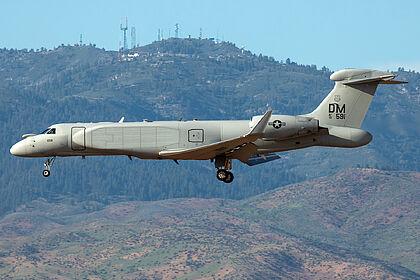
The G550 stayed in demand for more than a decade; the 500th was delivered in May 2015. Once the clean-sheet G600 took over its place in the range in 2019, Gulfstream kept building G550s at a low rate for government and special-mission customers, and it delivered the last commercial example on June 30, 2021, after more than 600 had been produced. Conversion work went on afterward. L3Harris turned G550s into the EC-37B Compass Call electronic-attack jet, which Air Combat Command redesignated EA-37B in November 2023, and the first operational EA-37B reached Davis-Monthan Air Force Base, Arizona, in August 2024.
Specifications
- First flight
- 1995
- Entered service
- 1997
- Engines
- 2 × Rolls-Royce BR710 (BR710A1-10 on the GV, BR710C4-11 on the G550)
- Typical seating
- 14 seats
- Cruise speed
- Mach 0.8
- Range
- 6,750 nm
- MTOW
- 41,277 kg
- Length
- 29.39 m
- Wingspan
- 28.5 m
- Status
- Production ended
Design notes
The wing is where the range comes from. The GV's new, semi-supercritical wing spans 93 ft 6 in with winglets, against 77 ft 10 in on the GIV, and it holds about 41,000 lb of fuel, some 12,000 lb more than the GIV. The FAA's type data adds the other changes: the fuselage is 5 ft longer ahead of the main door and 2 ft longer behind the wing, the horizontal tail has 30 percent more area, and maximum takeoff and landing weights are 15 percent higher. The certified ceiling rose from the GIV's 45,000 ft to 51,000 ft.
The BR710s are controlled by FADEC and fitted with thrust reversers. The GV's BR710A1-10 is rated at 14,750 lb of thrust and the G550's BR710C4-11 at 15,385 lb. A G550 typically climbs to about 41,000 ft first, cruises at Mach 0.80 for maximum range or Mach 0.85 when time matters, and is limited to Mach 0.885.
The G550's PlaneView flight deck is built on Honeywell's Primus Epic, with four 14-inch displays worked through cursor-control devices. Gulfstream made it the first civil aircraft to win an FAA type certificate with the Enhanced Vision System as standard equipment, alongside a standard head-up display. Gulfstream's brochure gives a takeoff run of 5,910 ft at maximum weight and a landing run of 2,770 ft.
Notable facts
- Gulfstream's reply to the Bombardier Global Express: certified in April 1997, it reached customers two years before the Global did.
- The GV program won the 1997 Collier Trophy, and the G550 brought Gulfstream a second one for 2003.
- The GV was the first business jet offered with an FAA-certified infrared Enhanced Vision System (September 2001); the G550 made it standard equipment.
- A GV has six cabin windows a side and a G550 has seven, because the G550's main door moved about 2 ft forward to free up cabin length.
- ICAO files the GV, the G550, the 2004-model G500 and the military C-37A, C-37B, EA-37B and NC-37B under one code, GLF5.
Who flies it
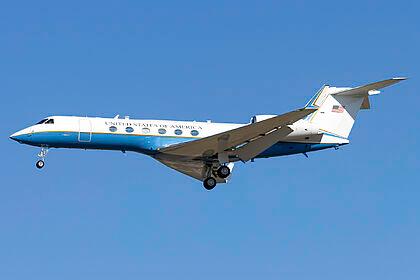
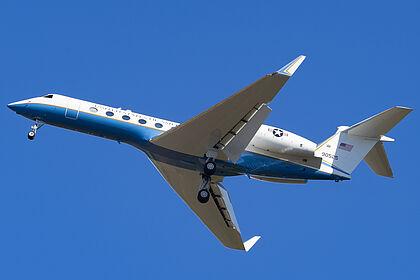
Most civil GVs and G550s fly as corporate and private aircraft, and charter companies and fractional programs operate others. Governments are the more visible customers. The US Air Force flies C-37As and C-37Bs with the 89th Airlift Wing at Joint Base Andrews, Maryland, and has based them at MacDill, Hickam and Ramstein; the Army, Navy, Marine Corps and Coast Guard have their own, and the Coast Guard's carry the Secretary of Homeland Security and the Commandant. The EA-37B flies with the 43rd Electronic Combat Squadron at Davis-Monthan.
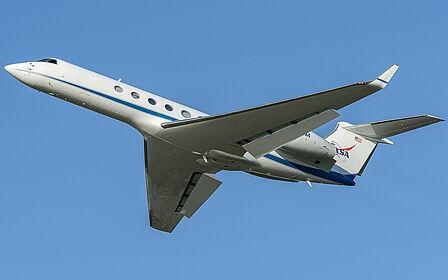
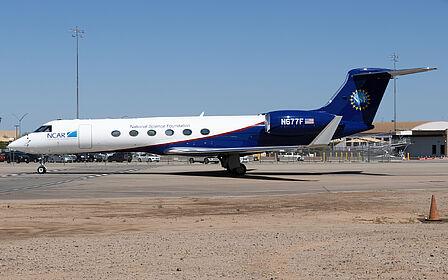
Abroad, Israel's Eitam early-warning jets, Italy's E-550A, Singapore's G550 AEW and Australia's MC-55A Peregrine signals-intelligence aircraft all carry the same code. The Japan Coast Guard took two GVs in 2005 for maritime surveillance and search and rescue. Scientists use the type as well: the NSF NCAR HIAPER GV is based in Broomfield, Colorado, and NASA's GV at Johnson Space Center flies astronauts home to Houston from Kazakhstan after Soyuz landings.
Flying on one
A G550 cabin is long rather than wide. Gulfstream's brochure gives 43 ft 11 in of cabin length excluding the baggage hold, about 6 ft 2 in of headroom and 7 ft 4 in of width (Aviation Week rounds those to 6 ft and 7 ft). Most adults can stand upright in the aisle, but it is narrower than in the G650, whose cabin is 8 ft 6 in wide and 6 ft 3 in high.
Gulfstream offers seating for up to 19 and sleeping room for up to eight, but most owners fit fewer seats, spread through three cabin zones; AOPA describes more than ten as typical. Each side has seven of Gulfstream's large oval windows. Baggage goes in a 170 cu ft compartment behind the cabin rather than overhead.
The cabin is pressurized to feel like 6,000 ft at the 51,000 ft ceiling. Aviation Week gives Bombardier's Global 6000 a 4,500 ft cabin up to 45,000 ft and 5,680 ft at its own 51,000 ft ceiling, and Business & Commercial Aviation judged the original Global Express roomier and softer-riding than the GV, though the Gulfstream flew farther on less fuel. The same magazine rated the GV's cabin noise and dispatch reliability well against jets of its era. Trips are long ones: Business & Commercial Aviation titled its 2018 used-GV report "Tokyo To New York Range," and the G550 adds about 250 nm more.
Variants
- Gulfstream V (GV) — Original model, first flown November 28, 1995; 193 built, about 6,500 nm range
- C-37A — US military GV for senior-leader transport, deployed by the Air Force from 1998
- G550 (GV-SP) — PlaneView cockpit, seventh window pair and about 6,750 nm; certified August 14, 2003
- G500 (2004) — Reduced-fuel GV-SP rated for 5,800 nm; not the later clean-sheet G500, which is GA5C
- C-37B — US military G550 in VIP configuration, deployed from 2006
- EA-37B, G550 CAEW, MC-55A — Special-mission G550s for electronic attack, airborne early warning and signals intelligence
How to spot it
Count the cabin windows. A GV has six oval windows on each side and a G550 has seven, with the main door noticeably closer to the cockpit. The G650 (GLF6) that followed is bigger in every direction, with eight larger windows a side and a wider fuselage.
A GIV or G450 (GLF4) has the same nose and the same family of oval windows, so check proportions: it is around 88 to 89 ft long against the G550's 96 ft 5 in, its wing spans 77 ft 10 in against 93 ft 6 in, and it uses Rolls-Royce Tay engines rather than BR710s.
The military versions are easier. C-37s usually wear government or service titles and a military serial on the fin, and the airborne-early-warning G550s carry large radar fairings on the nose, tail and fuselage sides.
Frequently asked
Why does a Gulfstream show as C-37 on a military tracker?
C-37A is the US military designation for the Gulfstream V and C-37B the designation for the G550, both used mainly to fly senior officials. ICAO's type list puts them under the same GLF5 code as the civil jets, so trackers that show the type code display GLF5, while those that use a registration database show the military model name. The Air Force deployed the C-37A in 1998 and the C-37B in 2006.
What is the difference between the Gulfstream V and the G550?
The G550 is an improved GV, certified as the GV-SP in August 2003. It has the PlaneView cockpit with four 14-inch displays, drag reductions worth about 250 nm of extra range (6,750 nm against 6,500), standard enhanced vision, and a main door moved 2 ft forward, which adds a seventh cabin window on each side. Both use BR710 engines and share the GLF5 code.
Is the Gulfstream G500 a GLF5?
Only the first one. From 2004 Gulfstream sold a reduced-fuel GV-SP as the G500, rated for 5,800 nm, and it is a GLF5. The G500 sold today is an unrelated clean-sheet jet from the G600 family, and ICAO gives it the separate code GA5C.
Is the G550 still in production?
No. Gulfstream delivered the last commercial G550 on June 30, 2021, after more than 600 had been built, and the G600 replaced it in the range. Existing airframes continue to be converted for military roles, such as the EA-37B Compass Call.
How far can a Gulfstream G550 fly?
Gulfstream rates the G550 at 6,750 nm at Mach 0.80 with eight passengers, four crew and NBAA IFR reserves. Flying faster at Mach 0.85 shortens that. The original GV is rated at 6,500 nm.
What is the EA-37B Compass Call?
It is a G550 converted by L3Harris and BAE Systems to carry the Compass Call electronic-attack system, replacing the Air Force's EC-130H. Originally named EC-37B, it was redesignated EA-37B in November 2023, and the first operational aircraft arrived at Davis-Monthan Air Force Base in August 2024. Trackers list it as GLF5, the code ICAO assigns to the EA-37.
What aircraft is GLF5?
GLF5 is the ICAO type designator for the Gulfstream V / G550, a Gulfstream Aerospace business jet that first flew in 1995. It is the code flight trackers and air traffic control use.
What is the wingspan of the Gulfstream V / G550?
The Gulfstream V / G550 has a wingspan of 28.5 m (94 ft) and is 29.39 m (96 ft) long.
What engines does the Gulfstream V / G550 have?
Two Rolls-Royce BR710 (BR710A1-10 on the GV, BR710C4-11 on the G550).
What is the MTOW and range of the Gulfstream V / G550?
Maximum takeoff weight is 41,277 kg (90,999 lb) and maximum range is about 6,750 nautical miles (12,501 km) at a cruise of Mach 0.8.
How many passengers does the Gulfstream V / G550 carry?
Typically 14 people including the pilot.
Compare with
Specs are approximate, compiled from public sources. See our editorial policy.