Bombardier Global 5000 (GL5T)
Bombardier · Business jet · In production
GL5T is the ICAO aircraft type code for the Bombardier Global 5000, a Bombardier business jet that first flew in 2003 and entered service in 2005. It typically carries 13 people, cruises at Mach 0.85, and has a range of about 5,200 nautical miles (9,630 km).
Loading live positions…
In the wild
History
The Bombardier Global 5000 is the Global Express cut down to a size and price that a wider market could justify. The original Global Express of 1996 had defined the ultra-long-range business jet, flying 6,000 nautical miles with a cabin large enough to walk about in, but by 2001 Bombardier saw demand for something that kept the cabin cross-section and most of the speed while giving up some range to undercut the Gulfstream GIV-SP and Dassault Falcon 900EX. The answer was a Global Express with 0.8 m removed from the cabin, less fuel and a lower price, announced in October 2001 as the Global 5000.
It first flew on 7 March 2003, was certified in Canada the following year and entered service in April 2005. Early aircraft were quoted at 4,800 nautical miles with eight passengers, enough for London to Los Angeles or New York to Dubai, at a typical cruise of Mach 0.85. Bombardier raised the weights and range to 5,200 nautical miles in later production and, from 2012, fitted the Vision flight deck based on Rockwell Collins Pro Line Fusion, which brought synthetic vision and head-up display options to the type.
The Global 5000 sold steadily to corporate flight departments, charter operators and governments. VistaJet built one of the largest fleets and used it to anchor its subscription model, the German Air Force bought four for VIP transport, and operators in the Middle East and Asia valued its cabin and hot-and-high performance. Production of the 5000 itself wound down around 2020 as Bombardier introduced the Global 5500, a re-engined version with Rolls-Royce Pearl 15 turbofans, a 5,900-nautical-mile range and a new interior, which carries on under the same ICAO designator.
Today GL5T covers both the Global 5000 and the Global 5500, and the pair sit between the smaller Challenger line and the flagship Global 7500 in Bombardier's range. Several hundred are in service.
Specifications
- First flight
- 2003
- Entered service
- 2005
- Engines
- 2 × Rolls-Royce BR710A2-20 (Global 5000) or Pearl 15 (Global 5500)
- Typical seating
- 13 seats
- Cruise speed
- Mach 0.85
- Range
- 5,200 nm
- MTOW
- 41,957 kg
- Length
- 29.5 m
- Wingspan
- 28.65 m
- Status
- In production
Design notes
The Global 5000 keeps the BD-700 airframe of the Global Express: a 94 ft (28.65 m) supercritical wing with 35 degrees of sweep, a T-tail and two rear-mounted Rolls-Royce BR710A2-20 turbofans of 14,750 lb thrust. The cabin is 0.81 m shorter than the Global Express/6000's, giving a floor length of about 12.3 m, and fuel capacity is lower, which is where the range difference comes from. Width and height are the same, at 2.49 m and 1.91 m, so the cabin accommodates three living zones with a full galley and a crew rest.
Cruise is Mach 0.85 with a maximum of Mach 0.89, and the aircraft can operate from runways under 5,500 ft at full weight, with notably good performance at hot and high airports. The Vision flight deck, standard from 2012, introduced four large displays, synthetic vision and a head-up display option. The Global 5500 replaced the BR710s with Pearl 15 engines of 15,125 lb thrust, added the 7500's Nuage seats and a reprofiled wing trailing edge, lifting range to 5,900 nautical miles and top speed to Mach 0.90.
Notable facts
- A shortened Global Express launched in 2001 for the 'super-large' cabin segment, trading about 0.8 m of cabin and some fuel for a lower price.
- Range rose from 4,800 to 5,200 nautical miles with higher weights and the Vision flight deck from 2012.
- The German Air Force flies four as VIP transports; charter fleets such as VistaJet operate large numbers.
- Replaced on the line by the Global 5500 of 2019 with Rolls-Royce Pearl engines and 5,900 nm range, under the same ICAO code.
- Shares its wing, tail and engines with the Global 6000 (GLEX); the family grew into the Global 7500 (GL7T).
Who flies it
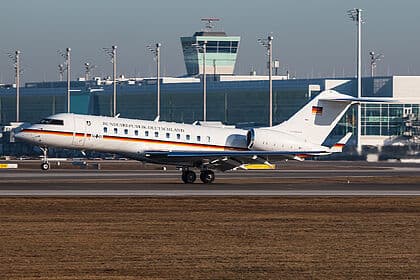
Global 5000s and 5500s fly for corporate flight departments worldwide, for charter and fractional operators including VistaJet, which has flown dozens, and for governments: the German Air Force's four Global 5000s carry ministers and senior officials, and the type serves in similar roles for several other states. Special-mission versions carry surveillance and signals equipment for a few air forces. Typical civil missions are transatlantic and intercontinental trips of six to eleven hours with four to eight passengers, from London or Geneva to the US East Coast, the Gulf or Asia.
Flying on one
Inside, a Global 5000 is one of the roomiest business jets short of a converted airliner: a cabin 2.49 m wide and 1.91 m high, so you can stand and walk, divided into a club-seating lounge, a conference or dining area and a rear lounge that converts to a bed, with a full galley and a lavatory forward and aft on most layouts. Seats are wide leather armchairs that recline flat, the windows are large and the cabin altitude is low, around 4,500 ft at cruise, which makes a nine-hour flight far less tiring than an airliner. Noise is low because the engines are far behind the cabin. The Global 5500 adds the 7500's Nuage seats and faster cabin internet. For the best seat, take a forward club chair facing aft on the right side, which gets the view and stays out of the galley traffic.
Variants
- Global 5000 — Original, BR710 engines, 4,800–5,200 nm
- Global 5500 — Pearl 15 engines, 5,900 nm, current production
- Global 6000 / 6500 — Longer-cabin siblings
How to spot it
All Globals share a long, slim fuselage, a T-tail, two large rear-mounted engines and a highly swept wing with winglets, and the family is hard to tell apart. The Global 5000 and 5500 are the shortest at 29.5 m, with one fewer cabin window than the Global 6000, which is the practical way to distinguish them: count the windows on the left side between the door and the wing. The Global 7500 is much longer, at 33.8 m, with a new wing and larger Passport engines, and its windows are visibly bigger. Against a Gulfstream G650, the Global has a T-tail with a smaller, less swept fin and a cabin door further forward.
Frequently asked
What is the difference between the Global 5000 and Global 6000?
The Global 6000 (and the earlier Global Express and XRS) has a cabin 0.8 m longer with one more window and carries more fuel, giving it about 6,000 nautical miles of range against the 5000's 5,200. They share the wing, engines, cockpit and type rating; ICAO codes are GL5T for the 5000/5500 and GLEX for the 6000.
What aircraft is GL5T?
GL5T is the ICAO type designator for the Bombardier Global 5000 and its re-engined successor, the Global 5500. Trackers show it for both; the longer Global 6000 is GLEX and the Global 7500 is GL7T.
How far can a Global 5000 fly?
About 5,200 nautical miles (9,630 km) with eight passengers at Mach 0.85 for later-production aircraft, or 4,800 nm for early ones; the Global 5500 reaches 5,900 nm. That covers London to Los Angeles or New York to Dubai nonstop.
How many passengers does a Global 5000 carry?
Typically 13 in a three-zone layout, with a certified maximum of 17, and berthing for six to seven on overnight flights.
What is the wingspan of the Bombardier Global 5000?
The Bombardier Global 5000 has a wingspan of 28.65 m (94 ft) and is 29.5 m (97 ft) long.
What engines does the Bombardier Global 5000 have?
Two Rolls-Royce BR710A2-20 (Global 5000) or Pearl 15 (Global 5500).
What is the MTOW and range of the Bombardier Global 5000?
Maximum take-off weight is 41,957 kg (92,498 lb) and maximum range is about 5,200 nautical miles (9,630 km) at a cruise of Mach 0.85.
How many passengers does the Bombardier Global 5000 carry?
Typically 13 people including the pilot.
Compare with
Specs are approximate, compiled from public sources. See our editorial policy.