Boeing 737-700 (B737)
Boeing · Narrowbody · Production ended
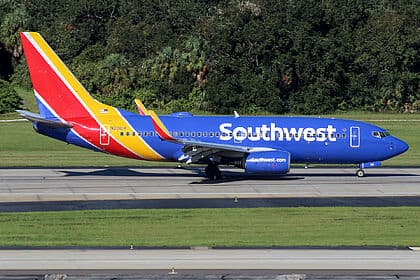
B737 is the ICAO aircraft type code for the Boeing 737-700, a Boeing narrowbody airliner that first flew in 1997 and entered service in 1998. It typically carries 126 passengers in a two-class layout, cruises at Mach 0.785, and has a range of about 3,010 nautical miles (5,575 km).
Loading live positions…
In the wild
History
The Boeing 737-700 was the first member of the 737 Next Generation family, the comprehensive redesign Boeing launched in November 1993 to answer the Airbus A320. Southwest Airlines, the world's largest 737 operator, was the launch customer with an order for 63, and the aircraft was conceived as a direct replacement for the 737-300, keeping its fuselage length while gaining an entirely new wing, new engines and a glass cockpit.
The first 737-700 flew on 9 February 1997 and entered service with Southwest in January 1998. The new wing, 25% larger in area and with 30% more fuel capacity, together with CFM56-7B engines, gave it transcontinental range and much better high-altitude performance than the classic 737, and the cockpit's six flat-panel displays could be configured to mimic the older aircraft's instruments so that airlines could keep one type rating across the fleet.
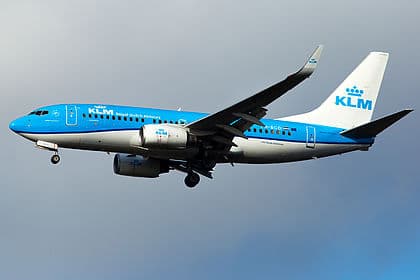
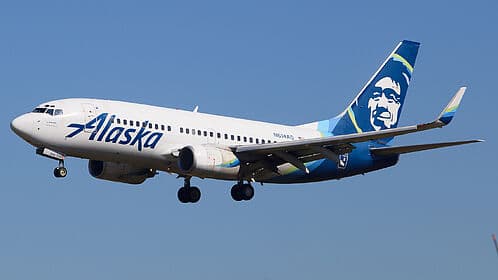
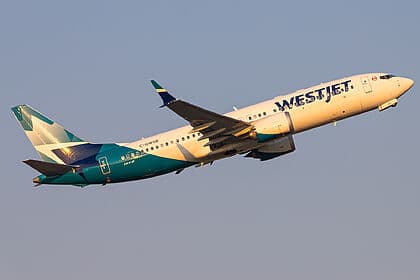
Southwest built its entire network on the -700 for two decades, eventually operating well over 400, and the type found favour with airlines that needed 120–140 seats: Alaska, WestJet, KLM, SAS, Aeroméxico and many others. Boeing spun off several derivatives: the 737-700C convertible freighter, adopted by the US Navy as the C-40 Clipper; the 737-700ER, which paired the -700 fuselage with the -800's wing and gear plus auxiliary tanks for ANA's premium-only service to Mumbai; and the Boeing Business Jet, which used the same -800 wing and gear combination to become the best-selling large corporate jet of its era.
Orders faded in the 2010s as airlines standardised on the larger 737-800 and then the MAX, and Boeing delivered the last commercial -700s by 2019. Its successor, the 737 MAX 7, was slow to be certified, which kept many -700s flying longer than planned, especially at Southwest.
Specifications
- First flight
- 1997
- Entered service
- 1998
- Engines
- 2 × CFM International CFM56-7B
- Typical seating
- 126 (2-class)
- Cruise speed
- Mach 0.785
- Range
- 3,010 nm
- MTOW
- 70,080 kg
- Length
- 33.63 m
- Wingspan
- 35.79 m
- Status
- Production ended
Design notes
The 737 Next Generation wing was a clean-sheet design with a greater span, a thicker aerofoil and double-slotted inboard flaps; it raised cruise altitude to 41,000 ft and range to over 3,000 nautical miles when fitted with blended winglets, the 2.4 m-tall tips introduced on the BBJ in 2000 and retrofitted across most of the fleet. The CFM56-7B engines are mounted close under the low wing, which is why the nacelles are flattened at the bottom and the engine accessories sit on the sides, a 737 trademark since the classic series.
The fuselage is the original 1960s 3.76 m 707 cross-section, narrower than the A320's, which limits seat and aisle width. The flight deck uses the Common Display System of six screens shared with the 777, and the -700 shares its type rating with every other NG and, with differences training, with the MAX.
Notable facts
- The first and smallest of the 737 Next Generation family, launched by Southwest Airlines in 1993 and delivered from 1997.
- Southwest flew more 737-700s than anyone, standardising on the type for two decades before the MAX 8 took over.
- The Boeing Business Jet (BBJ) pairs the 737-700 fuselage with the stronger 737-800 wing and landing gear.
- Serves as the basis of the C-40 Clipper military transport; the 737-700ER added auxiliary tanks for ANA's long thin routes.
- Superseded by the 737 MAX 7 (B37M), which kept the fuselage length but added LEAP-1B engines and a slightly longer cabin.
Who flies it
Southwest Airlines still operates the world's largest 737-700 fleet, flying it across its point-to-point US network, though it is gradually retiring them for MAX 8s and awaiting the MAX 7. Alaska Airlines, Delta, United and WestJet fly smaller fleets, while in Europe KLM, SAS and Jet2 use it on short and medium routes. Several carriers in Latin America, Africa and Asia operate ex-mainline examples. The C-40 Clipper serves the US Navy and Air Force, and BBJ1s fly for governments and corporations worldwide. Typical airline missions are two- to four-hour sectors where 120–150 seats is the right size.
Flying on one
The 737-700 is a small, familiar cabin with the 737's known trade-off: the fuselage is narrower than an Airbus's, so seats are about 17 inches wide in a 3-3 layout and the aisle is tight. Southwest's open-seating layout at 143 seats is the most common way to meet one, with 31–32 inches of pitch that is generous by low-cost standards; Alaska, Delta and United fit a first-class cabin up front. Overhead bins on older aircraft are shallow and roll-aboards must go in wheels-first; many have been retrofitted with the larger Boeing Sky Interior bins. The CFM56-7B is a quiet engine and the NG wing gives a smooth ride, but the rear rows sit between the engines and the lavatories. The single overwing exit row has the best legroom; for a view, pick a window ahead of the wing.
Who flies it, and how
1 airline cabin layout of the Boeing 737-700 in our dataset — expand any to see the cabin breakdown and seat map.
Southwest737-700143 seats143Y
- Economy (Economy): 143 seats, 3-3 across, 31″ pitch
Variants
- 737-700ER — Extended range with auxiliary fuel tanks; ordered by ANA
- 737-700C — Convertible passenger/cargo version with a large side door; basis of the C-40
- BBJ — Corporate jet with the 737-800 wing and extra tanks
- 737 MAX 7 (B37M) — Re-engined MAX-generation successor
How to spot it
The 737-700 is the shortest common Next Generation 737, and the quick check is the overwing exits: the -700 has one per side, the -800 and -900 have two. Against the 737-300 classic it replaced, the NG has the taller winglets on most aircraft, a longer, more pointed dorsal fin fillet ahead of the tail, and the squared-off rear of the engine nacelle. Against an A319 of similar size, look for the 737's pointed nose with large, angular cockpit windows, the flat-bottomed engine nacelles, and the low tail cone without the Airbus's upswept APU exhaust.
Frequently asked
What is the difference between the 737-700 and 737-800?
Length and capacity. The 737-800 is 5.84 m longer, seats about 162 in two classes against the -700's 126, and has two overwing exits per side instead of one. Wing, engines and cockpit are the same, so pilots fly both on one rating.
Is the 737-700 the same as the 737 MAX 7?
No. The MAX 7 is the re-engined successor with LEAP-1B engines, a redesigned tail cone and split winglets, and its fuselage is actually slightly longer than the -700's because Boeing stretched it to match the MAX 8's cabin systems. The -700 is 737 on trackers; the MAX 7 is B37M.
What is a BBJ?
The Boeing Business Jet, launched in 1996, is a 737-700 fuselage mated to the stronger wing and landing gear of the 737-800 and fitted with up to nine auxiliary fuel tanks, giving a 6,000-nautical-mile range for a VIP cabin of 8–50 seats.
Why did Southwest keep flying the 737-700 for so long?
Its replacement, the 737 MAX 7, was delayed for years by certification. Southwest's network needs a 140-seat aircraft for thinner routes, so it kept its -700s flying well past their planned retirement dates.
What aircraft is B737?
B737 is the ICAO type designator for the Boeing 737-700, a Boeing narrowbody that first flew in 1997. It is the code flight trackers and air traffic control use.
What is the wingspan of the Boeing 737-700?
The Boeing 737-700 has a wingspan of 35.79 m (117 ft) and is 33.63 m (110 ft) long.
What engines does the Boeing 737-700 have?
Two CFM International CFM56-7B.
What is the MTOW and range of the Boeing 737-700?
Maximum take-off weight is 70,080 kg (154,498 lb) and maximum range is about 3,010 nautical miles (5,575 km) at a cruise of Mach 0.785.
How many passengers does the Boeing 737-700 carry?
Typically 126 passengers in a two-class layout; dense single-class layouts seat more and premium-heavy layouts fewer.
Compare with
Specs are approximate, compiled from public sources. See our editorial policy.