Airbus A340-300 (A343)
Airbus · Four-Engine · Production ended
A343 is the ICAO aircraft type code for the Airbus A340-300, an Airbus four-engine widebody airliner that first flew in 1991 and entered service in 1993. It typically carries 280 passengers in a two-class layout, cruises at Mach 0.82, and has a range of about 7,300 nautical miles (13,520 km).
 The full story · with videoThe four-engine jet Lufthansa couldn't retire: the story of the A340

Loading live positions…
In the wild
History
The A340-300 is Airbus's long-haul quadjet from the years when four engines were the price of crossing an ocean. Airbus launched the A340 in June 1987 alongside the twin-engine A330, the two sharing a fuselage, wing, cockpit and most systems, so that airlines could buy a medium-haul twin and a long-haul four-engine airplane with one type rating. The A340 was meant to compete with the MD-11 and the 747 on routes where ETOPS rules still kept twins out, and its CFM56-5C engines, derivatives of the 737 and A320 engine, were chosen for reliability and low maintenance cost.
The first A340 flew on October 25, 1991, and the A340-300 entered service in March 1993 with Lufthansa and Air France. A shorter, longer-range A340-200 followed; the -300, 63.7 meters long with 250 to 290 seats in three classes and about 7,300 nautical miles of range, was the one most airlines wanted. Lufthansa, Air France, Swissair, SAS, Cathay Pacific, Singapore Airlines, Virgin Atlantic, Iberia, South African Airways and Air Canada all flew it on routes to the Americas, Asia and Africa. Airbus later added the much larger A340-500 and -600 with Rolls-Royce Trent engines, which carry their own codes.
The A340-300's problem was the airplane it was designed with. By the late 1990s the A330-300 and Boeing's 777 could fly most of the same routes on two engines, burning less fuel and costing less to maintain, and as ETOPS limits rose to 180 minutes and beyond the four-engine advantage disappeared. The -300's underpowered takeoff from hot, high airports became a running joke among pilots. Airbus delivered the last A340-300 in 2008 and ended the A340 program in 2011 after 377 aircraft of all versions, of which 218 were -300s.
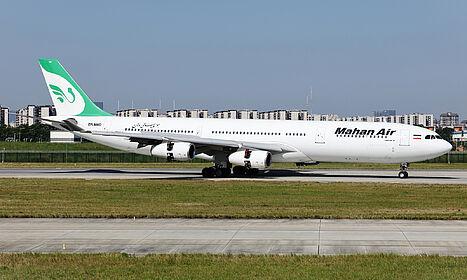
Retirement came fast after 2015, and the pandemic seemed to finish the type. It did not. In 2022 Lufthansa, short of long-haul aircraft as travel recovered and its new 787s and 777Xs were delayed, returned parked A340-300s to service from Frankfurt and Munich, and some are still flying. Edelweiss, Lufthansa's Swiss leisure airline, Mahan Air of Iran, Conviasa of Venezuela and a few charter and government operators keep others going. The A340 story on this site follows that revival.
Specifications
- First flight
- 1991
- Entered service
- 1993
- Engines
- 4 × CFM International CFM56-5C4
- Typical seating
- 280 (2-class)
- Cruise speed
- Mach 0.82
- Range
- 7,300 nm
- MTOW
- 276,500 kg
- Length
- 63.69 m
- Wingspan
- 60.3 m
- Status
- Production ended
Design notes
The A340 is an A330 with four engines, and the shared parts are the point: the 5.64-meter-wide fuselage with eight-abreast economy, the 60.3-meter wing, the fly-by-wire cockpit with sidesticks and the type rating are common, and the wing was designed from the start to carry two or four engines. The A340's wing adds a strengthened structure and the extra pylons, and the airplane has a two-wheel center main landing gear under the fuselage to carry its higher weight.
The engines are four CFM56-5C4 turbofans of about 34,000 pounds of thrust each, small engines for a 276-ton airplane. Their size is why the A340-300 climbs slowly and uses long runways, and why its fuel burn per seat is worse than a big twin's, but it is also why the engines were cheap to buy and easy to maintain, and why the A340 never had an ETOPS restriction anywhere.
The flight deck is the Airbus common cockpit shared with the A320, A330 and later types, with six displays and the fly-by-wire envelope protection Airbus introduced on the A320. The A340-300's maximum takeoff weight grew from 257 tons to 276.5 tons over its production life, with range rising to about 7,300 nautical miles; the -200 traded 15 fewer rows for more range, and the later -500 and -600 are different airplanes with a bigger wing and Trent engines.
Notable facts
- Airbus's first four-engine widebody, launched together with the twin-engine A330, with which it shares the fuselage, wing and cockpit. First flight October 25, 1991; into service with Lufthansa and Air France in March 1993.
- Four engines let it fly long ocean routes before twins were allowed to, but once ETOPS rules relaxed the A330 and 777 undercut it, and A340-300 production ended in 2008.
- Most have been retired, yet Lufthansa brought parked A340-300s back into service in the 2020s when it was short of long-haul aircraft, and a handful of other airlines still fly the type.
- Typical three-class seating is 250-290; the figure above is a common layout.
Who flies it
Lufthansa is the A340-300's most visible operator, flying a reactivated fleet on long-haul routes from Frankfurt and Munich, mostly to North America and Asia, until its new widebodies arrive. Edelweiss operates ex-Swiss A340-300s on leisure routes from Zurich to the Americas, Africa and Asia. Mahan Air of Iran flies a large fleet under sanctions, Conviasa of Venezuela and Air Algérie use small numbers, and Plus Ultra of Spain, several Portuguese and Spanish charter operators and a few governments account for most of the rest. Freighter conversions never happened at scale, so retired A340-300s are generally stored or scrapped. On a tracker the code A343 is now concentrated on Lufthansa's Frankfurt departures and Mahan's Tehran network.
Flying on one
An A340-300 flight is a widebody experience from the 1990s, which is mostly pleasant. Economy is 2-4-2, eight-abreast, so the side pairs are ideal for couples and no window seat has more than one neighbor; seats are typically 17.5 to 18 inches wide at 31 to 32 inches of pitch. The four small engines make it quieter than many twins in the back of the cabin, and the ride is steady. Cabins vary: Lufthansa's reactivated aircraft have older business seats but refurbished economy; Edelweiss flies a leisure layout with a small premium cabin. Overhead bins are smaller than on an A350 or 787 and the cabin altitude is higher, so long flights feel longer. Best seats are the window pairs forward of the wing; avoid the center block of four and the last rows near the rear galleys. Takeoffs are slow and long, which is normal for the type, not a sign of trouble.
Who flies it, and how
1 airline cabin layout of the Airbus A340-300 in our dataset — expand any to see the cabin breakdown and seat map.
SWISSA340-300215 seats8F · 42J · 21W · 144Y
- First (First): 8 seats, 1-2-1 across
- Business (Business): 42 seats, 1-2-1 across
- Premium Economy (Premium Economy): 21 seats, 2-3-2 across
- Economy (Economy): 144 seats, 2-4-2 across
To be retired by 2028. Cabin counts from public fleet records (checked 2026-10-28); abreast layout is the type's standard configuration.
Variants
- A340-200 — Shorter, longer-range version, code A342
- A340-300 — The main production version, described here
- A340-500/-600 — Stretched, Trent-powered versions with a bigger wing, codes A345 and A346
How to spot it
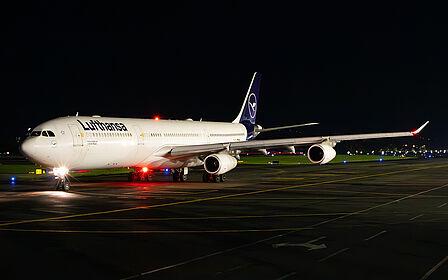
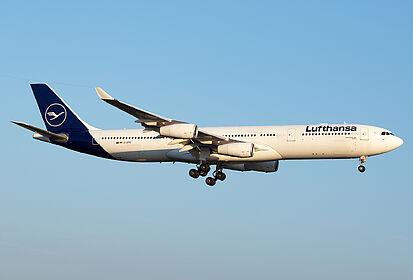
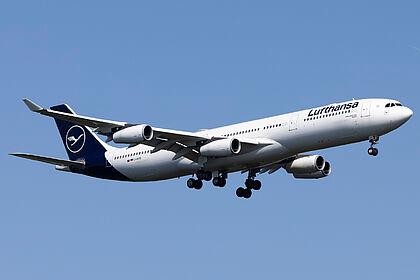
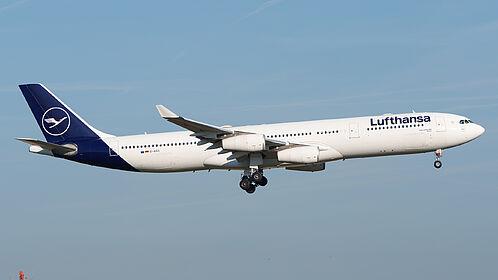
Four engines on a widebody that is not a 747 or an A380 narrows the field to the A340 and a few 747-sized military jets. The A340-300 has the A330's fuselage and the A330's rounded nose, but with four small CFM56 engines, visibly narrower than any big-twin engine, and a center main gear with two wheels under the belly. Its wingtips carry small wing fences, canted up and down, rather than tall winglets. Telling it from the A340-200 is a matter of length, the -200 being four meters shorter with fewer windows. The A340-500 and -600 are easy to separate: both have much larger Trent engines, a four-wheel center gear and the -600 is nearly twelve meters longer. Against an A330-300, the twin has two big engines where the A340 has four small ones; everything else matches.
Frequently asked
Why does the A340 have four engines?
When it was designed in the late 1980s, twin-engine airliners were restricted on long overwater routes by ETOPS rules. Four engines removed the restriction. Once those rules relaxed in the 1990s, big twins such as the A330 and 777 proved cheaper to run, and A340 sales faded.
What is the difference between the A340-300 and the A330-300?
They share a fuselage, wing, cockpit and type rating; the A340-300 has four CFM56 engines and a center main landing gear where the A330-300 has two large engines. The A340 flies further but burns more fuel per seat.
Is the A340-300 still flying?
Yes. Lufthansa returned stored A340-300s to service in 2022 and still flies them, Edelweiss operates ex-Swiss examples, and Mahan Air, Conviasa and some charter and government operators keep others in the air. Production ended in 2008.
How many A340-300s were built?
Airbus built 218 A340-300s out of 377 A340s of all versions between 1992 and 2011.
What aircraft is A343?
A343 is the ICAO type designator for the Airbus A340-300, a Airbus quad that first flew in 1991. It is the code flight trackers and air traffic control use.
What is the wingspan of the Airbus A340-300?
The Airbus A340-300 has a wingspan of 60.3 m (198 ft) and is 63.69 m (209 ft) long.
What engines does the Airbus A340-300 have?
Four CFM International CFM56-5C4.
What is the MTOW and range of the Airbus A340-300?
Maximum takeoff weight is 276,500 kg (609,572 lb) and maximum range is about 7,300 nautical miles (13,520 km) at a cruise of Mach 0.82.
How many passengers does the Airbus A340-300 carry?
Typically 280 passengers in a two-class layout; dense single-class layouts seat more and premium-heavy layouts fewer.
Compare with
Specs are approximate, compiled from public sources. See our editorial policy.