Sukhoi Superjet 100 (SU95)
Sukhoi · Regional · In production
SU95 is the ICAO aircraft type code for the Sukhoi Superjet 100, a Sukhoi regional jet that first flew in 2008 and entered service in 2011. It typically carries 98 passengers in a two-class layout, cruises at Mach 0.78, and has a range of about 2,470 nautical miles (4,574 km).

Loading live positions…
In the wild
History
The Superjet 100 was Russia's attempt to build a modern regional jet with Western partners, and the airplane now shows what happens when those partners leave. Sukhoi, famous for fighters, set up Sukhoi Civil Aircraft in 2000 to build a 75- to 95-seat jet to replace the Tupolev Tu-134 and Yakovlev Yak-42 in Russian fleets and, it hoped, to sell abroad. Boeing consulted on the program, Safran of France co-developed the SaM146 engine with Russia's NPO Saturn, Thales supplied the avionics, and Liebherr, Honeywell, Goodrich and others provided systems.
The first Superjet flew on May 19, 2008 from Komsomolsk-on-Amur, where the fuselages are built, and the type was certified in Russia in 2011 and by Europe's EASA in 2012, a first for a Russian airliner. Armavia of Armenia flew the first commercial service in April 2011; Aeroflot took its first aircraft the same year and became the largest operator by far, flying the type on domestic routes from Moscow Sheremetyevo.
Export sales were the goal and mostly did not happen. Mexico's Interjet operated up to 22 Superjets from 2013 but grounded them as spares and support became unreliable; Ireland's CityJet flew a few for Brussels Airlines from 2017 and returned them in 2019. A demonstration flight crashed into a mountain in Indonesia in 2012, killing 45, and an Aeroflot Superjet caught fire after a hard landing at Sheremetyevo in 2019, killing 41. Russian airlines, often with state encouragement, kept buying.
The sanctions that followed Russia's invasion of Ukraine in 2022 cut off the French engine parts and Western systems, and the program was redesigned as the SJ-100 with the Aviadvigatel PD-8 engine and Russian-built avionics, landing gear and other components. The first fully import-substituted SJ-100 flew in 2024, and deliveries of the new version to Aeroflot have been promised repeatedly. By early 2026 about 236 Superjets of all versions had been built. The type is now marketed under the Yakovlev name, Sukhoi's civil arm having been merged into the United Aircraft Corporation.
Specifications
- First flight
- 2008
- Entered service
- 2011
- Engines
- 2 × PowerJet SaM146; the import-substituted SJ-100 uses the Aviadvigatel PD-8
- Typical seating
- 98 (2-class)
- Cruise speed
- Mach 0.78
- Range
- 2,470 nm
- MTOW
- 49,450 kg
- Length
- 29.94 m
- Wingspan
- 27.8 m
- Status
- In production
Design notes
The Superjet is a conventional twin-engine regional jet of the E-Jet pattern: low wing, two underwing engines, a swept tail and a two-pilot fly-by-wire cockpit. Its fuselage is 3.24 meters wide, wider than a CRJ or ERJ, allowing 2-3 seating in a cabin 2.12 meters high, with five-abreast economy at around 18 inches per seat.
The original engines are two PowerJet SaM146 turbofans of about 17,000 pounds of thrust, developed by Safran and NPO Saturn: the French side built the hot section and the Russian side the fan and low-pressure spool. The flight deck uses Thales avionics with sidesticks and envelope protection, and much of the rest, from the landing gear to the air conditioning and fuel system, came from Western suppliers. That mix is what the post-2022 SJ-100 replaces, with the PD-8 engine, Russian avionics and some forty substituted systems; Russian officials have said the new version is heavier.
The airplane is 29.9 meters long with a 27.8-meter wingspan; a later "Sabrelet" winglet option extends the span to 29.7 meters. Maximum takeoff weight is 45.9 tons for the basic 95B and 49.5 tons for the long-range 95LR, giving ranges of about 1,900 and 2,470 nautical miles. Cruise is Mach 0.78 to 0.81. A shortened Superjet 75 and a stretched version have been proposed and not built.
Notable facts
- Russia's first new airliner since the Soviet era, designed with Western partners: Safran co-built the SaM146 engines and Thales supplied the avionics. First flight May 19, 2008; into service with Armavia in April 2011.
- Aeroflot and its subsidiary Rossiya are the main operators. Mexico's Interjet and Ireland's CityJet flew it in the West, but both gave it up.
- Sanctions after 2022 cut off the Western parts, so the program was redesigned as the SJ-100 with Russian PD-8 engines and systems; it is now marketed under the Yakovlev name.
- Figures above are for the long-range SSJ100-95LR. Typical seating is 87 to 108.
Who flies it
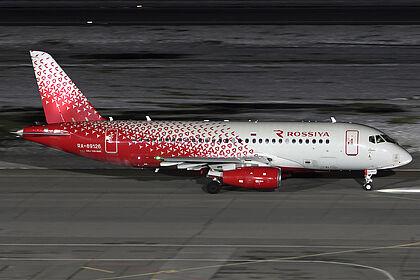
Aeroflot and its regional subsidiary Rossiya operate most of the Superjets in service, flying them from Moscow and St. Petersburg across European Russia and Siberia. Azimuth, a Rostov-based airline built around the type, Yakutia, Red Wings, IrAero, Gazpromavia and several other Russian carriers fly the rest, along with Russian government and corporate operators. Outside Russia the fleet has almost disappeared: Interjet's aircraft were grounded and scrapped, CityJet returned its lease, and small fleets in Thailand, Kazakhstan and Armenia have come and gone. Sanctions keep the type out of Western airspace, so on a tracker nearly every SU95 is inside Russia or on a flight to a neighboring country, and ADS-B coverage there is thin.
Flying on one
Passengers who fly the Superjet mostly do so on Aeroflot domestic routes, and the cabin is better than the airplane's reputation. Economy is 2-3, five-abreast, with seats about 18 inches wide at 31 to 32 inches of pitch, which is roomier than a CRJ or ERJ and comparable to an A220. The cabin is tall enough to stand in and the overhead bins take roll-aboards, though smaller ones than an A320's. Aeroflot flies a 12-seat business cabin in 2-2 at the front with 75 economy seats behind. The engines are reasonably quiet and the ride is ordinary for the class. Best seats are the two-seat side forward of the wing, where no one has a middle; the three-seat side has a true middle seat. Lavatories are at the front and rear. Reliability and spares have been the Superjet's weakness, so schedule changes are more common than on other types.
Variants
- SSJ100-95B — Basic version, 45.9-ton takeoff weight
- SSJ100-95LR — Long range, described here
- SJ-100 — Import-substituted version with PD-8 engines
How to spot it
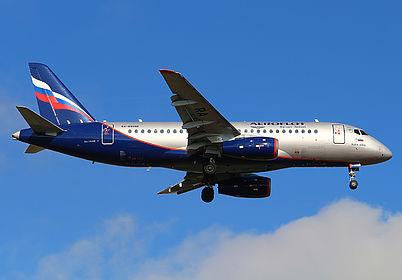
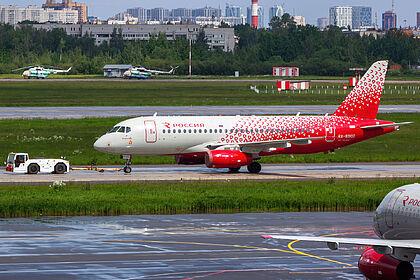
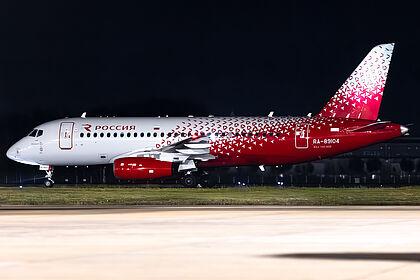
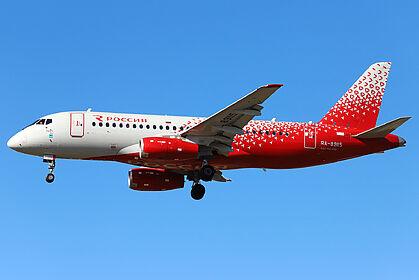
The Superjet is a mid-sized regional jet with underwing engines and a conventional low tail, so the first job is separating it from an E-Jet or an A220. Its nose is short and rounded with a sloping cockpit windshield, less pointed than an E-Jet's, and the fuselage is relatively fat for its length. The wing is swept with no winglets on most aircraft; a few have the later sabre-shaped winglets. The engines sit well forward of the wing on long pylons. The windows are large and closely spaced, and the registration prefix RA-89 is a reliable tell, since nearly all Superjets are Russian-registered. Compared with the E190, the Superjet is slightly shorter and wider, with a rounder nose; compared with the A220 it is smaller with a more conventional, less swept wing.
Frequently asked
Is the Superjet 100 still being built?
Yes, as the import-substituted SJ-100 with Russian PD-8 engines and systems, now marketed under the Yakovlev name. The original SaM146-powered version cannot be built since Western suppliers withdrew in 2022.
Why did the Superjet fail to sell outside Russia?
Support and spares were unreliable, which drove Interjet of Mexico and CityJet of Ireland to give up the type, and the 2012 and 2019 fatal accidents damaged its reputation. Sanctions since 2022 have closed Western markets entirely.
Who flies the Superjet 100?
Aeroflot and Rossiya operate most of them, with Azimuth, Yakutia, Red Wings, IrAero and other Russian carriers flying the rest. Almost no Superjets fly outside Russia today.
What is the difference between the Superjet 100 and the SJ-100?
The SJ-100 is the same airframe with Russian-built engines, avionics, landing gear and other systems replacing the French, American and German originals. It was developed after 2022 and is slightly heavier. Both share the ICAO code SU95.
What aircraft is SU95?
SU95 is the ICAO type designator for the Sukhoi Superjet 100, a Sukhoi regional that first flew in 2008. It is the code flight trackers and air traffic control use.
What is the wingspan of the Sukhoi Superjet 100?
The Sukhoi Superjet 100 has a wingspan of 27.8 m (91 ft) and is 29.94 m (98 ft) long.
What engines does the Sukhoi Superjet 100 have?
Two PowerJet SaM146; the import-substituted SJ-100 uses the Aviadvigatel PD-8.
What is the MTOW and range of the Sukhoi Superjet 100?
Maximum takeoff weight is 49,450 kg (109,017 lb) and maximum range is about 2,470 nautical miles (4,574 km) at a cruise of Mach 0.78.
How many passengers does the Sukhoi Superjet 100 carry?
Typically 98 passengers in a two-class layout; dense single-class layouts seat more and premium-heavy layouts fewer.
Compare with
Specs are approximate, compiled from public sources. See our editorial policy.