Pilatus PC-12
PC12Pilatus · Turboprop · In production
In the wild
History
The Pilatus PC-12 is the aircraft that turned a Swiss manufacturer best known for trainers and mountain aircraft into a major force in the turboprop market. Pilatus announced the PC-12 in 1989 as a single-engine turboprop that would offer near-business-jet comfort and versatility at far lower cost, and it first flew in 1991. After some early redesign, notably enlarged winglets and more power to meet performance targets, it entered service in 1994.
The concept was ambitious. Pilatus set out to combine the economy and simplicity of a single turbine engine with a pressurised, comfortable cabin, a large cargo door and the ability to operate from short and unpaved runways. That mix let the PC-12 serve as an executive aircraft, an air ambulance, a small freighter and a regional passenger aircraft, all from the same airframe. Its single Pratt & Whitney Canada PT6 turboprop kept operating costs well below those of a comparable twin or light jet.
For a time single-engine turbine aircraft faced regulatory restrictions on commercial passenger flights in cloud and at night, but as authorities gained confidence in the reliability of modern turbine engines those rules were eased. That change was important to the PC-12, opening it up to commercial operators and fractional-ownership programmes that could exploit its low costs.
Commercially the PC-12 became a major success and is widely regarded as one of the best-selling pressurised single-engine turboprops ever built, with well over 2,000 delivered. Pilatus refined it steadily, through the PC-12 NG with a modern glass cockpit and the current PC-12 NGX with further engine and cabin improvements, keeping it competitive for decades. Its commercial success also gave Pilatus the confidence and resources to develop a twin-engine business jet, the PC-24, broadening the company's range. In the United States, meanwhile, large fractional and membership operators built substantial fleets around the PC-12's low costs and cabin flexibility, which helped cement its reputation.
As of 2026 the PC-12 remains in production and in wide use across executive, medical, cargo and passenger roles. It is a favoured aircraft of organisations such as Australia's Royal Flying Doctor Service and of fractional programmes that put private-aircraft travel within reach of more customers. For enthusiasts the PC-12 is significant as the aircraft that proved a single-engine turboprop could be a genuine, comfortable, do-everything alternative to twins and light jets, and as one of the most successful and recognisable utility aircraft of its generation, its bulky pressurised fuselage and big rear door a familiar sight worldwide.
Specifications
- First flight
- 1991
- Entered service
- 1994
- Engines
- 1 × Pratt & Whitney Canada PT6A-67P (turboprop)
- Typical seating
- 10 seats
- Cruise speed
- Mach 0.44
- Range
- 1,800 nm
- MTOW
- 4,740 kg
- Length
- 14.4 m
- Wingspan
- 16.28 m
- Status
- In production
Design notes
The Pilatus PC-12 is a low-wing single-engine turboprop designed for versatility and comfort. Unlike the utilitarian Cessna Caravan, it has a pressurised cabin, which lets it cruise high, above much of the weather, at around 30,000 feet, and it uses a retractable undercarriage to reduce drag and raise cruise speed. The airframe is predominantly metal, with distinctive upswept winglets that were enlarged early in development to meet performance targets.
Power comes from a single Pratt & Whitney Canada PT6 turboprop, in current NGX form an uprated version driving a multi-blade propeller. The aircraft is certified for single-pilot operation, which helps keep operating costs down.
A key design feature is the large cargo door at the rear of the cabin, which allows bulky freight, stretchers or equipment to be loaded easily, and underpins the type's use as a freighter and air ambulance. The cabin itself is roomy and can be configured for executive, commuter or medical layouts.
As of 2026 the current PC-12 NGX adds a modernised cabin and avionics. The overall design intent is clear: to deliver much of the comfort, speed and cabin flexibility of a twin or light jet, but on the economics of a single turbine engine, an ambitious balance that has underpinned the type's long commercial success.
Notable facts
- A single PT6 turboprop with a pressurised cabin, allowing high-altitude cruise up to around FL300.
- Features a large aft cargo door for loading bulky freight or stretchers.
- Widely regarded as one of the best-selling pressurised single-engine turboprops, with over 2,000 built.
- Uses retractable landing gear, unlike the fixed-gear Cessna Caravan.
- Popular for executive transport, air ambulance, and fractional programs, and famously with Australia's Royal Flying Doctor Service.
Who flies it
As of 2026 the Pilatus PC-12 is used across a remarkably wide range of roles. In business aviation it is a popular executive aircraft, flown both by companies and by fractional-ownership and shared programmes that spread its cost among many users; such programmes operate large PC-12 fleets. Its low running costs relative to a twin or light jet are central to that appeal.
The type is also a mainstay of air-ambulance and medical-evacuation work, where its pressurised cabin, big cargo door and short-field ability are ideal, and it is famously operated by Australia's Royal Flying Doctor Service. Regional and charter operators use it for passenger flights on thin routes, and it serves as a light freighter and in government, surveillance and special-mission roles. From corporate ramps to remote outback strips, the PC-12 turns up wherever comfortable, flexible single-turbine capability is valued.
Flying on one
The Pilatus PC-12 is the luxury end of single-engine flying, and riding in one feels closer to a business jet than a light aircraft. It is a large single turboprop with a pressurised cabin, so it can climb into the high, smooth air and stay quiet and comfortable rather than droning along low down. Operators fit it in many ways — executive club layouts for charter and corporate use, or higher-density seating for regional airline hops — typically carrying six to nine passengers. You board through a proper airstair door, and there is a big cargo door for baggage, which travels in a dedicated rear hold rather than overhead. The cabin is close to stand-up height, well finished and notably hushed for a propeller aircraft. For the best experience, an executive club seat facing a companion, with a big window, is the one to have. Versatile, quiet and comfortable, the PC-12 is the single most people would happily fly on for a couple of hours.
Variants
- PC-12/45 & /47 — Early production models
- PC-12 NG — 2008 update with Honeywell glass cockpit
- PC-12 NGX — Current model, PT6A-67P and updated cabin
- PC-12 Spectre / Eagle — Special-missions and surveillance versions
How to spot it
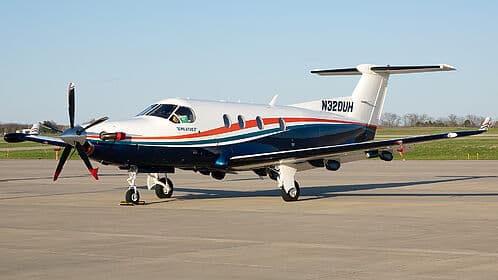
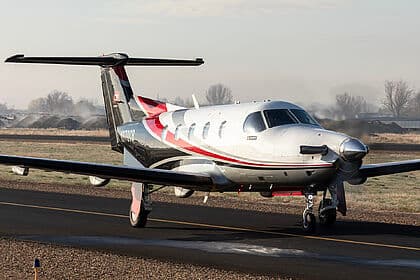
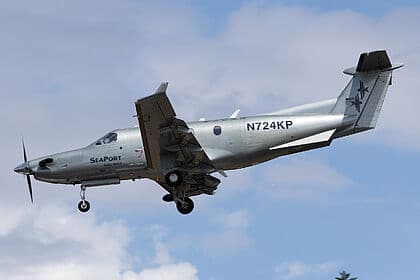
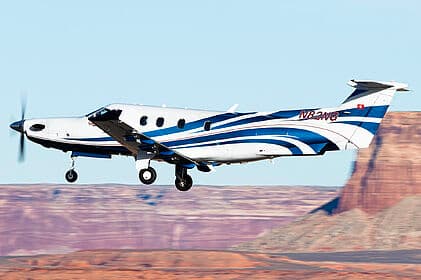
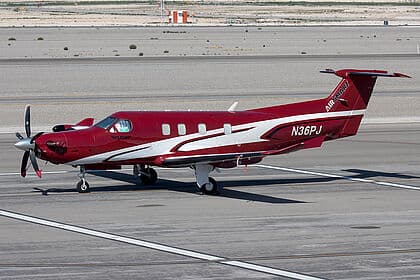
The Pilatus PC-12 is a large single-engine turboprop, and its size and shape help identify it. It is a low-wing aircraft with a bulky, purposeful fuselage, upswept winglets and a single turboprop in the nose. Because the cabin is pressurised, the fuselage looks fuller and rounder than a Caravan's, with fewer, smaller windows on some layouts.
Two features clinch it. First, the undercarriage retracts, so in flight the PC-12 shows a clean belly, unlike the fixed-gear Caravan. Second, the nose has the slim, pointed profile of a PT6 turboprop with a large multi-blade propeller, not a piston engine's cowling. Against the Cessna Caravan, its closest rival, the differences are clear: the PC-12 has a low wing, retractable gear and a pressurised body, whereas the Caravan is a high-wing, fixed-gear aircraft.
Frequently asked
What is the Pilatus PC-12 used for?
The PC-12 is a versatile single-engine turboprop used across many roles from one basic design. It serves as an executive and fractional-ownership aircraft, an air ambulance, a regional passenger aircraft on thin routes, and a light freighter, and it is also flown in government and special-mission work. Its pressurised cabin, large cargo door and short-field ability let it switch between these jobs readily.
How is the PC-12 different from the Cessna Caravan?
Both are single PT6 turboprops, but they suit different missions. The PC-12 is a faster, low-wing aircraft with retractable gear and a pressurised cabin, built for comfortable executive and passenger transport at altitude. The Caravan is a rugged, high-wing, fixed-gear utility aircraft with an unpressurised cabin, focused on cargo and rough-field work at the lowest possible cost. The PC-12 travels in comfort; the Caravan hauls.
Is a single-engine PC-12 safe for passenger flights?
The PC-12 uses a Pratt & Whitney Canada PT6, among the most reliable turbine engines ever made, and modern turbine reliability is why authorities eased earlier restrictions on single-engine commercial passenger flights. Operators further manage the risk through rigorous maintenance, training and route planning. Its long service record in demanding roles, including air-ambulance work, is generally regarded as strong. As with any single, an engine failure still requires a glide to a landing, a risk operators plan for carefully.
How fast and how far can the PC-12 fly?
The current PC-12 NGX cruises at around 290 knots, roughly 330 miles per hour, which is fast for a turboprop though slower than a jet. Its maximum range is in the region of 1,800 nautical miles, enough to link distant cities nonstop. Actual figures depend on load, altitude and cruise setting, so those numbers are representative rather than exact.
How much does a Pilatus PC-12 cost?
The PC-12 is a substantial aircraft, and a new one costs several million dollars, though still far less to buy and operate than a comparable twin-turboprop or light jet. Used examples remain valuable, reflecting strong demand. Operating costs include jet fuel, insurance, maintenance and crew, but the single turbine engine keeps them notably lower than a jet's. Precise figures depend on configuration and usage, so these are broad guidelines.
Compare with
Specs are approximate, compiled from public sources. See our editorial policy.