ATR 72-500 (AT75)
ATR · Turboprop · Production ended
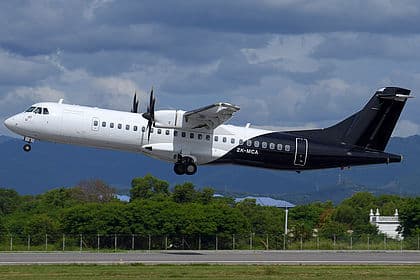
AT75 is the ICAO aircraft type code for the ATR 72-500, an ATR turboprop that first flew in 1997 and entered service in 1997. It typically carries 70 people, cruises at Mach 0.45, and has a range of about 800 nautical miles (1,482 km).
Loading live positions…
In the wild
History
The ATR 72-500 is the mid-life refresh that made the ATR 72 the world's default regional turboprop. The original ATR 72 of 1989, a stretch of the ATR 42 built by the Franco-Italian joint venture of Aérospatiale and Aeritalia, had been successful but noisy and modestly powered. In the mid-1990s ATR fitted the more powerful Pratt & Whitney Canada PW127F engines, six-blade Hamilton Standard 568F propellers that turned more slowly and cut cabin noise markedly, and a reworked interior with new overhead bins. Certified in 1997 and initially called the ATR 72-210A, it was soon renamed the ATR 72-500.
It arrived as the turboprop market was collapsing. Through the late 1990s and early 2000s North American and European regionals replaced turboprops with 50-seat jets, and ATR's deliveries fell to a trickle; Bombardier's rival Dash 8 was down to a handful a year too. The -500 kept the line alive with orders from carriers in markets where jets made no sense, in the Caribbean, Southeast Asia, the Indian Ocean and the Pacific, and from airlines like Air New Zealand and Bangkok Airways that valued its economics on short sectors.
Then fuel prices rose. From about 2005 the ATR 72-500's fuel burn per seat, roughly 40% below a regional jet's on a 300-mile sector, made it the aircraft airlines wanted again, and orders surged. By the time the glass-cockpit ATR 72-600 replaced it in production around 2011, the -500 had become the most numerous ATR variant, with several hundred built.
Many remain in service two decades on, and the type has a second life as a freighter: FedEx Feeder operates a large fleet of ATR 72-500Fs with large cargo doors, and conversion lines in Europe and Asia continue to turn retired passenger aircraft into cargo haulers.
Specifications
- First flight
- 1997
- Entered service
- 1997
- Engines
- 2 × Pratt & Whitney Canada PW127F
- Typical seating
- 70 seats
- Cruise speed
- Mach 0.45
- Range
- 800 nm
- MTOW
- 22,500 kg
- Length
- 27.17 m
- Wingspan
- 27.05 m
- Status
- Production ended
Design notes
The ATR 72-500's defining change was its propulsion: PW127F turboprops of 2,750 shp driving six-blade 568F propellers of 3.93 m diameter. The six blades allowed a lower propeller speed for the same thrust, which cut the characteristic turboprop drone and reduced vibration enough that ATR could offer a lighter, quieter cabin. The high wing and T-tail are unchanged from the original ATR 72, as is the distinctive upward-folding rear passenger door and the forward cargo door; passengers board through the rear left door and the forward area holds baggage.
The aircraft has no auxiliary power unit in its standard form; instead the right engine's propeller can be braked while the engine runs to supply power and air on the ground, the 'hotel mode' that spotters recognise by one stationary propeller on a running aircraft. The cockpit is conventional, with electromechanical instruments and a two-screen EFIS; the -600 replaced it with Thales glass displays.
Notable facts
- The second-generation ATR 72, originally the -210A, with PW127F engines and six-blade Hamilton Standard 568F propellers that cut cabin noise.
- Built from 1997 until the glass-cockpit ATR 72-600 replaced it around 2011; hundreds remain in service worldwide.
- A mainstay of island and short-sector flying, from Air New Zealand and Bangkok Airways to the Caribbean and the Indian Ocean.
- Many have been converted to freighters, including FedEx Feeder's large-cargo-door ATR 72-500Fs.
- Shares its ICAO family with the ATR 72-200 (AT72) and -600 (AT76); airlines list all of them as AT7.
Who flies it
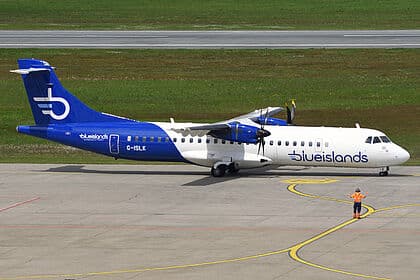
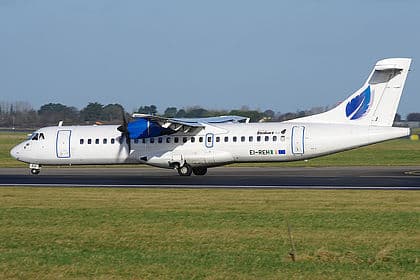
Air New Zealand, Bangkok Airways, Air Tahiti, Air Mauritius, Vietnam Airlines, Wings Air, Binter Canarias and Caribbean carriers such as LIAT built large ATR 72-500 fleets, and many still fly them alongside -600s. In Europe, Aer Lingus Regional, Blue Islands and Air Corsica operated the type; in North America it is rarer, used mainly by FedEx Feeder in freighter form. Typical missions are 30- to 90-minute sectors between islands, regional cities and hubs, often from short or unpaved runways where a jet cannot go.
Flying on one
The ATR 72-500 is a short-sector workhorse and feels like it: a narrow 2-2 cabin of 17-inch seats, a low ceiling, small bins that take a soft bag but not a roll-aboard, and the sound of two big turboprops. It is quieter than the original ATR 72 thanks to the six-blade props, but the front rows, level with the propellers, are the loudest and the rear is calmer. Boarding is through the rear door, so the last rows fill first and the front, oddly, is the quietest place to sit. Turboprops ride lower and slower through weather, so expect more bumps than on a jet on a hot afternoon. For the best seat, pick a window near the rear on the side away from the props' arc; the exit rows have extra legroom. Flights are short, and the views from a high-wing aircraft are the best in the business.
Variants
- ATR 72-200 (AT72) — Original four-blade version
- ATR 72-600 (AT76) — Current-production successor with Thales glass cockpit
- ATR 72-500F — Freighter conversion
How to spot it
ATRs are the high-wing turboprops with a T-tail, a rear boarding door that folds upward, and the main landing gear retracting into fairings on the fuselage rather than the engine nacelles. The ATR 72 is the long one (the ATR 42 is 4.5 m shorter with fewer windows). To tell a -500 from the original -200, look at the propellers: the -500 has six slim blades, the -200 four broader ones. Telling a -500 from a -600 from outside is hard, as they share the airframe and six-blade props; the -600 has the registration's hint, an updated interior and, on many, a winglet-free wing identical to the -500's, so the cockpit's glass displays are the reliable cue.
Frequently asked
What is the difference between the ATR 72-500 and ATR 72-600?
The -600 replaced the -500 in production around 2011 with a Thales glass cockpit, a new cabin with larger bins, PW127M engines with more take-off power and higher weights. The airframe, six-blade propellers and seating are essentially the same.
Why is one propeller stopped on a running ATR?
Hotel mode. The ATR has no auxiliary power unit, so on the ground the right engine runs with its propeller braked to provide electricity and air conditioning. It is normal and not a fault.
How many passengers does an ATR 72-500 carry?
Typically 68–72 in a single class at 30–31 inches of pitch, with a maximum of 74.
Is the ATR 72 safe?
Yes. It is one of the most widely flown regional aircraft in the world, with more than 1,000 ATR 72s built across all versions and a safety record in line with other modern turboprops; its reputation suffered unfairly from a 1994 icing accident that led to improved de-icing systems and procedures.
What aircraft is AT75?
AT75 is the ICAO type designator for the ATR 72-500, a ATR turboprop that first flew in 1997. It is the code flight trackers and air traffic control use.
What is the wingspan of the ATR 72-500?
The ATR 72-500 has a wingspan of 27.05 m (89 ft) and is 27.17 m (89 ft) long.
What engines does the ATR 72-500 have?
Two Pratt & Whitney Canada PW127F.
What is the MTOW and range of the ATR 72-500?
Maximum take-off weight is 22,500 kg (49,604 lb) and maximum range is about 800 nautical miles (1,482 km) at a cruise of Mach 0.45.
How many passengers does the ATR 72-500 carry?
Typically 70 people including the pilot.
Compare with
Specs are approximate, compiled from public sources. See our editorial policy.