Embraer E175 (short wing) (E75S)
Embraer · Regional · Production ended
E75S is the ICAO aircraft type code for the Embraer E175 (short wing), an Embraer regional jet that first flew in 2003 and entered service in 2005. It typically carries 76 passengers in a two-class layout, cruises at Mach 0.82, and has a range of about 2,000 nautical miles (3,704 km).
Loading live positions…
In the wild
History
The short-wing E175 is simply the Embraer E175 as it was built for its first eight years, and the reason it has its own ICAO code is a wing change rather than a new aircraft. Embraer launched the E-Jet family in 1999 with the 70-seat E170 and announced a stretched E175 alongside it. The E175 first flew on 14 June 2003 and Air Canada put it into service in July 2005, flying between Toronto, Montreal and US cities on routes that had been the preserve of 50-seat regional jets and turboprops.
Its break-out market was the United States. American pilot contracts, the scope clauses, cap the size and weight of jets that regional partners may fly for the majors, and the E175 fitted neatly under the 76-seat limit while offering a cabin that felt like a mainline aircraft. Republic Airways took the type for US Airways Express in 2007, Compass Airlines flew it for Northwest and then Delta, and in Europe LOT, Alitalia's CityLiner, Flybe and Royal Jordanian added fleets. Through the early 2010s the E175 became the regional jet that major airlines wanted their partners to buy, displacing the CRJ700 and CRJ900 in order after order.
In 2013 Embraer introduced a revised wing for the E175 with a wider span and new, swept wingtips, promising a fuel-burn cut of around 6% without any change to the cabin, engines or cockpit. The change was significant enough aerodynamically that ICAO issued a new designator, E75L, for the long-wing aircraft and reassigned the original to E75S. From then on every E175 delivered, including the hundreds for SkyWest, Republic, Envoy, Horizon and Mesa, has been an E75L.
The short-wing fleet did not disappear. Several hundred remain in service, many with the same airlines that bought them and others on the second-hand market, and because they share a type rating and a cabin with the E75L, airlines run them interchangeably. To a passenger the two are indistinguishable. To a tracker or a flight plan they are two codes, which is why people who see E75S on one day and E75L the next end up searching for the difference.
Specifications
- First flight
- 2003
- Entered service
- 2005
- Engines
- 2 × General Electric CF34-8E
- Typical seating
- 76 (2-class)
- Cruise speed
- Mach 0.82
- Range
- 2,000 nm
- MTOW
- 38,790 kg
- Length
- 31.68 m
- Wingspan
- 26 m
- Status
- Production ended
Design notes
The E75S is the E175 with its original wing: a span of 26.0 m and conventional, slightly upturned wingtips. The 2013 long-wing modification extended the tips and reshaped them into larger swept winglets, taking the span to roughly 28.7 m and reducing induced drag; that is the whole difference between the two codes. Fuselage, cabin cross-section, General Electric CF34-8E engines of 14,200 lb thrust, Honeywell Primus Epic cockpit and the E-Jet's fly-by-wire flight controls are identical, as is the pilot type rating, which covers the E170, E175, E190 and E195 together.
Like all first-generation E-Jets the E175 uses a 'double-bubble' fuselage that gives a 2-2 cabin with no middle seats and overhead bins large enough for a standard roll-aboard, the features that won it the North American market against the narrower CRJ. Weight options are the Standard, LR and AR versions; the LR at 38.8 tonnes is the most common. The E175-E2 that Embraer flew in 2019 is a different aircraft with a new wing and geared turbofans, and is too heavy for current US scope clauses.
Notable facts
- The original E175 as built from 2005 to 2013, with the 26 m wing and conventional wingtips; ICAO assigned it E75S when the long-wing E75L arrived.
- Identical to the E75L in fuselage, cabin, engines, cockpit and type rating; the only difference is the wing's span and tips.
- Air Canada was the launch operator in 2005; Republic Airways, LOT, Alitalia CityLiner, Royal Jordanian and Flybe built fleets before the switch.
- Airlines and booking sites list it as E75, against E7W for the long-wing version.
- Trackers show a mix of E75S and E75L in the same regional fleets, which is why the two codes confuse people.
Who flies it
Short-wing E175s fly for Republic Airways on behalf of American, Delta and United, for Air Canada Express through Jazz, and in Europe for LOT Polish Airlines and ITA Airways' regional operation, among others. Royal Jordanian, Oman Air and a number of African and Latin American carriers operate smaller fleets, and ex-Flybe and ex-Compass aircraft have been placed with new owners. Typical duties are 60- to 120-minute regional and hub-feeder sectors with 76 to 88 seats, alongside the long-wing E75Ls that now make up the majority of the world's E175 fleet.
Flying on one
An E75S is an E175 in every way that matters to a passenger: a 2-2 cabin with no middle seats, seats about 18 inches wide, big windows, a cabin ceiling you can stand under, and overhead bins that take a wheeled carry-on, which is the main reason travellers prefer it to the CRJ it replaced. North American layouts seat 76 in three cabins, with 12 first-class seats, extra-legroom rows and 31 inches of pitch in economy; European operators fit 82 to 88 in one or two classes. The engines are under the wing, so the cabin is quiet front to back, and the ride is smooth for its size. You will not notice the wing. For the best seat, take a window ahead of the wing; row 1 of first class and the exit rows have the most space, and the last row backs onto the lavatory.
Variants
- E175 STD / LR / AR — Weight and range options of the original wing
- E175 (long wing, E75L) — Wider span and new wingtips from 2013
- E175-E2 — Re-engined second generation, not yet sold in the US
How to spot it
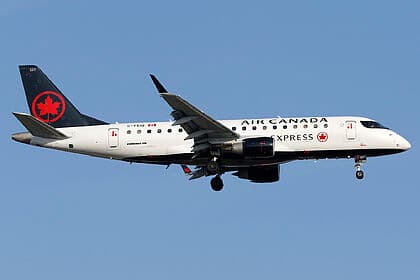
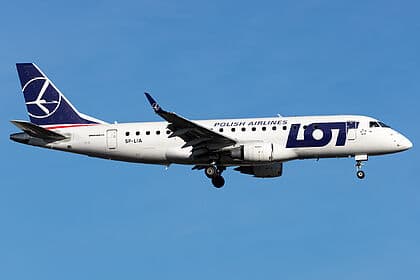
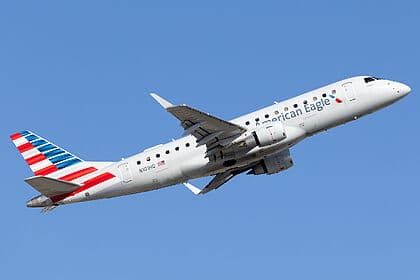
From the ground, the only visual difference between an E75S and an E75L is the wingtip. The short-wing aircraft has a small, conventional upturned tip; the long-wing has a larger, swept winglet that blends into an extended span. Everything else, from the pointed E-Jet nose and the underwing CF34 engines to the four-window-per-side overwing exit area, is the same. If you cannot see the tips, the registration is the way to know: E175s delivered before 2013 are E75S, and anything delivered to SkyWest, Envoy, Horizon or Mesa is a long-wing E75L. Against an E170, the E175 is 1.8 m longer with an extra window pair.
Frequently asked
What is the difference between E75S and E75L?
Both are Embraer E175s. E75S is the original short-wing version built from 2005 to 2013; E75L is the long-wing version with a wider span and new wingtips introduced in 2013, which burns about 6% less fuel. Cabin, engines, cockpit and type rating are identical.
What aircraft is E75S?
E75S is the ICAO type designator for the Embraer E175 with its original 26 m wing, listed by airlines and booking sites under the IATA code E75. The long-wing E175 is E75L (IATA E7W).
Can I tell whether my flight is an E75S or E75L?
Not from the seat map, which is the same. A flight tracker shows the code once the aircraft is assigned, and the wingtips give it away on the ramp: a small upturned tip is the E75S, a large swept winglet is the E75L.
Is the E75S still being built?
No. Every E175 delivered since 2013 has the long wing, so new aircraft are all E75L. Several hundred short-wing E175s remain in service and are expected to fly for years.
What is the wingspan of the Embraer E175 (short wing)?
The Embraer E175 (short wing) has a wingspan of 26 m (85 ft) and is 31.68 m (104 ft) long.
What engines does the Embraer E175 (short wing) have?
Two General Electric CF34-8E.
What is the MTOW and range of the Embraer E175 (short wing)?
Maximum take-off weight is 38,790 kg (85,516 lb) and maximum range is about 2,000 nautical miles (3,704 km) at a cruise of Mach 0.82.
How many passengers does the Embraer E175 (short wing) carry?
Typically 76 passengers in a two-class layout; dense single-class layouts seat more and premium-heavy layouts fewer.
In-depth comparisons
Compare with
Specs are approximate, compiled from public sources. See our editorial policy.