McDonnell Douglas MD-80 (MD-83) (MD83)
McDonnell Douglas · Narrowbody · Production ended
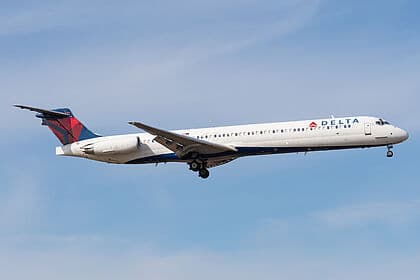
MD83 is the ICAO aircraft type code for the McDonnell Douglas MD-80 (MD-83), a McDonnell Douglas narrowbody airliner that first flew in 1979 and entered service in 1980. It typically carries 155 passengers in a two-class layout, cruises at Mach 0.76, and has a range of about 2,500 nautical miles (4,630 km).
Loading live positions…
In the wild
History
The McDonnell Douglas MD-80 began life as the DC-9 Super 80, the largest and last major development of the DC-9 that Douglas had launched in 1965. By the late 1970s airlines wanted a quieter, larger DC-9 for the growing short-haul market, and McDonnell Douglas responded with a 4.3 m stretch, a larger wing, higher weights and the new Pratt & Whitney JT8D-200 series engines, which were quieter and more efficient than the earlier JT8Ds. The Super 80 flew on 18 October 1979 and Swissair put it into service in October 1980; the family was renamed MD-80 in 1983 as the company sought a new identity for its products.
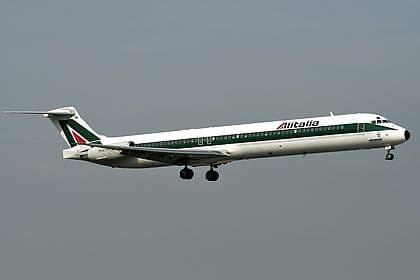
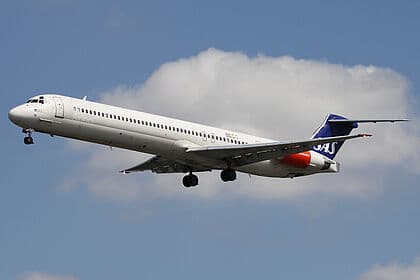
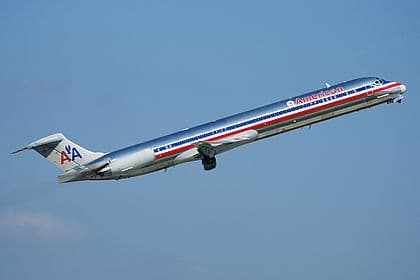
The MD-80 arrived at the right moment. US deregulation in 1978 had created hub-and-spoke networks that needed a 140-seat jet with good economics, and American Airlines' 1984 order, with leases structured so cheaply that the aircraft were nicknamed 'free', made it the backbone of the largest US carrier for thirty years. American eventually flew more than 360; Delta, TWA, Continental, Northwest, Alitalia, SAS, Iberia, Austrian and Finnair all built large fleets. The series grew into the MD-81, the higher-thrust MD-82, the long-range MD-83 of 1985 with more fuel and 21,000 lb JT8D-219 engines, the short MD-87 and the glass-cockpit MD-88.
Competition from the 737-300 and A320 in the late 1980s exposed the MD-80's limits: its 1960s fuselage was narrow, and the rear-mounted JT8Ds, however improved, were noisy and thirsty compared with high-bypass turbofans under a wing. The V2500-powered MD-90 and the smaller MD-95, which became the Boeing 717 after the 1997 merger, were the family's last developments. Production ended in 1999 after more than 1,190 MD-80s.
The 'Mad Dog', as crews called it, soldiered on for two more decades. American retired its last in September 2019 and Delta its MD-88s and MD-90s in June 2020, brought forward by the pandemic. A handful still fly with cargo and charter operators, and the type's rugged, pilot-flown character has earned it a devoted following.
Specifications
- First flight
- 1979
- Entered service
- 1980
- Engines
- 2 × Pratt & Whitney JT8D-219
- Typical seating
- 155 (2-class)
- Cruise speed
- Mach 0.76
- Range
- 2,500 nm
- MTOW
- 72,575 kg
- Length
- 45.06 m
- Wingspan
- 32.87 m
- Status
- Production ended
Design notes
The MD-80 is a classic rear-engined, T-tailed design: two JT8D-200 series turbofans on the aft fuselage, which keeps the cabin ahead of them quiet and the wing uncluttered, and a horizontal stabiliser mounted at the top of the fin. The wing was enlarged over the DC-9-50's with root plugs and new tips, giving more span and fuel, and uses full-span leading-edge slats and double-slotted flaps for strong field performance.
The MD-83 variant combined the highest-thrust JT8D-219 engines with additional fuel tanks in the holds and a maximum take-off weight of 160,000 lb (72.6 tonnes), extending range to around 2,500 nautical miles. The flight deck was a mix of eras: the MD-81 through -83 kept mostly electromechanical instruments with a digital flight guidance system, while the MD-88 and MD-90 introduced electronic displays. Pilots prized the aircraft's directness and its tolerance of hot, high and short runways.
Notable facts
- The 'Mad Dog': a stretched, re-engined DC-9 with rear-mounted JT8D-200 engines and a T-tail, sold as the DC-9 Super 80 before the 1983 rename.
- American Airlines built the largest fleet, peaking above 360, and Delta flew the MD-88 and MD-90 until June 2020.
- The MD-83 is the long-range member, with higher weights, more fuel and the most powerful JT8D-219 engines.
- Over 1,190 MD-80s were built between 1979 and 1999, when the last went to TWA; the MD-90 and Boeing 717 were its successors.
- A handful remain in service with charter and cargo operators, notably USA Jet and Aeronaves TSM, long after the majors retired them.
Who flies it
Scheduled passenger service has all but ended. The last significant operators were Delta (MD-88 and MD-90, retired 2020), American (MD-82 and MD-83, retired 2019), Allegiant (MD-80s retired 2018) and a dwindling group in Africa, Latin America and Iran, where sanctions kept old fleets flying. Today the type is mostly a freighter and charter aircraft: USA Jet and Everts Air Cargo in the United States, Aeronaves TSM in Mexico and several ad-hoc charter operators fly converted MD-80s and MD-83s, and a few are kept in VIP or sports-team configurations. Dozens are preserved or in storage.
Flying on one
If you find yourself on an MD-80 today it is almost certainly a charter, and you are flying a piece of history. The cabin is a narrow 3-2 layout, three seats on the left and two on the right, so the right-hand side offers pairs with no middle seat, a quirk passengers of the American and Delta era remember fondly. Seats were typically 17–18 inches wide at 31–32 inches of pitch. The front half of the cabin is remarkably quiet because the engines are far behind it; the rear rows, beside the JT8Ds, are loud and the engines' rumble on take-off is unmistakable. Overhead bins are small by modern standards, and the low-slung rear airstair on some aircraft is a reminder of the DC-9's self-sufficient design. For the best seat, sit in the forward right-hand pairs; avoid anything behind the wing if you want to hear yourself think.
Variants
- MD-81 / MD-82 — Standard and higher-thrust baseline versions
- MD-87 — Shortened fuselage seating about 130
- MD-88 — MD-82/83 standard with glass cockpit and updated cabin; Delta's workhorse
- MD-90 — V2500-powered stretch with a modernised cockpit
- Boeing 717 — The MD-95, renamed after Boeing's 1997 merger with McDonnell Douglas
How to spot it
The MD-80 is a long, slim jet with two engines on the rear fuselage and a T-tail, a layout it shares with the DC-9, MD-90 and 717. Telling them apart is a matter of length and engines: the MD-80 is noticeably longer than a DC-9 and has larger JT8D-200 nacelles with a prominent exhaust mixer; the MD-90 has much bigger, rounder V2500 nacelles; the 717 is short, with its engine pylons angled and smaller nacelles. Within the MD-80 family the -87 is the short one, while -81, -82, -83 and -88 look identical from outside. The pointed nose with its small, rounded cockpit windows and the two overwing exits set close together are classic DC-9 heritage.
Frequently asked
Why is the MD-80 called the Mad Dog?
The nickname comes from the 'MD' in its name and from its reputation among crews as a demanding, hands-on aircraft with powerful engines and a lively response. It was used affectionately by American and Delta pilots for decades.
Are MD-80s still flying?
A few dozen, almost all as freighters or charter aircraft. USA Jet and Everts Air Cargo in the US and Aeronaves TSM in Mexico operate converted MD-80s; the last big passenger operators, American and Delta, retired theirs in 2019 and 2020.
What is the difference between the MD-82 and MD-83?
The MD-83 is the long-range version: it has the more powerful JT8D-219 engines, extra fuel tanks in the cargo holds and a higher maximum take-off weight, giving roughly 500 nautical miles more range than the MD-82. They look identical from outside and share a type rating.
Is the Boeing 717 an MD-80?
It is a relative. The 717 began as the MD-95, a shortened, modernised DC-9/MD-80 derivative with new BR715 engines and a glass cockpit, and was renamed after Boeing merged with McDonnell Douglas in 1997. It shares the layout but almost no parts.
What aircraft is MD83?
MD83 is the ICAO type designator for the McDonnell Douglas MD-80 (MD-83), a McDonnell Douglas narrowbody that first flew in 1979. It is the code flight trackers and air traffic control use.
What is the wingspan of the McDonnell Douglas MD-80 (MD-83)?
The McDonnell Douglas MD-80 (MD-83) has a wingspan of 32.87 m (108 ft) and is 45.06 m (148 ft) long.
What engines does the McDonnell Douglas MD-80 (MD-83) have?
Two Pratt & Whitney JT8D-219.
What is the MTOW and range of the McDonnell Douglas MD-80 (MD-83)?
Maximum take-off weight is 72,575 kg (159,999 lb) and maximum range is about 2,500 nautical miles (4,630 km) at a cruise of Mach 0.76.
How many passengers does the McDonnell Douglas MD-80 (MD-83) carry?
Typically 155 passengers in a two-class layout; dense single-class layouts seat more and premium-heavy layouts fewer.
Compare with
Specs are approximate, compiled from public sources. See our editorial policy.