Airbus A340-600
A346Airbus · Four-Engine · Production ended
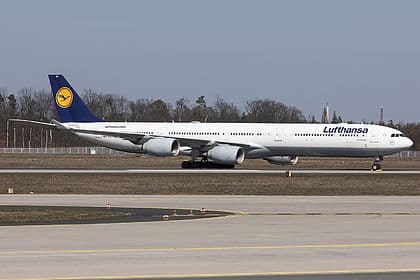
In the wild
History
The Airbus A340-600 was the largest member of the A340 family, a four-engine long-haul aircraft that Airbus developed to compete at the top of the market against the Boeing 747 and 777. The A340 traces back to the late 1980s, when Airbus launched it in 1987 alongside the twin-engine A330, the two sharing a common wing and fuselage. The original A340-200 and -300 used four CFM56 engines and entered service in 1993, chosen by airlines partly because four engines eased the over-water operating rules of the era.
By the mid-1990s Airbus wanted larger, longer-range models, and in December 1997 launched the A340-500 and A340-600. The -600 was the stretch, trading some range for capacity, while the -500 was a shorter, ultra-long-range variant. Both used a new engine, the Rolls-Royce Trent 500, and a larger wing, and added a four-wheel main landing gear bogie on the fuselage centreline to carry the higher weights. The A340-600 first flew on 23 April 2001 and entered service with launch customer Virgin Atlantic in August 2002.
At just over 75 metres long, the A340-600 was, on entry into service, the longest airliner in the world, a distinction it held until the first flight of the Boeing 747-8 in 2010. It typically seated around 320 to 380 passengers in three classes and could fly routes of roughly 7,500 nautical miles, giving airlines a genuine 747 alternative with somewhat lower capacity.
Its commercial fate, however, was shaped by the rise of large twin-engine aircraft. The Boeing 777, in particular the 777-300ER that entered service in 2004, offered similar capacity and range with two engines rather than four, and therefore lower fuel and maintenance costs. As fuel prices climbed through the 2000s, the economics turned decisively against the four-engine A340. Orders dried up, and Airbus wound the programme down, ending A340 production in 2012 after 377 aircraft of all variants had been delivered, of which 97 were -600s.
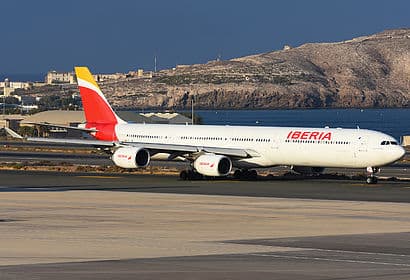
In service the A340-600 was operated by carriers including Virgin Atlantic, Lufthansa, Iberia, China Eastern, Cathay Pacific, Qatar Airways, Etihad, South African Airways and Thai Airways. Lufthansa, long the largest A340 operator, flew a substantial -600 fleet and became one of the type's last significant users, even reactivating some stored examples in the early 2020s to cover capacity while awaiting new deliveries. By the mid-2020s, though, the A340-600 had largely disappeared from front-line passenger service, retired in favour of more efficient twins. For enthusiasts it endures as a distinctive, unusually long four-engined jet, remembered both for its once-record length and as a late example of the four-engine layout that twin-engine aircraft ultimately displaced.
Specifications
- First flight
- 2001
- Entered service
- 2002
- Engines
- 4 × Rolls-Royce Trent 500
- Typical seating
- 380 (2-class)
- Cruise speed
- Mach 0.83
- Range
- 7,500 nm
- MTOW
- 380,000 kg
- Length
- 75.36 m
- Wingspan
- 63.45 m
- Status
- Production ended
Design notes
The A340-600 is most obviously defined by its length and its four wing-mounted engines. At just over 75 metres it was, at its debut, the longest airliner yet built, and the fuselage looks notably slender for its length. The wing is shared in basic design with the A330 but was enlarged for the -500 and -600, with greater span and area to support higher weights and longer range.
To carry those weights, Airbus fitted a four-wheel main landing gear bogie on the fuselage centreline, between the two wing-mounted main gears. This braked centre bogie functions as a full main gear and replaced the smaller two-wheel centreline unit of the A340-200 and -300; it is shared with the A340-500 and is a useful identification feature. Power comes from four Rolls-Royce Trent 500 engines, the only engine offered on the -500 and -600, and considerably larger than the CFM56 engines of the earlier A340-200 and -300.
The flight deck uses Airbus fly-by-wire and sidesticks and shares a common type rating with the A330 and other A340s. Inside, the long cabin allowed generous three-class layouts, and several operators fitted lower-deck crew rest areas. Structurally the aircraft is predominantly aluminium, typical of its generation. The defining engineering trade of the -600 was capacity over range relative to the A340-500, achieved chiefly through the fuselage stretch while keeping the same engines and broad systems layout.
Notable facts
- On its 2002 debut it was the longest airliner in the world, a record it held until the 747-8.
- The only variant of the A340 family with dedicated Rolls-Royce Trent 500 engines.
- Four engines let it fly long routes without ETOPS restrictions, but twins later undercut its fuel economy.
- Airbus ended A340 production in 2011 as twin-engine widebodies took over long-haul.
Who flies it
The A340-600 was flown mainly by large intercontinental carriers during the 2000s and 2010s, including Virgin Atlantic, Lufthansa, Iberia, China Eastern, Cathay Pacific, Qatar Airways, Etihad, South African Airways and Thai Airways. Its role was long-haul, high-capacity work on routes where a 747-sized aircraft was more than needed but a smaller widebody was too little.
By the mid-2020s the type had been largely retired from scheduled passenger service, displaced by more efficient twin-engine aircraft such as the A350 and Boeing 787 and 777. Lufthansa, historically the largest operator, kept the -600 in service longest and reactivated some stored examples in the early 2020s, but has been retiring them as new aircraft arrive. A small number continue in niche roles such as charter, VIP or government use. Anyone hoping to see one in airline service should check current fleet information, as remaining passenger operators are few.
Flying on one
Flying on an A340-600 is increasingly a nostalgic pleasure, as only a handful of carriers still operate the type. It is one of the longest airliners ever built, so expect a genuinely long walk to the rear and a stately, unhurried character. The four engines give a smooth, quiet ride, and economy is laid out eight-abreast in a 2-4-2 cabin — the same passenger-friendly arrangement as the A330, with side pairs for couples and only the two central seats stuck in a true middle. Cabins are a generation older than the latest composite twins, so cabin altitude and humidity are typical rather than class-leading, and overhead bins are adequate rather than cavernous. Because operators are few, the specific product depends heavily on the airline. For the best seat, take a 2-4-2 window pair well forward of the rear galleys; the very back of so long an aircraft is a long way from the doors and close to the aft service areas.
Who flies it, and how
1 airline cabin layout of the Airbus A340-600 in our dataset — expand any to see the cabin breakdown and seat map.
LufthansaA340-600281 seats8F · 56J · 28W · 189Y
- First (First): 8 seats, 1-2-1 across
- Business (Business): 56 seats, 2-2-2 across
- Premium Economy (Premium Economy): 28 seats, 2-3-2 across
- Economy (Economy): 189 seats, 2-4-2 across
Primary config (8F/56J/28W/189Y = 281). An alternate layout (8F/44J/32W/213Y = 297) also flies on part of the fleet.
Variants
- A340-500 — Ultra-long-range, shorter fuselage
How to spot it
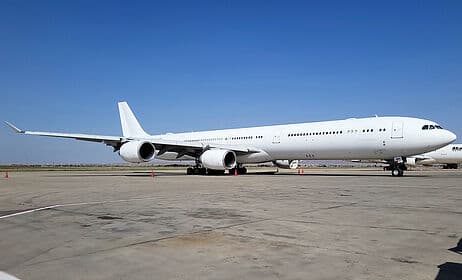
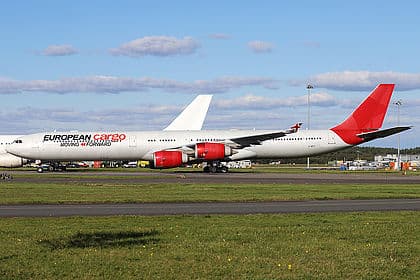
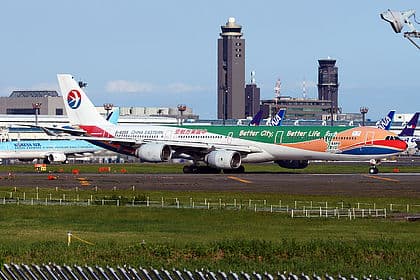
The A340-600 stands out as a very long, slender jet with four wing-mounted engines. The four engines immediately separate any A340 from the near-identical twin-engine A330, which shares the same wing and fuselage cross-section; if it has four engines under the wing and otherwise looks like an A330, it is an A340.
To identify the -600 specifically, look for extreme length, over 75 metres, far longer than the A340-300, and for the four-wheel main landing gear bogie on the fuselage centreline; the earlier A340-200 and -300 carry only a small two-wheel centreline gear there. The -600 is much longer than the ultra-long-range A340-500, which shares the four-wheel centre bogie and Trent 500 engines but has a noticeably shorter fuselage. Those large Trent 500 engines also distinguish the -500 and -600 from the smaller CFM56-powered -200 and -300.
Frequently asked
How do you tell an A340-600 from an Airbus A330?
Count the engines. The A340-600 has four engines mounted under the wing, whereas every A330 is a twin. The two families share the same wing and fuselage cross-section and can look almost identical in a photograph, so the engine count is the decisive cue; the A340-600's great length is a further giveaway.
How do you tell an A340-600 from an A340-300?
The -600 is dramatically longer, at just over 75 metres against about 63 metres for the -300, so length is the first clue. The -600 also has larger Rolls-Royce Trent 500 engines, where the -300 uses smaller CFM56 engines. Its centreline main gear is a four-wheel bogie, whereas the -300 has only a small two-wheel centreline gear.
Was the A340-600 really the longest airliner?
For a time, yes. At just over 75 metres it was the longest airliner in the world when it entered service in 2002, and it held that distinction until the Boeing 747-8 first flew in 2010 and later entered service. The Boeing 777-9, longer still, had not yet entered service as of the mid-2020s.
Why did the A340-600 sell poorly and go out of production?
Its four engines made it more expensive to operate than large twin-engine aircraft, especially the Boeing 777-300ER, which offered similar range and capacity on two engines. As fuel prices rose through the 2000s, airlines increasingly preferred twins, and orders for the A340 faded. Airbus ended A340 production in 2012 after delivering 377 of all variants, 97 of them -600s.
Are any A340-600s still flying?
By the mid-2020s the A340-600 had largely left scheduled passenger service, replaced by more efficient twins, though Lufthansa operated the type longer than most and reactivated some stored aircraft in the early 2020s. A handful remain in niche charter, VIP or government roles. Because remaining passenger operators are few, current fleet listings are the best guide.
Compare with
Specs are approximate, compiled from public sources. See our editorial policy.