Boeing 777-300 (B773)
Boeing · Widebody · Production ended
B773 is the ICAO aircraft type code for the Boeing 777-300, a Boeing widebody airliner that first flew in 1997 and entered service in 1998. It typically carries 396 passengers in a two-class layout, cruises at Mach 0.84, and has a range of about 6,030 nautical miles (11,168 km).

Loading live positions…
In the wild
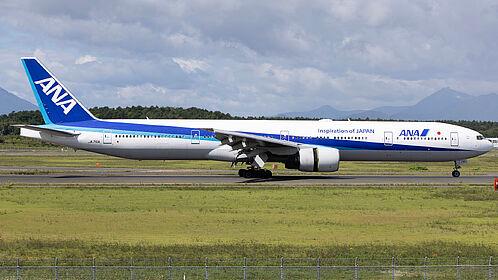
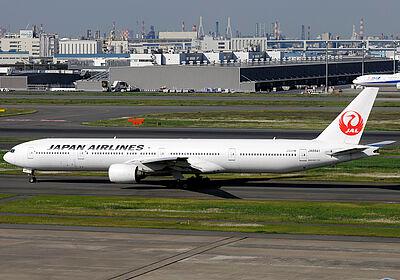
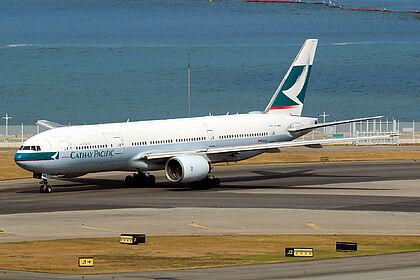
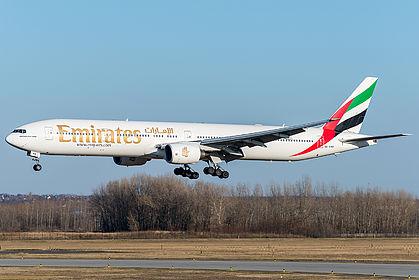
History
The 777-300 was the first stretch of the 777 and, for a few years, the longest airliner in the world. Boeing designed it for one job: replacing the first-generation 747-100s and -200s on busy Asian trunk routes, where airlines wanted 747 seats with the fuel burn of a twin. Launched in 1995, it added just over ten meters to the 777-200's fuselage, taking typical three-class capacity to around 368 and all-economy capacity past 500.
The first 777-300 flew on October 16, 1997 and entered service with Cathay Pacific in May 1998. Cathay, which had pushed hardest for the stretch, used it between Hong Kong and Japan, Taiwan and Korea; Japan Airlines and ANA bought it for domestic routes between Tokyo and Osaka, Sapporo and Fukuoka that are among the densest in the world; Emirates, Thai Airways, Korean Air and Singapore Airlines took the rest. The sales were small because the airplane's range of about 6,000 nautical miles, limited by the engines and takeoff weight of the time, kept it off the longest routes.
Boeing's answer was the 777-300ER, launched in 2000 with the GE90-115B, the most powerful jet engine ever certified, plus raked wingtips, a strengthened wing and gear, and a takeoff weight of 351 tons. When it entered service with Air France in 2004 it could fly the same 368 passengers more than 7,000 nautical miles, and it took over not only the 777-300's market but much of the 747-400's. Production of the original -300 ended in 2006 after 60 aircraft; the -300ER went on to sell more than 800.
The 60 survivors have had long lives because the routes they were built for have not changed. ANA and JAL still fly 777-300s on domestic trunk routes with cabins of around 500 seats, and several of the others remain with their original owners or have moved to second operators. On a tracker the code B773 is rare compared with the sea of B77Ws, which is itself a clue: a B773 is almost always one of those original Asian airframes.
Specifications
- First flight
- 1997
- Entered service
- 1998
- Engines
- 2 × Rolls-Royce Trent 892, Pratt & Whitney PW4090/PW4098, or GE90-92B/-94B
- Typical seating
- 396 (2-class)
- Cruise speed
- Mach 0.84
- Range
- 6,030 nm
- MTOW
- 299,370 kg
- Length
- 73.86 m
- Wingspan
- 60.93 m
- Status
- Production ended
Design notes
The 777-300 is a 777-200 fuselage with two plugs, one ahead of the wing and one behind, for a total length of 73.9 meters. The wing, tail and systems are essentially unchanged, which is why the stretch was cheap to develop and why its range is shorter: the same wing and fuel tanks now carry a heavier airplane.
A longer fuselage brought two changes pilots notice. The tail-strike risk on rotation led Boeing to fit a tailskid and to tune the flight-control laws, and the distance between the cockpit and the main gear made taxiing on tight taxiways harder, so the 777-300 introduced a ground-maneuver camera system with cameras under the fuselage and on the horizontal stabilizer feeding displays in the cockpit. That system became standard on later long 777s and on the 747-8.
Engines are the same three families as the 777-200ER, uprated: the Rolls-Royce Trent 892, the Pratt & Whitney PW4090 and PW4098, and the GE90-92B and -94B, each in the 90,000-pound-thrust class. The main gear is the 777's six-wheel bogie. The cabin uses the 777's 6.2-meter-wide cross-section, which Japanese operators fill ten-abreast at tight pitch for domestic flying; the -300's extra length adds two main doors, for ten in total, and the exit limit allows up to 550 seats.
Notable facts
- A 10-meter stretch of the 777-200 built to replace early 747s on dense Asian trunk routes. First flight October 16, 1997; into service with Cathay Pacific in May 1998.
- At 73.9 meters it was the longest airliner in the world until the A340-600 arrived in 2002, and it introduced a ground-maneuver camera system so pilots could see the main gear while taxiing.
- Only 60 were built. The 777-300ER (code B77W), with bigger engines and far more range, replaced it in 2004 and became the best-selling 777.
- Operators were a short list: Cathay Pacific, Emirates, Japan Airlines, ANA, Thai Airways, Korean Air and Singapore Airlines, and some are still flying on domestic and regional routes.
Who flies it
The 777-300 has only ever had a handful of operators and most of them still fly it. ANA and Japan Airlines use theirs on Japanese domestic trunk routes in high-density layouts, where a 500-seat twin that can turn around in under an hour is exactly what the schedule needs. Cathay Pacific flew the type until the 2020s on regional routes from Hong Kong. Emirates, Thai Airways, Korean Air and Singapore Airlines operated the rest, and some of those airframes have passed to lessors and smaller carriers. No freighter conversion program exists for the -300, so retirement usually means storage or scrapping. The type's successor, the 777-300ER, is one of the most common widebodies in the world and is where almost all B77W-coded traffic comes from.
Flying on one
Most 777-300s fly short, dense routes, so the experience is unlike a long-haul 777. ANA and JAL configure theirs with around 500 seats, economy ten-abreast at about 31 inches of pitch, with a small premium cabin up front. For a one-hour hop between Tokyo and Osaka that is fine, and the airplane is quiet and smooth. Boarding and deplaning are the bottleneck on a jet this long, so a seat near the doors saves real time. On the international -300s that remain, cabins are older generations of the operator's product, often angled-flat business seats and nine- or ten-abreast economy, so check the airline's seat map. Overhead bins are large on all of them. For the smoothest ride choose rows over the wing, between the second and third doors; the very rear rows are a long way behind the center of gravity and move more in turbulence.
Variants
- 777-300 — The 1998 non-ER version described here
- 777-300ER — Longer range, GE90-115B engines, separate code B77W
How to spot it
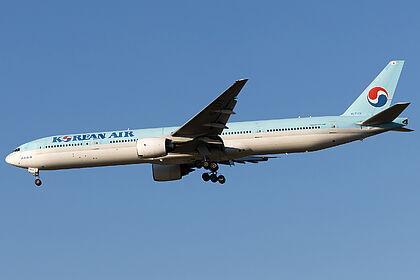
Length is the first clue: at 73.9 meters the 777-300 is ten meters longer than a 777-200 and the proportions look stretched, with ten main doors down each side. The six-wheel main gear and the flattened, blade-like tail cone confirm it is a 777. Telling it from the 777-300ER is the harder part. The ER has raked wingtips that extend the span to 64.8 meters; the original -300 has the plain, squared-off wingtips of the 777-200. The ER also carries only the GE90-115B, whose fan is visibly huge; a 777-300 with a Rolls-Royce Trent, recognizable by its pointed spinner, or a Pratt & Whitney engine is by definition a non-ER. Operator helps too: a long 777 in ANA or JAL colors on a Japanese domestic flight is very likely a -300.
Flights we've seen the Boeing 777-300 operate
From our own observations of notable flights — each links to the flight's status, on-time history and fares.
- JL2 Japan Airlines · HND–SFO · seen 9×
- AF6 Air France · CDG–JFK · seen 4×
- AF7 Air France · JFK–CDG · seen 4×
- GA88 Garuda Indonesia · AMS–CGK · seen 4×
- AI173 Air India · BLR–SFO · seen 3×
- PR102 Philippine Airlines · MNL–LAX · seen 3×
- AA100 American Airlines · JFK–LHR · seen 2×
- AC856 Air Canada · YYZ–LHR · seen 2×
- BA269 British Airways · LHR–LAX · seen 2×
- BR12 EVA Air · TPE–LAX · seen 2×
- CX883 Cathay Pacific · LAX–HKG · seen 2×
- SQ11 Singapore Airlines · LAX–NRT · seen 2×
Frequently asked
What is the difference between the 777-300 and the 777-300ER?
The 777-300ER has GE90-115B engines, raked wingtips, a stronger wing and landing gear, and about 50 tons more takeoff weight, which gives it more than 7,000 nautical miles of range against about 6,000 for the original -300. The fuselage and cabin are the same. The ER carries the code B77W; the original is B773.
Why were so few 777-300s built?
Its range was limited by the engines and weights available in 1998, so it suited only dense medium-haul routes, mostly in Asia. Once the much longer-range 777-300ER arrived in 2004, there was no reason to buy the original, and production ended in 2006 after 60 aircraft.
Who still flies the 777-300?
Japanese carriers ANA and Japan Airlines are the main operators, using the type on domestic trunk routes with around 500 seats. A few others remain with the original Asian and Middle Eastern customers or with second-hand operators.
Was the 777-300 the longest airliner?
At 73.9 meters it was the longest airliner in service from 1998 until the 75.4-meter Airbus A340-600 arrived in 2002. The 777-9, when it enters service, will be longer than both at 76.7 meters.
What aircraft is B773?
B773 is the ICAO type designator for the Boeing 777-300, a Boeing widebody that first flew in 1997. It is the code flight trackers and air traffic control use.
What is the wingspan of the Boeing 777-300?
The Boeing 777-300 has a wingspan of 60.93 m (200 ft) and is 73.86 m (242 ft) long.
What engines does the Boeing 777-300 have?
Two Rolls-Royce Trent 892, Pratt & Whitney PW4090/PW4098, or GE90-92B/-94B.
What is the MTOW and range of the Boeing 777-300?
Maximum takeoff weight is 299,370 kg (659,991 lb) and maximum range is about 6,030 nautical miles (11,168 km) at a cruise of Mach 0.84.
How many passengers does the Boeing 777-300 carry?
Typically 396 passengers in a two-class layout; dense single-class layouts seat more and premium-heavy layouts fewer.
Compare with
Specs are approximate, compiled from public sources. See our editorial policy.