Embraer Phenom 300
E55PEmbraer · Business jet · In production
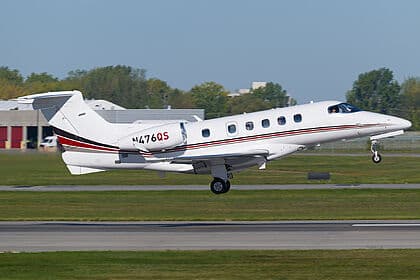
In the wild
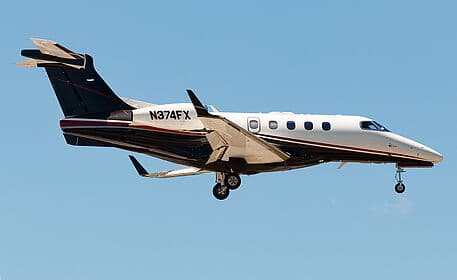
History
The Embraer Phenom 300 is a light business jet from the Brazilian manufacturer Embraer, and the larger of the two jets, with the smaller Phenom 100, that marked the company's serious entry into the business aviation market in the late 2000s. Embraer, long established in regional airliners, announced its executive jet ambitions in the mid-2000s and launched the Phenom 300 to compete in the crowded light-jet class against established names such as Cessna's Citation family.
The prototype first flew on 29 April 2008, and the aircraft was certified in December 2009, entering service the same month. It was designed around a stand-up cabin, swept wings with winglets and two rear-mounted Pratt and Whitney Canada PW535E engines, and was certified for single-pilot operation, an important feature for owner-operators. Embraer aimed for a jet that was fast, comfortable and relatively simple to operate, bringing an airliner manufacturer's approach to systems and cabin design.
The Phenom 300 proved a strong success. It became one of the best-selling light jets of its era, topping light-jet deliveries for many consecutive years through the 2010s and into the 2020s, and found a wide market among private owners, air-taxi and charter fleets, and fractional programmes. Its combination of speed, a range of around 2,000 nautical miles and single-pilot capability suited it well to both owner-flown and commercial use.
In 2020 Embraer introduced an updated version, the Phenom 300E, with a redesigned cabin, new avionics features and modest performance improvements that raised the top speed to about Mach 0.80 and range to roughly 2,010 nautical miles. The designation E55P covers the family. The 300E kept the aircraft competitive against newer rivals and sustained its position at the top of the light-jet sales charts.
As of 2026 the Phenom 300E remains in production and one of the most popular light business jets in service. For enthusiasts it is notable as the aircraft that established Embraer as a serious force in business aviation beyond its regional-airliner roots, and as a light jet that has dominated its class commercially for well over a decade. Its blend of performance, single-pilot certification and a comparatively spacious cabin has made it a common sight at business airports around the world, and a frequent choice for the growing private-charter and air-taxi sector that expanded through the 2010s and 2020s. Its comparatively strong short-field performance also lets it use runways that exclude some rivals, widening the set of airports owners can reach nonstop.
Specifications
- First flight
- 2008
- Entered service
- 2009
- Engines
- 2 × Pratt & Whitney Canada PW535E
- Typical seating
- 8 seats
- Cruise speed
- Mach 0.78
- Range
- 2,010 nm
- MTOW
- 8,415 kg
- Length
- 15.64 m
- Wingspan
- 15.91 m
- Status
- In production
Design notes
The Phenom 300 is a clean-sheet light jet designed with the resources of a large airliner manufacturer. It combines a stand-up cabin, generous for its class, with swept wings carrying prominent blended winglets and a T-tail, in which the horizontal stabiliser is mounted at the top of the fin. Two Pratt and Whitney Canada PW535E turbofans are mounted on pylons on the rear fuselage.
The swept wing and winglets give the aircraft a relatively high cruise speed for a light jet, with a top speed of about Mach 0.80 in the updated 300E, and help deliver a range of roughly 2,010 nautical miles. The aircraft is certified for single-pilot operation, which broadens its appeal to owner-flyers, and Embraer gave it airliner-derived systems and a robust airframe. Embraer marketed the cabin's comfort, including an air-stair door and a rear baggage compartment accessible in flight.
The Phenom 300E update of 2020 focused heavily on the interior, with a new seat design, cabin-management technology and revised styling, along with the small performance gains. Avionics are based on a Garmin-derived flight deck tailored by Embraer, branded Prodigy Touch. Throughout, the design balances speed, range and single-pilot simplicity with a cabin and build quality intended to feel a step above the traditional light-jet class, which is much of the reason for its strong sales.
Notable facts
- One of the best-selling light business jets of its era, topping light-jet deliveries for many consecutive years.
- Certified for single-pilot operation, which has made it popular with owner-operators as well as charter fleets.
- Has swept wings with prominent blended winglets, a T-tail and two rear-fuselage-mounted PW535E engines.
- Marked Embraer's serious entry into business aviation alongside the smaller Phenom 100.
- The updated Phenom 300E of 2020 added a new cabin and raised the top speed to about Mach 0.80 and range to roughly 2,010 nautical miles.
Who flies it
The Phenom 300 is flown by a broad mix of private owners, air-taxi and charter operators, and fractional programmes, and is one of the defining aircraft of the modern light-jet charter market. Its single-pilot certification makes it popular with owner-operators, while its economics and cabin suit it to commercial fleets. Large charter and membership operators, including NetJets and various air-taxi companies, have taken the type in significant numbers.
Typical roles are short-to-medium regional business trips, often carrying six to eight passengers between cities that do not justify a larger jet, and it is a frequent choice for on-demand and per-seat charter services. The aircraft's ability to use shorter runways widens the airports it can serve. As of 2026, with the Phenom 300E still in production and selling strongly, the type remains a mainstay of light-jet fleets and a common sight at business airports across the Americas, Europe and beyond.
Flying on one
The Embraer Phenom 300 is the world's best-selling light jet, and it is the aircraft behind a great many fractional and charter flights — if you buy a share in a jet, there is a fair chance it is one of these. As a light jet it is smaller than the midsize Citations, typically seating six to eight in a club layout, and while the cabin is comfortable and nicely finished it is not full stand-up height, so you stoop a little moving about. What it offers is speed and enough range for most short-to-medium private trips, flown quietly and efficiently, often with a single pilot. The seats are large and the big windows keep it bright; there is a compact galley, a lavatory, and a baggage compartment rather than overhead bins. For the best seat, the forward club chairs facing each other are the natural choice for a short hop with companions. It is the sensible, popular way to sample private-jet travel without a flagship-sized budget.
Variants
- Phenom 300 — Original model, in service from December 2009
- Phenom 300E — Updated version from 2020 with a new cabin, top speed near Mach 0.80 and about 2,010 nautical miles range
How to spot it
The Phenom 300 is a light business jet with two engines mounted on the rear fuselage, clearly swept wings carrying prominent blended winglets, and a T-tail with the horizontal surface at the very top of the fin. The combination of swept wings, upturned winglets and a T-tail is the quickest way to recognise it.
The closest comparison is the Cessna Citation XLS, a slightly larger mid-size jet in the same charter and fractional role. The Citation has a straight, unswept wing without winglets and a cruciform tail whose horizontal surface sits part way up the fin, whereas the Phenom has a swept wing, obvious winglets and a full T-tail. The Phenom is also a little smaller overall. Among light jets, the winglets and clean, modern lines help separate it from older designs such as earlier Citations and Learjets, which have different wing and tail shapes.
Frequently asked
What is the difference between the Phenom 300 and the Citation XLS?
The Phenom 300 is a light jet and the Citation XLS a slightly larger mid-size jet, and the two compete in the same charter and fractional market. The Phenom is faster and more modern, with swept wings, winglets, a T-tail and single-pilot certification, while the XLS offers a taller, stand-up cabin and is usually flown by two pilots. Operators often pick the Phenom for speed and efficiency and the XLS for cabin size.
How far can the Phenom 300 fly?
The Phenom 300, and the updated Phenom 300E, has a range of about 2,010 nautical miles with reserves. That is enough for typical regional and transcontinental hops, such as many US coast-to-inland routes or intra-European trips, though not for ocean crossings. It is a light jet optimised for shorter sectors rather than long-haul flying.
Is the Phenom 300 single-pilot certified?
Yes. The Phenom 300 is certified for single-pilot operation, meaning one appropriately rated pilot can legally fly it, which is a significant attraction for owner-operators. Many charter and fractional operators nonetheless fly it with two pilots as a matter of policy. The single-pilot capability is one reason the type has been so popular with private owners.
Why is the Phenom 300 so popular?
The Phenom 300 combines a relatively spacious, comfortable cabin with good speed, a range of around 2,000 nautical miles, single-pilot certification and competitive operating costs. That mix has made it a favourite of both private owners and commercial charter and fractional fleets. As of 2026 it has topped light-jet deliveries for many consecutive years, making it one of the best-selling business jets of its class.
What is the difference between the Phenom 300 and the Phenom 300E?
The Phenom 300E, introduced in 2020, is an updated version of the original Phenom 300 rather than a new aircraft. It brought a redesigned cabin, new seating and cabin-management technology, and modest performance gains that raised the top speed to about Mach 0.80 and range to roughly 2,010 nautical miles. Both share the E55P type designator, and the 300E is the version in production as of 2026.
Compare with
Specs are approximate, compiled from public sources. See our editorial policy.