Dassault Falcon 900
F900Dassault Aviation · Business jet · In production
In the wild
History
The Dassault Falcon 900 is a three-engine, long-range business jet built by the French manufacturer Dassault Aviation, and one of the most distinctive designs in business aviation thanks to its trijet layout. Dassault, better known to many for its Mirage and Rafale combat aircraft, has built the Falcon family of business jets since the 1960s, and developed the Falcon 900 as a larger, longer-range successor to its earlier three-engine Falcon 50, itself derived from the twin-engine Falcon 20.
The Falcon 900 first flew on 21 September 1984 and entered service in 1986. Like the Falcon 50, it used three engines, two in pods on the rear fuselage and a third mounted in the tail and fed by an S-shaped duct. The three-engine arrangement gave the aircraft long transoceanic range while allowing it to operate from shorter and higher airfields than many twins, and eased the over-water operating rules of the era. Its wide-body cabin, unusually spacious for its generation, seated around twelve to fourteen passengers in comfort.
Dassault developed the type steadily over the following decades. The Falcon 900B of the early 1990s brought uprated engines and range, and the Falcon 900EX of the later 1990s added more powerful Honeywell TFE731-60 engines for longer legs, followed by the 900EX EASy with a modern Honeywell Primus Epic flight deck. The current production model, the Falcon 900LX, introduced high-Mach blended winglets and offers a range of about 4,750 nautical miles.
Commercially the Falcon 900 has been a durable success, selling steadily across its variants to corporate, private and government operators, and it became a favourite for government and head-of-state transport in many countries, valued partly for the perceived safety margin of a third engine. Dassault drew on its military experience in the aircraft's aerodynamics and digital flight controls.
As of 2026 the Falcon 900, in its 900LX form, remains in production, though at a modest rate late in a long career, as Dassault's newer twin-engine Falcon 6X and 8X take on much of the range once served by the trijets. For enthusiasts the Falcon 900 endures as one of the last of the business-jet trijets, a configuration once common at the top of the market but now rare, and as a design that has stayed in production for some four decades. Its combination of three engines, a wide cabin and long range gives it a character no current twin quite matches.
Specifications
- First flight
- 1984
- Entered service
- 1986
- Engines
- 3 × Honeywell TFE731-60
- Typical seating
- 12 seats
- Cruise speed
- Mach 0.84
- Range
- 4,750 nm
- MTOW
- 22,226 kg
- Length
- 20.21 m
- Wingspan
- 21.38 m
- Status
- In production
Design notes
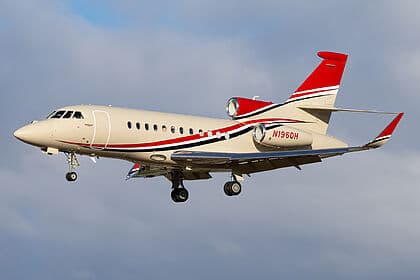
The Falcon 900's defining feature is its three engines. Two are carried in pods on the sides of the rear fuselage, in the usual business-jet position, while the third sits in the tail and breathes through an S-shaped duct that curves air down from an intake at the base of the fin. This trijet layout, shared with the smaller Falcon 50 and the later Falcon 7X and 8X, is the aircraft's signature and increasingly rare in business aviation.
The engines are Honeywell TFE731 turbofans, in progressively more powerful variants across the family, with the TFE731-60 on the EX and current LX models. Three engines give useful redundancy and strong runway and climb performance, at the cost of a little more complexity and weight than a twin. The cabin is wide for the type's generation, seating around twelve to fourteen and offering a genuine walk-around interior.
The current Falcon 900LX adds tall, high-Mach blended winglets that extend the wingspan and improve efficiency and range. Dassault, drawing on its fighter experience, gave later Falcons digital flight controls and, in the EASy and LX models, the Honeywell Primus Epic flight deck. Normal cruise is around Mach 0.80 to 0.84, with a maximum operating speed of Mach 0.87. Throughout, the design balances long range and a roomy cabin with the field performance and redundancy that the three-engine layout provides.
Notable facts
- A three-engine business jet, with two engines in rear-fuselage pods and a third fed by an S-duct at the base of the tail.
- The trijet layout offers long transoceanic range, strong short-field and high-altitude performance, and the redundancy of a third engine.
- Developed from the earlier three-engine Falcon 50 and part of Dassault's long-running Falcon family.
- A popular choice for government and head-of-state transport in many countries.
- The current Falcon 900LX adds tall, high-Mach blended winglets and flies about 4,750 nautical miles.
Who flies it
The Falcon 900 is flown by corporate flight departments, private owners, charter operators and, notably, a large number of governments and air forces, which use it for head-of-state and official transport. The perceived reassurance of a third engine, together with the aircraft's long range and ability to use shorter runways, has made it a popular choice for government VIP fleets in Europe, Africa, Asia and the Americas.
Typical roles are long-range corporate and government travel, including intercontinental and transoceanic sectors that the trijet can fly nonstop. Charter and fractional use is less prominent than for some rivals, as many Falcon 900s are held by single corporate or state operators. As of 2026, with the Falcon 900LX still in production and a large installed base of earlier variants in service, the type remains a common sight at business airports and government terminals worldwide, valued for its cabin, range and distinctive three-engine layout.
Flying on one
The Dassault Falcon 900 stands out in the large-cabin business-jet world for having three engines rather than two, a legacy of Dassault's fighter heritage that gives it strong short-field performance and reassuring redundancy on long overwater flights. For passengers it is a spacious, quiet, long-range cabin, comfortably seating a dozen or so in a typical layout of a forward club, a mid-cabin group and an aft area arranged for dining or resting. The ride is smooth and the cabin well isolated from engine noise, and its ability to use shorter or higher runways means it can often land closer to a final destination than its rivals. As with any jet of its class, luggage travels in a dedicated hold, there is a full galley and lavatory, and the finish is plush. For the best seat, a club chair by a window suits working or watching the view, while the aft section is the place to stretch out on a longer flight. It is a refined, capable long-haul private aircraft.
Variants
- Falcon 900B — Early-1990s production with uprated TFE731 engines and more range
- Falcon 900EX — Later-1990s long-range model with more powerful TFE731-60 engines
- Falcon 900EX EASy — 900EX fitted with the Honeywell Primus Epic (EASy) flight deck
- Falcon 900LX — Current production version with high-Mach blended winglets and about 4,750 nautical miles range
How to spot it
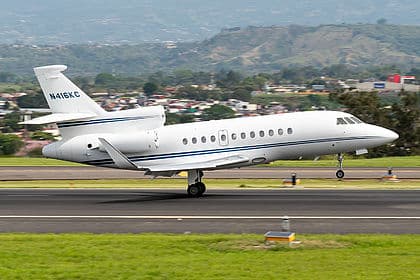
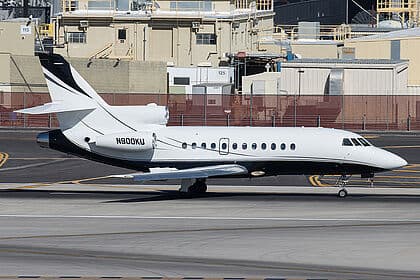
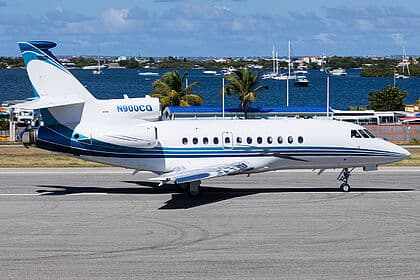
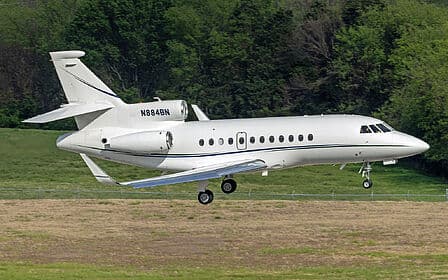
The Falcon 900 is easy to identify by its three engines, a layout now rare in business aviation. Two engines sit in pods on the rear fuselage and a third is set in the tail, fed by an S-duct with its intake at the base of the fin, giving a distinctive bulged tail with a central exhaust. Any business jet with three engines is almost certainly a Dassault Falcon.
To separate the Falcon 900 from the larger Falcon 7X and 8X, which share the trijet layout, look at size and wing: the 900 is shorter, and the current 900LX has tall blended winglets, while the 7X and 8X are noticeably longer with a different, more swept wing. Against twin-engine rivals such as the Gulfstream G650 or a Bombardier Global, the engine count settles it at once, as those aircraft have two rear engines and a clean tail rather than three.
Frequently asked
Why does the Falcon 900 have three engines?
The Falcon 900 uses three engines, two in rear-fuselage pods and one in the tail, a layout Dassault carried over from the earlier Falcon 50. The third engine gives long transoceanic range with a useful safety margin, strong performance from shorter or higher airfields, and, historically, easier compliance with the over-water operating rules of the era. It is the aircraft's most distinctive feature and increasingly rare in business aviation.
What is the difference between the Falcon 900 and the Gulfstream G650?
Both are long-range business jets, but they are quite different aircraft. The Falcon 900 is a three-engine trijet with a range of about 4,750 nautical miles in its current 900LX form, while the Gulfstream G650 is a larger, faster twin with roughly 7,000 to 7,500 nautical miles of range. The G650 is aimed at the ultra-long-range top of the market, whereas the Falcon 900 offers a distinctive three-engine layout, a wide cabin and strong field performance at a lower size and price. As of 2026 the Falcon 900LX remains in production, while the G650 does not.
How far can the Falcon 900 fly?
Range depends on the variant. The current Falcon 900LX flies about 4,750 nautical miles, enough for many transatlantic and long intercontinental sectors, while earlier models such as the 900B and 900EX offered somewhat less. That range, combined with the field performance of the trijet layout, lets the aircraft reach airports that some longer-range twins would struggle to use.
Is the Falcon 900 still in production?
Yes, as of 2026 the Falcon 900 remains in production in its 900LX form, though at a modest rate late in a long career that began in the 1980s. Dassault's newer twin-engine Falcon 6X and 8X now cover much of the long-range market, but the 900LX continues to be offered. A large fleet of earlier Falcon 900 variants also remains in service worldwide.
Who uses the Falcon 900?
The Falcon 900 is flown by corporations, private owners, charter operators and, in particular, many governments and air forces, which use it for head-of-state and official transport. The reassurance of a third engine and the aircraft's long range and field performance make it a popular government VIP aircraft. It is a common sight at both business airports and government terminals around the world.
Compare with
Specs are approximate, compiled from public sources. See our editorial policy.