Boeing 757-300 (B753)
Boeing · Narrowbody · Production ended
B753 is the ICAO aircraft type code for the Boeing 757-300, a Boeing narrowbody airliner that first flew in 1998 and entered service in 1999. It typically carries 243 passengers in a two-class layout, cruises at Mach 0.8, and has a range of about 3,400 nautical miles (6,297 km).
Loading live positions…
In the wild


History
The Boeing 757-300 is the aircraft that pushed the single-aisle jet to its limit. The 757-200 of 1983 had been a success as a powerful, long-legged 200-seater, but by the mid-1990s charter airlines wanted more seats for the same crew, and Boeing launched a stretch in September 1996 with an order from Condor, Lufthansa's leisure subsidiary. Two fuselage plugs added 7.1 m, taking the cabin to as many as 295 seats, more than any other narrowbody before or since.
The first 757-300 flew on 2 August 1998 and Condor began services in March 1999, packing it with 275 seats for Mediterranean and Canary Islands holiday routes. Icelandair, Arkia of Israel, American Trans Air, Northwest and Continental followed, each using the type on dense routes where a widebody would be too much aircraft. Northwest fitted a comfortable 224-seat layout for domestic trunk routes; Continental used it between its hubs and Hawaii.
The aircraft's length brought operational quirks. Rotation on take-off has to be gentle to avoid striking the tail, so Boeing fitted a retractable tail skid, and boarding and deplaning 280 people through two forward doors takes time, a complaint airlines raised from the start. Economically it was efficient per seat but demanding to fill, and when Boeing ended all 757 production in 2004 only 55 of the -300 had been built, the last delivered to Continental in 2005.
That small fleet has proved durable. Delta took Northwest's sixteen in the 2008 merger and still flies them on high-demand domestic routes, United inherited Continental's nine, and Icelandair uses a couple across the Atlantic. With nothing comparable on the market, the surviving 757-300s may outlast many newer aircraft.
Specifications
- First flight
- 1998
- Entered service
- 1999
- Engines
- 2 × Rolls-Royce RB211-535E4 or Pratt & Whitney PW2043
- Typical seating
- 243 (2-class)
- Cruise speed
- Mach 0.8
- Range
- 3,400 nm
- MTOW
- 123,600 kg
- Length
- 54.43 m
- Wingspan
- 38.05 m
- Status
- Production ended
Design notes
The 757-300 is structurally the 757-200 with two plugs, 4.1 m forward of the wing and 3.0 m aft, and a strengthened fuselage, wing and landing gear to handle a maximum take-off weight of 123.6 tonnes, up from the -200's 115.7. The engines are the same Rolls-Royce RB211-535E4 or Pratt & Whitney PW2043 turbofans, so performance is a little more sedate than the famously brisk -200, though still strong for a single-aisle.
The most distinctive addition is the retractable tail skid under the rear fuselage, which protects the structure if the crew over-rotates; it is a visible lump when the gear is down. The cabin received the 757's later interior with larger bins, and the extra length required a fourth pair of doors, giving the -300 three full-size doors per side plus overwing exits. The cockpit is unchanged, so pilots fly it on the common 757/767 type rating.
Notable facts
- At 54.4 m the longest single-aisle twin-jet ever built, 7.1 m longer than the 757-200, seating up to 295.
- Launched by Condor for European charter work and delivered from 1999; only 55 were built before 757 production ended in 2004.
- Carries a retractable tail skid because its length makes tail strikes on rotation a real risk.
- Delta, United and Icelandair are the remaining scheduled operators, flying it on dense domestic and leisure routes.
- Its capacity has never been matched by a single-aisle successor; the A321neo tops out around 244.
Who flies it
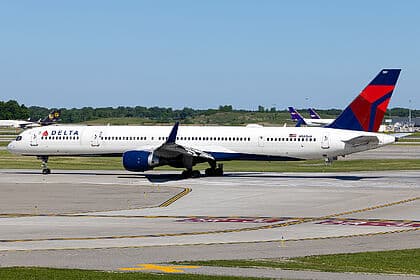
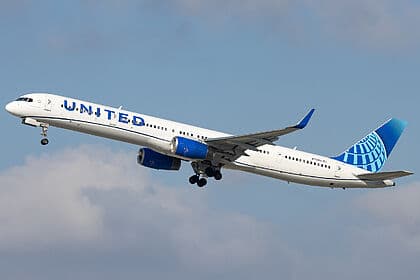
Delta Air Lines is the largest operator with sixteen ex-Northwest 757-300s, used on busy domestic routes such as Atlanta–Orlando, Salt Lake City–Honolulu and Minneapolis trunks, in a 234-seat layout with first class and Comfort+. United flies nine ex-Continental aircraft on similar high-density domestic and Hawaii routes, and Icelandair operates two between Keflavík and North America and Europe. Condor, the launch customer, retired its fleet in favour of A321s, as did Arkia. No other scheduled operators remain.
Flying on one
The 757-300 is a long cabin with the 757's narrow 3-3 seating and the 757's tall ride, and it feels like a very big single-aisle. Seats are about 17 inches wide, and because there are up to 40 rows, boarding through the front doors is slow; sit near a door if you have a connection. Delta's and United's layouts keep 31 inches of pitch in economy with a first-class cabin forward, and both have retrofitted modern interiors with power and bigger bins, so the experience is close to a 737-900 with more rows. The rear rows sit well behind the engines and are quieter than you might expect, but the aisle traffic in a 230-seat single-aisle is constant. For the best seat, pick a window in the first few rows of economy or an exit row; the rearmost rows back onto the galley and lavatories.
Variants
- 757-200 (B752) — The original, far more common 757
- 757-200PF / -200SF — Freighter versions of the -200
How to spot it
Length is everything: the 757-300 is a very long, slim tube on the 757's distinctive tall landing gear, and once you have seen the proportions you will not mistake it. Count the doors: three full-size doors per side plus overwing exits, where the 757-200 has two doors and overwing exits (or three doors in some layouts). The retractable tail skid is visible under the rear fuselage on the ground. Against an A321, the 757 sits far higher on its gear, has the pointed 757 nose with large cockpit windows, and its engines are mounted further forward with a visible gap below the wing.
Frequently asked
How many seats does a 757-300 have?
Up to 295 in a single-class charter layout; Delta and United fly it with 234 and 234 seats respectively in two or three classes. It is the highest-capacity single-aisle jet ever built.
Why did Boeing build so few 757-300s?
It arrived late in the 757's life, airlines found it hard to fill and slow to board, and Boeing ended all 757 production in 2004 as orders shifted to the 737-900 and A321. Only 55 were built.
Who still flies the 757-300?
Delta (16), United (9) and Icelandair (2) as of 2026. Condor, Northwest, Continental, ATA and Arkia were the other operators.
What replaced the 757-300?
Nothing directly. The A321neo is the closest in size but seats fewer and has less range in most configurations; airlines mostly moved to 787s and A321neos for the routes the -300 flew.
What aircraft is B753?
B753 is the ICAO type designator for the Boeing 757-300, a Boeing narrowbody that first flew in 1998. It is the code flight trackers and air traffic control use.
What is the wingspan of the Boeing 757-300?
The Boeing 757-300 has a wingspan of 38.05 m (125 ft) and is 54.43 m (179 ft) long.
What engines does the Boeing 757-300 have?
Two Rolls-Royce RB211-535E4 or Pratt & Whitney PW2043.
What is the MTOW and range of the Boeing 757-300?
Maximum take-off weight is 123,600 kg (272,489 lb) and maximum range is about 3,400 nautical miles (6,297 km) at a cruise of Mach 0.8.
How many passengers does the Boeing 757-300 carry?
Typically 243 passengers in a two-class layout; dense single-class layouts seat more and premium-heavy layouts fewer.
Compare with
Specs are approximate, compiled from public sources. See our editorial policy.