Cessna Citation Latitude (C68A)
Cessna · Business jet · In production
C68A is the ICAO aircraft type code for the Cessna Citation Latitude, a Cessna business jet that first flew in 2014 and entered service in 2015. It typically carries 8 people, cruises at Mach 0.76, and has a range of about 2,700 nautical miles (5,000 km).

Loading live positions…
In the wild
History
In 2011 Cessna's jet lineup had a gap. The Citation XLS+ sold for about $12.6 million and the larger Citation Sovereign for about $17.5 million, and nothing sat between them. At the NBAA convention in October 2011 Cessna filled that space with the Citation Latitude, announced at $14.9 million.
The design reused parts that already worked. The wing, the Pratt & Whitney Canada PW306D engines and the cruciform tail came from the Model 680 Sovereign. The new part was the fuselage: a round section wider than any earlier Citation, with a flat floor and six feet of cabin height. Because so much carried over, the FAA added the Latitude to the Sovereign's existing type certificate, T00012WI, as the Model 680A. That model number is where the ICAO designator C68A comes from.
The airplane had its most important customer before it flew. In 2012 NetJets announced an order for up to 425 business jets split between Bombardier and Cessna, and the Cessna share was 25 firm Latitudes with options on 125 more. The Latitudes were meant to anchor a new NetJets fleet program, with deliveries from 2016.
The prototype first flew at Wichita, Kansas, on February 18, 2014. Four test aircraft made 690 flights totaling 1,697 hours, and the FAA certified the type on June 5, 2015, with a Garmin G5000 flight deck and autothrottles. Customer deliveries began on August 27, 2015. NetJets put a demonstrator into service in January 2016, and deliveries to its fractional owners began in mid-2016.
Price helped as much as the cabin. In 2018 Aviation Week's Business & Commercial Aviation reported that Textron was discounting it by up to 20 percent, to about $13.5 million to $14 million. At that price it outsold Embraer's Legacy 450 about three to one, even though the Embraer had fly-by-wire controls, more range and a slightly faster cruise. The magazine called the Latitude a "bargain-priced super-midsize", although Textron sells it as a midsize jet.
Special-mission versions followed. In October 2017 Babcock Scandinavian Air Ambulance ordered the first medevac Latitude for Norway's air ambulance service, with a modified door for wide stretchers. Japan's Air Self-Defense Force took the first two of three flight-inspection Latitudes in April 2020. In 2022 Turkish Aerospace ordered two more, plus a Longitude, to check navigation aids for DHMI, Turkey's state airports authority.
In May 2024 Textron rolled the 400th production Latitude out of the Wichita factory. At the same time it announced a G5000 upgrade, due for Latitudes in 2025, adding a synthetic vision guidance system that supports approach minimums as low as 150 ft and a 3D view of the airport for taxiing. By then the Latitude's cabin had also become the starting point for a bigger airplane, the Citation Longitude, which kept the cross-section but changed nearly everything around it.
Specifications
- First flight
- 2014
- Entered service
- 2015
- Engines
- 2 × Pratt & Whitney Canada PW306D1
- Typical seating
- 8 seats
- Cruise speed
- Mach 0.76
- Range
- 2,700 nm
- MTOW
- 13,971 kg
- Length
- 18.97 m
- Wingspan
- 22.05 m
- Status
- In production
Design notes
The Latitude has borrowed flying surfaces, a new pressure vessel and a modern flight deck.
The wing is the Sovereign's: 543 sq ft, with 16.3 degrees of sweep and no winglets, spanning 72 ft 4 in, which is longer than the 62 ft 3 in fuselage. The payoff is airfield performance rather than speed: Textron quotes a 3,580 ft takeoff field length at maximum weight and a 2,480 ft landing distance, and BCA praised its performance at hot, high airports. Two FADEC-controlled PW306D1 turbofans of 5,907 lb thrust each hang on the rear fuselage. The horizontal tail sits partway up the fin, the cruciform layout Cessna also used on the Sovereign and the Excel.
Most of the new engineering went into the fuselage. It is a circle 83.25 in across, giving a cabin 72 in high and 77 in wide over a flat floor, so the aisle is not sunk below the seats. The 31 in entry door opens and closes electrically at the push of a button. The pressurization system holds a 5,950 ft cabin altitude at the 45,000 ft ceiling.
Up front, the Garmin G5000 suite uses three 14 in landscape displays, with fully integrated autothrottles as standard. Textron lists RNP AR approaches down to 0.3 nm and ADS-B In and Out as standard, with CPDLC datalink and Category II approaches as options. Most operators cruise between Mach 0.72 and 0.76. Maximum cruise is 446 knots true airspeed, and the airplane climbs to 37,000 ft in about 16 minutes.
Notable facts
- Certified by the FAA on June 5, 2015 as the Model 680A, an amendment to the Citation Sovereign's type certificate rather than a new one.
- Its round fuselage was the widest Cessna had put on any Citation when it was certified, with a flat floor and 6 ft (1.83 m) of cabin height.
- NetJets signed for 25 firm and 125 optional Latitudes in 2012, well before the prototype's first flight in February 2014.
- Japan's Air Self-Defense Force uses Latitudes fitted with UNIFIS 3000 equipment to check navigation aids, flown by the Flight Checker Squadron at Iruma Air Base.
- Textron rolled the 400th production Latitude out of its Wichita factory in May 2024.
Who flies it
NetJets defines the Latitude. In the United States its aircraft carry registrations ending in "QS", and NetJets Europe flies them on the Portuguese register with CS-L prefixes. A fractional jet works hard: BCA reported in 2018 that NetJets flew each Latitude more than 1,000 hours a year, while medium-size companies typically flew theirs 200 to 300.
Company flight departments are the other big group of users, and charter operators such as Air Charter Scotland offer Latitudes for hire. Governments use the type for technical work. Japan's Air Self-Defense Force ordered three Latitudes for checking navigation aids, Turkey's DHMI ordered two for the same job, and Babcock ordered the first medevac version for Norway's national air ambulance service. In the United States, the FAA registry lists Latitudes belonging to the State of Texas and the Florida Department of Law Enforcement.
Flying on one
The cabin cross-section is the Latitude's selling point. It is 6 ft high and 6 ft 5 in wide over a flat floor, so most adults can walk from the door to the lavatory upright, without stepping down into a sunken aisle. Embraer's Praetor 500 is about five inches wider at the same height. The Challenger 3500 is wider again at 7 ft 2 in, but it belongs to the larger super-midsize class.
The cabin is 21 ft 9 in long. That is enough for a club of four facing chairs plus a few more seats; Textron's standard seating takes up to nine passengers, and NetJets is reported to fit seven. A common layout puts a refreshment center at the front and the lavatory at the back, with a belted seat in the lavatory compartment. Textron quotes 127 cu ft of baggage space, up to 1,245 lb, of which an easily reached external compartment takes 100 cu ft and 1,000 lb. Cabin altitude stays at 5,950 ft even at 45,000 ft.
According to BCA's 2018 survey, the Latitude's users are mostly medium-size companies and large fleet operators led by NetJets, so passengers usually reach one through a fractional share, a card program, a charter booking or an employer's flight department. Typical missions run 2 to 2.7 hours. The airplane can stay up much longer, with a range of 2,700 nm at high-speed cruise carrying four passengers.
Variants
- Citation Latitude (680A) — Executive model in production since 2015; Garmin G5000 with autothrottles, PW306D1 engines and the Sovereign's wing
- Special-mission Latitude — Factory-modified aircraft for navaid flight inspection (Japan, Turkey) and medevac, the latter with a door widened for stretchers
How to spot it
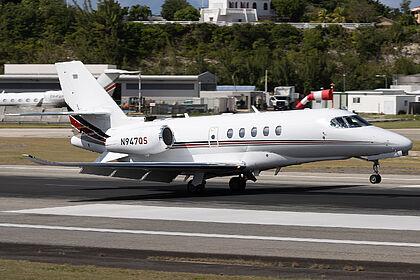
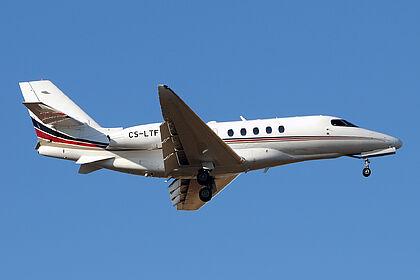
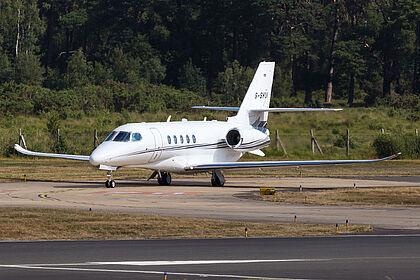
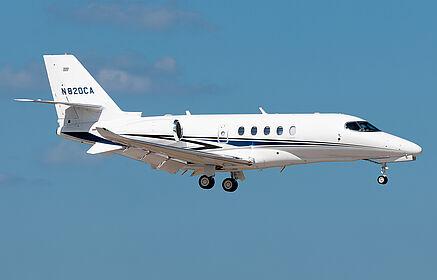
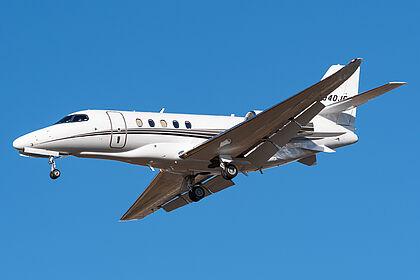
Look at the tail first. The Latitude's horizontal stabilizer sits partway up the fin in a cruciform layout, and the wing has a gentle sweep with plain tips and no winglets. The body is deep and round, which makes the airplane look short and stocky next to older Citations.
Two look-alikes cause most of the confusion. The Citation Excel and XLS have the same style of tail but a straight, unswept wing and a slimmer fuselage. The Citation Longitude has the Latitude's fuselage cross-section but carries its stabilizer on top of the fin as a T-tail, has a more sharply swept wing with winglets, and is about 11 ft longer. One oddity helps on the ramp: the smaller Latitude's 72 ft 4 in wingspan is more than 3 ft wider than the Longitude's. On flight trackers, NetJets aircraft show registrations ending in QS.
Frequently asked
Is the Citation Latitude a midsize or super-midsize jet?
Textron markets it as a midsize jet with a 6 ft stand-up cabin. Its flat-floor cabin and 2,700 nm range overlap the super-midsize class, and Aviation Week's Business & Commercial Aviation called it a "bargain-priced super-midsize" in 2018. Its 21 ft 9 in cabin is shorter than true super-midsize rivals such as the Challenger 3500, which measures 25 ft 2 in.
Why does the Citation Latitude show as C68A?
Cessna certified the Latitude as a derivative of the Model 680 Citation Sovereign, whose wing, engines and tail it reuses, so the FAA added it to the Sovereign's type certificate as the Model 680A. The ICAO designator C68A follows that model number, which is why flight trackers show C68A. The Sovereign itself appears as C680.
How far can a Citation Latitude fly nonstop?
Textron quotes 2,700 nm with four passengers at high-speed cruise, and the 2015 certification announcement gave 2,850 nm at long-range cruise. That covers the roughly 2,130 nm great-circle distance from Teterboro, New Jersey, to Van Nuys, California, with room to spare. It falls short of New York to London, about 2,990 nm. Winds, payload and fuel reserves set the real limit on any given day.
Can you stand up in a Citation Latitude?
Yes, most adults can. The cabin is 6 ft (1.83 m) high and 6 ft 5 in wide, and the floor is flat all the way along, so there is no sunken aisle. Anyone over about six feet will still need to dip their head.
What is the difference between the Citation Latitude and the Longitude?
They share a fuselage cross-section but are different airplanes. The Latitude has the Sovereign's wing, PW306D1 engines, a cruciform tail and 2,700 nm of range. The Longitude is about 11 ft longer and has its own swept wing with winglets, Honeywell HTF7700L engines, a T-tail and 3,500 nm of range. It also has its own type certificate, as the Model 700.
How much does a Citation Latitude cost?
Cessna announced the Latitude at $14.9 million in 2011. Business & Commercial Aviation's 2023 Purchase Planning Handbook listed a typically equipped price of about $19.8 million. BCA reported in 2018 that Textron was discounting the Latitude by up to 20 percent to win sales, so actual transaction prices have often been below list.
What aircraft is C68A?
C68A is the ICAO type designator for the Cessna Citation Latitude, a Cessna business jet that first flew in 2014. It is the code flight trackers and air traffic control use.
What is the wingspan of the Cessna Citation Latitude?
The Cessna Citation Latitude has a wingspan of 22.05 m (72 ft) and is 18.97 m (62 ft) long.
What engines does the Cessna Citation Latitude have?
Two Pratt & Whitney Canada PW306D1.
What is the MTOW and range of the Cessna Citation Latitude?
Maximum takeoff weight is 13,971 kg (30,800 lb) and maximum range is about 2,700 nautical miles (5,000 km) at a cruise of Mach 0.76.
How many passengers does the Cessna Citation Latitude carry?
Typically 8 people including the pilot.
Compare with
Specs are approximate, compiled from public sources. See our editorial policy.