Piper PA-28 Cherokee/Archer
P28APiper · Piston single · In production
In the wild
History
The Piper PA-28 family, known through its early years as the Cherokee, was Piper's answer to a simple commercial problem. In the 1950s Piper's mainstay light aircraft, the fabric-covered, high-wing Tri-Pacer, was looking dated beside newer all-metal designs. The company set out to create a modern, low-wing, all-metal single that would be cheap to build and easy to fly, and the PA-28 was the result. It first flew in 1960 and entered production in 1961.
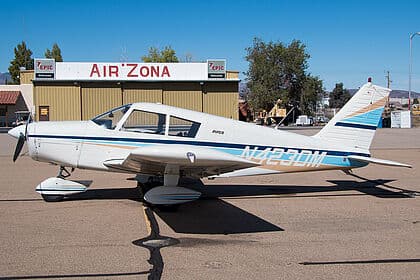
The design was deliberately economical to manufacture. Early Cherokees used a broad, constant-chord wing, later nicknamed the Hershey bar wing for its rectangular, slab-like shape, which was simple and cheap to build even if it was not the most aerodynamically refined. The aircraft was offered with a range of engines and model names, from the 140 and 150-horsepower Cherokee 140 trainers up to more powerful 180-horsepower touring versions, all sharing a common airframe.
Over time the family expanded and evolved. In the 1970s Piper introduced a new, tapered wing that improved handling and efficiency, and rebranded the models: the trainer became the Warrior, the 180-horsepower tourer became the Archer, and higher-powered and retractable-gear versions took names such as Dakota and Arrow. The retractable-gear Arrow, in particular, became a widely used complex trainer, introducing retractable landing gear and a constant-speed propeller within a familiar airframe, and it is often flown by students building experience toward a commercial licence, though it carries its own distinct ICAO code rather than P28A. The single ICAO code P28A is commonly used for many of these fixed-gear four-seaters, which is why the designation covers such a broad span of aircraft.
Commercially the PA-28 was a major success and became one of the most-produced families of light aircraft, built in the tens of thousands. Alongside the Cessna 172, it became one of the two aircraft on which a very large share of the world's pilots learned to fly, and the rivalry between high-wing Cessna and low-wing Piper is a familiar theme in general aviation.
As of 2026 the line continues, though at a much reduced rate: Piper still builds the PA-28-181 Archer, chiefly for flight-training fleets and airline-pathway academies that value a modern, well-supported low-wing trainer. Production is best described as low-rate and dedicated rather than the high-volume manufacturing of the type's heyday. For enthusiasts the Cherokee and Archer endure as the archetypal low-wing trainer, the aircraft that gave Cessna's high-wing singles their most persistent competition and that remains a fixture of flying schools worldwide.
Specifications
- First flight
- 1960
- Entered service
- 1961
- Engines
- 1 × Lycoming O-360 (180 hp)
- Typical seating
- 4 seats
- Cruise speed
- Mach 0.19
- Range
- 520 nm
- MTOW
- 1,157 kg
- Length
- 7.32 m
- Wingspan
- 10.8 m
- Status
- In production
Design notes
The defining feature of the PA-28 is its low wing, mounted beneath the fuselage, which distinguishes it at a glance from the high-wing Cessnas it competes with. The wing places the main spar under the cabin floor and gives the aircraft a low, planted stance on its fixed tricycle undercarriage. The whole structure is conventional all-metal, mostly aluminium, chosen to be cheap and durable.
Two wing shapes define the family's history. Early Cherokees used a constant-chord Hershey bar wing, a plain rectangular plan that was simple to build; from the 1970s Piper adopted a tapered wing that improved low-speed handling and cruise efficiency, and this is fitted to the Warrior and Archer.
Inside, the PA-28 has a single cabin door, on the right-hand side, unlike the Cessna's two doors, so occupants climb onto the wing to board. The cabin seats four. Power on the common P28A models is a four- or six-cylinder Lycoming engine of 150 to 180 horsepower, driving a fixed-pitch propeller on the fixed-gear versions.
The overall character is stable and forgiving, much like its Cessna rival, which is why the type has endured as a trainer. Its low wing gives a clearer view upward and into turns, at the cost of the downward visibility a high wing provides.
Notable facts
- A low-wing, all-metal, fixed-gear single that is the classic low-wing counterpart to the high-wing Cessna 172.
- The ICAO code P28A covers a large family: Cherokee 140/160/180, Warrior, Archer and others.
- Early models used a constant-chord 'Hershey bar' wing; later Warriors and Archers adopted a tapered wing.
- Among the most-produced low-wing training and touring singles, with tens of thousands built since 1961.
- Has a single cabin door on the right side, unlike the Cessna's two doors.
Who flies it
As of 2026 the Piper PA-28, especially the Archer and Warrior, is above all a training aircraft. Flight schools, university programmes and airline cadet academies operate large fleets of them, prizing a modern low-wing trainer that is well supported and simple to maintain. Many students take their first lessons in a Cherokee or Archer just as others do in a Cessna 172.
Beyond training, large numbers of older Cherokees are owned privately for personal and family flying, and many are held within flying clubs and partnerships that spread the cost of ownership. The family's spread of models, from economical 140-horsepower trainers to more powerful tourers, means a PA-28 suits everything from local circuit flying to modest cross-country trips. They are a common sight at general-aviation airfields worldwide, frequently parked wingtip to wingtip with the Cessnas they have competed against for decades.
Flying on one
A Piper PA-28 — the Cherokee family, including the Warrior and Archer — is one of the most common ways people take their first small-aircraft flight, usually as a student or a passenger on an introductory hop. The first thing to know is boarding: unlike a Cessna, the PA-28 has a single door on the right side, over the wing, so passengers climb up onto the wing walk and step down into the cabin, and the person in the right seat gets in first. It is a low-wing design, which trades the Cessna's downward view for a better outlook upward and to the sides. Four seats are fitted, but like most trainers it is happiest with two adults and light bags. You will wear a headset against the engine noise, stow luggage in a small aft compartment, and feel the bumps of low-level air. For the best experience, take a front seat; the aircraft is stable, docile and an easy, honest introduction to light flying.
Variants
- Cherokee 140/160/180 — Original 1960s constant-chord-wing models
- PA-28-161 Warrior — Tapered-wing trainer, 160 hp
- PA-28-181 Archer — 180 hp; the current production model
- PA-28-236 Dakota — 235 hp higher-performance variant
- PA-28R Arrow — Retractable-gear complex-trainer (distinct ICAO code)
How to spot it
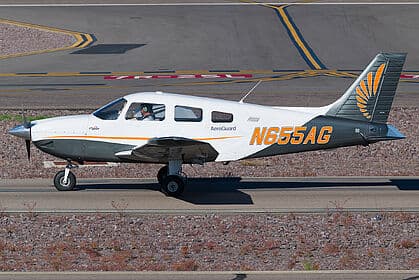
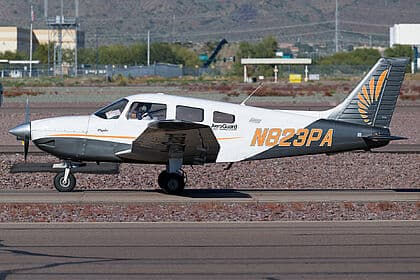
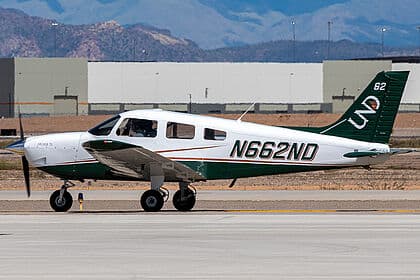
The quickest way to identify a PA-28 is its low wing: unlike the high-wing Cessna 172, the Cherokee and Archer carry the wing beneath the fuselage, so the aircraft sits low and you look down onto the wing from beside it. It has fixed tricycle gear, a single door on the right side, and a fixed-pitch propeller on the common fixed-gear models.
Distinguishing it from other low-wing singles takes more care. Against the Cirrus SR22, the Piper is plainly metal, with a squarer, more slab-sided look, and lacks the Cirrus's sculpted composite curves and parachute housing. Against a Diamond, the Piper looks heavier and more conventional, without the Diamond's long, slender wings and bubble canopy. An early Cherokee's rectangular Hershey bar wing, versus the tapered wing of a Warrior or Archer, helps pin down the exact model.
Frequently asked
Cessna 172 versus Piper Cherokee - which is better to learn on?
Both are classic four-seat trainers with similar performance, and neither is clearly better; the choice usually depends on what your local flight school flies. The main difference is wing position: the high-wing 172 gives better downward visibility and shade and has two doors, while the low-wing Cherokee offers a clearer view in turns and a single door. Most instructors say the quality of teaching matters far more than the aircraft. Many pilots learn on one and later fly both without trouble.
What is the difference between a Cherokee, a Warrior and an Archer?
They are all members of the same PA-28 family and share a common fuselage. Cherokee was the original name covering a range of engines, and early ones had a rectangular Hershey bar wing. The Warrior and Archer are later, tapered-wing versions: the Warrior is the lower-powered trainer, and the Archer has a 180-horsepower engine for better touring performance.
Is the Piper Archer still in production?
Yes, but in small numbers. As of 2026 Piper still builds the PA-28-181 Archer, mainly for flight-training fleets and airline-pathway academies rather than for the wider private market. Production is best described as low-rate and specialised, a shadow of the tens of thousands turned out during the type's 1960s and 1970s heyday.
Why does the Piper Cherokee have only one door?
It is a design and cost decision. The single cabin door, on the right-hand side, simplifies the structure of the low wing and fuselage, so occupants step up onto the wing and in through that one door. It does mean that boarding and, in an emergency, evacuation are less convenient than in the two-door Cessna 172. Pilots simply learn to work around it.
How fast and how far can a Piper Archer go?
A typical Archer cruises at around 125 to 130 knots, roughly 145 miles per hour, which is comparable to a Cessna 172. Its range depends on fuel and power setting but is generally in the region of 500 to 700 nautical miles. Like the 172, it is designed for training and shorter trips rather than fast long-distance travel.
Compare with
Specs are approximate, compiled from public sources. See our editorial policy.