McDonnell Douglas MD-11
MD11McDonnell Douglas · Widebody · Production ended
In the wild
History
The McDonnell Douglas MD-11 is a three-engine widebody developed from the DC-10 of the 1970s. After studying various DC-10 derivatives, McDonnell Douglas launched the MD-11 in 1986 as a modernised, stretched successor aimed at long-haul routes. It retained the DC-10's basic configuration, with two engines under the wing and a third mounted at the base of the vertical fin, but added a longer fuselage, a new wing with winglets, a smaller horizontal tail with a fuel tank for trim, and a two-crew glass cockpit that removed the flight engineer.
The MD-11 first flew in January 1990 and entered service in December 1990 with Finnair. It was offered in passenger, combi, and freighter forms, powered by either the General Electric CF6-80C2 or the Pratt and Whitney PW4000. Typical passenger layouts seated roughly 290 in three classes, with a maximum in the low 400s. A combi version could carry passengers and containerised freight on the same main deck.
Early aircraft, however, fell short of the range and fuel-burn figures McDonnell Douglas had promised, an issue widely attributed to higher-than-expected aerodynamic drag. The company ran a performance improvement programme that eventually brought the aircraft close to its targets, but the early reputation hurt sales, and some launch customers reduced orders. Coming to market just as highly efficient twin-engine widebodies such as the 777 and A330 arrived, the trijet struggled to compete on operating cost. The MD-11 also gained a reputation among pilots as demanding to land, a trait often linked to its smaller tail and relatively high approach speeds; several landing accidents drew attention to this, though it remained in service for decades.
Only about 200 MD-11s were built. McDonnell Douglas merged with Boeing in 1997, and Boeing ended MD-11 production around 2000, with the final example delivered in early 2001. Passenger operators, including Swissair, Delta, American, Alitalia, and VARIG, phased the type out relatively quickly; KLM flew the last scheduled passenger MD-11 service in 2014.
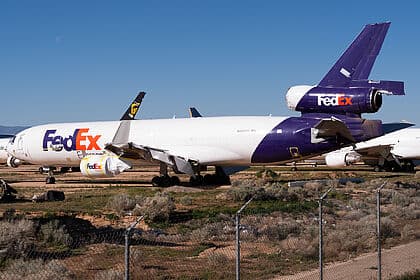
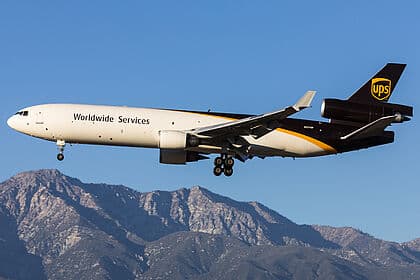
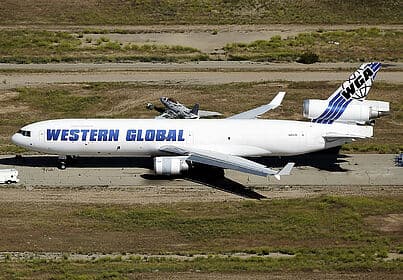
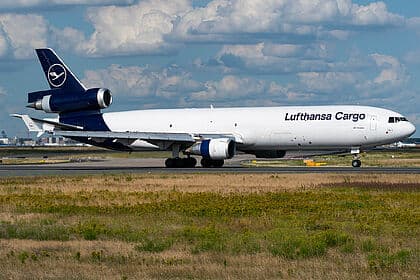
The aircraft found a durable second life as a freighter. Its capacity and range suited cargo operators, and many passenger MD-11s were converted alongside factory-built MD-11Fs. FedEx and UPS became the largest operators, with others including Lufthansa Cargo and Western Global. Through the 2010s the MD-11 was a common sight at cargo hubs, but the fleet has been shrinking during the 2020s as operators retire it in favour of more efficient twins such as the 767 and 777 freighters. The MD-11 was the last all-new trijet airliner and the final widebody to carry the McDonnell Douglas name.
Specifications
- First flight
- 1990
- Entered service
- 1990
- Engines
- 3 × General Electric CF6-80C2 or Pratt & Whitney PW4000
- Typical seating
- 293 (2-class)
- Cruise speed
- Mach 0.82
- Range
- 6,840 nm
- MTOW
- 285,990 kg
- Length
- 61.62 m
- Wingspan
- 51.66 m
- Status
- Production ended
Design notes
The MD-11 is most easily understood as a modernised DC-10. It keeps the trijet layout, with two underwing engines and a third fed through the base of the vertical fin in a straight-through installation, the tail engine exhausting from the very back of the fuselage. Compared with the DC-10 it is about five metres longer and adds winglets, which are among its clearest external identifiers.
The wing was refined for cruise efficiency and fitted with those winglets, while the horizontal stabiliser was made smaller and given an internal fuel tank used to shift the aircraft's centre of gravity in cruise, reducing trim drag. This relaxed-stability approach improved efficiency but is often cited as a reason the aircraft was considered demanding to fly precisely, particularly in the landing flare.
The flight deck was fully updated to a two-crew electronic cockpit, removing the DC-10's third crew member. Power came from two engine choices, the General Electric CF6-80C2 or the Pratt and Whitney PW4000, in roughly the 60,000 lbf class. The cabin retained the DC-10's wide, twin-aisle cross-section, seating eight to nine abreast. The freighter version uses a large forward main-deck cargo door and a strengthened floor. Overall the MD-11 blended familiar 1970s widebody architecture with 1990s aerodynamics, systems, and avionics.
Notable facts
- A stretched, modernized derivative of the DC-10 with winglets and a two-crew glass cockpit.
- One of the last trijet widebodies; the third engine sits in the tail.
- Early range and payload shortfalls versus advertised figures hurt passenger sales.
- Found a long second life as a freighter with operators such as FedEx and UPS.
Who flies it
The MD-11 has effectively disappeared from passenger service and now flies almost entirely as a freighter. In its passenger heyday it was operated by long-haul carriers such as Swissair, Delta Air Lines, American Airlines, Alitalia, VARIG, China Eastern, and KLM, the last of which operated the final scheduled passenger flights in 2014. Today the surviving fleet is overwhelmingly cargo. FedEx Express and UPS Airlines have been the dominant operators, flying both factory-built MD-11F freighters and converted former airliners on long-haul cargo routes, with additional aircraft at carriers such as Lufthansa Cargo and Western Global Airlines. The trijet's numbers have declined steadily during the 2020s as these operators retire it in favour of more economical twin-engine freighters. Where it still flies, it carries heavy, long-range main-deck cargo rather than passengers.
Flying on one
Flying on an MD-11 as a fare-paying passenger is now a rare, largely historical experience — the type long ago migrated to cargo work, and only a tiny number ever remained on passenger duties. When it did carry passengers, economy was typically a nine-abreast 2-5-2 cabin, and the row of five in the centre was about as far from a window and an aisle as air travel gets. As a trijet with an engine buried in the tail, the rear cabin was noticeably louder than the front. The flip side was character: the sharp cockpit-forward lines, the distinctive engine whine, and a genuinely spacious feel up front. Cabin pressurisation and humidity were of their 1990s era. Any passenger MD-11 you find today will be with a niche operator or a special charter, so treat a flight on one as a treat for enthusiasts rather than a mainstream option. For the best seat, sit as far forward as the cabin allows to escape the tail-engine noise.
Variants
- MD-11F — Freighter — its most enduring role
How to spot it
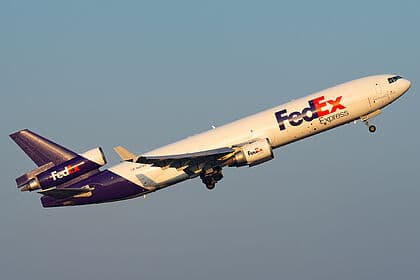
The MD-11 is a large trijet: two engines under the wings and a third at the tail. The key to identifying the tail engine is its installation. On the MD-11, as on its DC-10 ancestor, the centre engine passes straight through the base of the fin, so its intake sits high at the fin root and it exhausts from the tailcone. This distinguishes it from the Lockheed L-1011 TriStar, whose centre engine is buried in the rear fuselage with an S-duct and an intake on top. To separate an MD-11 from a DC-10, look for winglets, which the MD-11 has and the DC-10 does not, and for the MD-11's longer fuselage and smaller tailplane. Today most examples wear cargo-airline colours.
Frequently asked
How do you tell an MD-11 from a DC-10?
They share the same basic trijet shape, so the surest cues are the winglets and the length: the MD-11 has winglets at the wingtips and a longer fuselage, while the DC-10 has plain wingtips and is shorter. The MD-11 also has a smaller horizontal tail. From the front the two are easy to confuse; from the side or a three-quarter view the winglets settle it.
How do you tell an MD-11 from a Lockheed L-1011 TriStar?
Both are widebody trijets, but their tail engines are installed differently. The MD-11's centre engine runs straight through the base of the fin, with a high intake at the fin root, whereas the L-1011's is buried inside the rear fuselage with an S-shaped duct and an intake on top of the body. The MD-11 also has winglets; the TriStar does not.
Why did the MD-11 sell relatively poorly?
Early aircraft failed to meet the range and fuel-burn figures McDonnell Douglas had guaranteed, widely attributed to excess drag, which damaged the type's reputation even after a performance improvement programme largely fixed it. It also arrived just as efficient twin-engine widebodies like the 777 and A330 were entering the market. Only about 200 were built before production ended around 2000.
Why is the MD-11 now mostly a freighter?
Its capacity and long range made it attractive to cargo operators even after it became uncompetitive for passengers, so many airframes were converted to freighters alongside factory-built MD-11Fs. FedEx and UPS in particular built large MD-11 cargo fleets. As a result the type long outlived its passenger career, though those fleets are now being retired.
Is the MD-11 hard to fly?
It gained a reputation as demanding, especially in the landing flare, a trait often linked to its smaller horizontal tail and relaxed longitudinal stability, which were adopted to save fuel. Several landing accidents drew attention to this characteristic. Even so, it operated safely for decades in the hands of trained crews.
Compare with
Specs are approximate, compiled from public sources. See our editorial policy.