Airbus A350-1000
A35KAirbus · Widebody · In production
In the wild
History
The Airbus A350-1000 is the largest member of the A350 XWB family, conceived from the start as the stretched, higher-capacity partner to the A350-900. When Airbus formally launched the A350 programme in December 2006, the family was planned around three sizes; the -1000 was positioned at the top, aimed squarely at the Boeing 777-300ER and, later, the 777-9. Its development lagged the -900 by several years while Airbus refined the design, at one point increasing the planned thrust and strengthening the structure in response to airline demands for more range and payload.
The -1000 differs from the -900 by more than a fuselage plug. It is roughly seven metres longer, seating around 350 to 410 passengers depending on layout, and is powered by a more powerful version of the Rolls-Royce Trent XWB, the -97 rated near 97,000 pounds of thrust. To carry the higher weights, Airbus fitted a six-wheel main landing gear in place of the -900's four-wheel bogies, and made detailed changes to the wing trailing edge. The aircraft first flew on 24 November 2016 and entered service with launch customer Qatar Airways in February 2018.
In service the -1000 has been taken up by carriers looking for a large, efficient twin to replace 777-300ERs and older four-engine aircraft. Cathay Pacific, British Airways, Virgin Atlantic, Etihad, Japan Airlines and others operate it on dense long-haul trunk routes. Because it shares a common type rating and most systems with the -900, airlines already flying the smaller model can add it with minimal additional crew training.
The most prominent future development is the A350-1000ULR, an ultra-long-range version selected by Qantas for its Project Sunrise plan of nonstop flights from Australia's east coast to London and New York. That aircraft carries additional fuel and a low-density, premium-heavy cabin. The first example made its first flight in mid-2026 and was rolled out in Qantas livery, with entry into service planned for 2027; the timeline has moved more than once, in part because of the effort to certify the enlarged fuel system.
Commercially the -1000 sells in smaller numbers than the -900, as is typical for the largest member of a widebody family, but it has secured a solid order book. It is generally regarded as the more capable competitor to Boeing's ageing 777-300ER while the 777-9 works through its own delayed certification. For enthusiasts, the -1000 is notable as the aircraft that pushed the A350 family into the very-large-twin category once dominated by the 777, and as the platform chosen to attempt some of the longest nonstop flights ever scheduled.
Specifications
- First flight
- 2016
- Entered service
- 2018
- Engines
- 2 × Rolls-Royce Trent XWB-97
- Typical seating
- 366 (2-class)
- Cruise speed
- Mach 0.85
- Range
- 8,700 nm
- MTOW
- 319,000 kg
- Length
- 73.79 m
- Wingspan
- 64.75 m
- Status
- In production
Design notes
The A350-1000 shares its airframe philosophy and cockpit with the -900, including the curved dark surround around the flight-deck windows and the composite fuselage and wing. The wing is the same span as the -900's, just under 65 metres, but the trailing edge was modified, and the aircraft carries a higher maximum take-off weight, near 319 tonnes.
The clearest structural distinction is the landing gear. Where the -900 rides on four-wheel main bogies, the -1000 uses six-wheel bogies to spread its greater weight, a change that also affects runway and taxiway loading. The stretch adds roughly seven metres of length and a fourth pair of passenger doors, giving the -1000 a visibly longer, more slender look on the ground.
Power is the Rolls-Royce Trent XWB-97, a higher-thrust variant of the -900's Trent XWB-84, with a larger fan and revised core to deliver around 97,000 pounds of thrust. The cabin retains the family's wide cross-section and supports nine- or ten-abreast economy. Flight controls are fly-by-wire with sidesticks, and the type rating is common with the A350-900 and closely related to the A330, so the -1000 slots into an existing Airbus widebody pilot pool with little friction. These shared systems are a large part of the -1000's appeal to carriers already operating the smaller variant.
Notable facts
- Stretched, higher-capacity development of the A350-900.
- Uses the more powerful Trent XWB-97 and a six-wheel main landing gear.
- Entered service with Qatar Airways in February 2018.
- Positioned against the Boeing 777-300ER and 777-9.
- An ultra-long-range version was selected by Qantas for its Project Sunrise nonstops.
Who flies it
The A350-1000 is flown by large network carriers that need a very big twin for dense long-haul markets. Qatar Airways, the launch operator, has one of the largest fleets, alongside Cathay Pacific, British Airways, Virgin Atlantic, Etihad, Japan Airlines, Air Caraibes and French bee, among others. Typical duties are high-demand intercontinental trunk routes, often replacing Boeing 777-300ERs or four-engine A380s and A340s.
The type generally operates from major intercontinental hubs rather than secondary airports, given its size. British Airways and Virgin Atlantic use it heavily on transatlantic and long-haul leisure routes from London; Cathay Pacific and Japan Airlines deploy it across the Asia-Pacific and to North America and Europe. Once Qantas introduces its ultra-long-range examples, the -1000 is set to fly some of the longest nonstop passenger services in the world.
Flying on one
As a passenger the A350-1000 feels almost identical to the smaller -900: the same wide composite cabin, the same low cabin altitude and higher humidity that take the edge off jet lag, and the same quiet, calm environment. It is simply longer, so there are more rows and a longer walk to the rear. Most operators fly it nine-abreast in economy at roughly eighteen inches a seat, though some choose a tighter ten-abreast, and premium cabins are often where airlines spend their money on this flagship. Overhead bins are generous and handle carry-ons easily. Because the -1000 tends to fly an airline's longest, most premium routes, the onboard product is frequently a carrier's best. For economy, a window seat mid-cabin keeps you away from galley traffic while giving the wide seat and a view; the very back rows near the aft galleys are the ones to avoid if you want to sleep.
Variants
- A350-1000 (Project Sunrise) — Ultra-long-range version ordered by Qantas for nonstop Sydney–London/New York
How to spot it
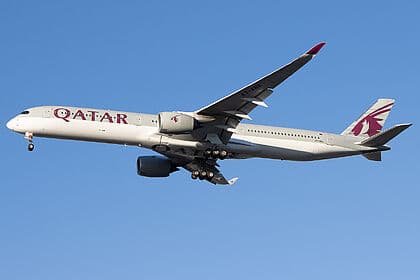
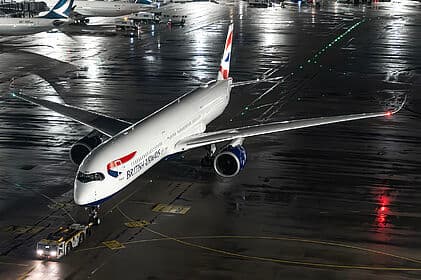
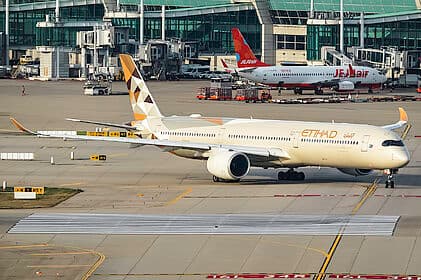
The A350-1000 shares the A350 family's giveaways: the curved dark mask around the cockpit windows, a pointed nose, and smoothly upswept, curved composite wingtips. To confirm it is the larger -1000 rather than the -900, look at the main landing gear, which has six wheels on each side rather than four. The -1000 is also noticeably longer and carries four pairs of passenger doors, versus three on the -900.
Against the Boeing 777-300ER, its closest rival in size, the A350 shows its cockpit mask and blended, curving wingtips, whereas the 777 has no mask, a raked wingtip with no upward curve, and much larger engine nacelles housing the General Electric GE90. Both types use six-wheel main bogies, so rely on the cockpit and nacelle differences rather than the gear.
Frequently asked
How do you tell an A350-1000 from an A350-900?
Both share the A350's cockpit mask and curved wingtips, so size is the tell. The -1000 is about seven metres longer, with four pairs of passenger doors instead of three. The most definitive check is the main landing gear: the -1000 rolls on six-wheel bogies, the -900 on four-wheel bogies.
How is the A350-1000 different from the Boeing 777-300ER?
The two are close in size and role, but the A350 is the newer, mostly composite design with a curved cockpit surround, blended upswept wingtips and the Rolls-Royce Trent XWB. The 777-300ER is largely metal, has no cockpit mask, uses much larger General Electric GE90 engines, and ends its wing in a raked tip without an upward curve. The A350-1000 generally burns less fuel per seat, which is why several carriers are replacing 777-300ERs with it.
What is Project Sunrise and how does the A350-1000 fit in?
Project Sunrise is Qantas's plan to fly nonstop from Sydney and Melbourne to destinations such as London and New York. For it, Qantas selected an ultra-long-range A350-1000, the A350-1000ULR, fitted with extra fuel capacity and a low-density cabin. The first aircraft flew in 2026 and was shown in Qantas colours, with services planned to begin in 2027 after the enlarged fuel system is certified.
Why does the A350-1000 have six-wheel landing gear?
The stretch and higher maximum take-off weight, near 319 tonnes, require the load to be spread over more wheels to keep runway and pavement stresses within limits. Airbus therefore fitted six-wheel main bogies in place of the four-wheel units used on the lighter A350-900. It is one of the easiest ways to distinguish the two variants on the ground.
Does the A350-1000 use the same pilots and engines as the A350-900?
Yes to both, in effect. The -1000 uses a higher-thrust version of the same Rolls-Royce Trent XWB, the -97 rather than the -84, and shares a common pilot type rating with the -900. Airlines operating both variants can therefore use a single pool of crews and much common maintenance knowledge.
In-depth comparisons
Compare with
Specs are approximate, compiled from public sources. See our editorial policy.