Cessna 182 Skylane
C182Cessna · Piston single · In production
In the wild
History
The Cessna 182 Skylane appeared in 1956, a year after the 172 and closely related to it. Cessna's idea was straightforward: take the successful high-wing, tricycle-gear formula of the 172 and give it more power, more weight-carrying ability and better cruise performance, creating a step-up aircraft for owners who wanted to travel with a full cabin and baggage. The 182 was essentially a heavier, more capable stablemate rather than an all-new design.
Where the 172 used a modest four-cylinder engine and a fixed-pitch propeller, the 182 was built around a larger six-cylinder engine of around 230 horsepower turning a constant-speed propeller. That combination gave it noticeably faster cruise, a stronger climb and the ability to lift four adults with fuel and bags, something the 172 struggles to do. The trade-off was greater complexity and cost, and an aircraft that demanded a little more of its pilot, particularly in managing the nose-heavy handling on landing.
Like the 172, the Skylane was refined steadily over the decades. Cessna offered a turbocharged version for better high-altitude performance and, in the late 1970s, a retractable-gear model, the R182 Skylane RG, that traded simplicity for extra speed. The company also briefly offered a diesel-powered Skylane burning jet fuel rather than avgas, reflecting a wider industry search for alternatives to an increasingly scarce and costly fuel, though it was built only in limited numbers and later withdrawn. Production was halted in the mid-1980s amid the same product-liability crisis that stopped the 172, and resumed in the late 1990s with updated models.
As of 2026 the 182 remains in production as the 182T Skylane, fitted with fuel injection and modern Garmin avionics, and it is frequently described as one of the more successful and long-lived personal aircraft ever built. Over the decades Cessna has delivered many thousands of all versions, making it one of the best-selling Cessna singles after the 172 itself.
The Skylane's enduring appeal lies in its balance. It is fast enough and roomy enough to be a genuine cross-country touring aircraft, yet it retains much of the docile, forgiving character of the 172, so pilots stepping up from a basic trainer generally adapt to it quickly. It is also valued as a capable load-hauler for its size, popular with owners who routinely fly with a full cabin. For enthusiasts the 182 sits in a familiar but important niche: the sensible, do-everything family single that many pilots aspire to own once they have outgrown a trainer.
Specifications
- First flight
- 1955
- Entered service
- 1956
- Engines
- 1 × Lycoming IO-540 (230 hp)
- Typical seating
- 4 seats
- Cruise speed
- Mach 0.22
- Range
- 930 nm
- MTOW
- 1,406 kg
- Length
- 8.84 m
- Wingspan
- 11 m
- Status
- In production
Design notes
The Cessna 182 shares its basic architecture with the 172, a strut-braced high wing, fixed tricycle gear and an all-metal, mostly aluminium structure, but it is scaled up for more performance. The most important difference is under the cowling: a six-cylinder engine of around 230 horsepower in place of the 172's four-cylinder unit, driving a constant-speed propeller rather than a fixed-pitch one.
That constant-speed propeller is a defining feature. It lets the pilot select an efficient blade pitch for climb or cruise, much as gears do in a car, which is a large part of why the 182 is faster and climbs better than a 172. It also makes the aircraft a common stepping stone for pilots learning to manage more complex powerplants.
The 182 carries a higher maximum weight and useful load, so it can genuinely fly four adults with fuel and baggage. Its extra engine mass makes the nose heavier, which gives solid, stable cruise but calls for firm, well-judged elevator control in the landing flare to avoid touching down flat on the nosewheel.
As of 2026 current 182T models add fuel injection and Garmin glass cockpits. A turbocharged variant improves performance at altitude, and the earlier retractable-gear R182 traded a little simplicity for extra cruise speed.
Notable facts
- A more powerful, higher-useful-load sibling of the 172, sharing the same basic high-wing layout.
- Uses a constant-speed propeller and a larger six-cylinder engine, giving faster cruise and better load-carrying.
- One of the most-produced Cessna singles after the 172, in near-continuous production since 1956.
- A retractable-gear version, the R182 Skylane RG, was built in the 1970s-80s.
- Popular as a step-up personal and family touring aircraft for pilots moving beyond a 172.
Who flies it
As of 2026 the Cessna 182 is predominantly a private owner's aircraft. Its blend of speed, cabin space and load-carrying makes it a popular personal and family tourer for pilots who have moved beyond a basic trainer and want to make longer cross-country trips with people and baggage aboard.
Beyond private ownership, flying clubs often keep a 182 as a step-up aircraft for members, and it appears in a range of light utility roles that benefit from its useful load and short-field ability. It is a well-known platform for parachute-jump operations, aerial survey and photography, pipeline and border patrol, and light charter. Some are used for humanitarian and missionary flying in remote regions. Though built in smaller numbers than the 172, the Skylane is still a common sight at general-aviation fields worldwide.
Flying on one
The Cessna 182 Skylane is the 172's larger, stronger sibling, and as a passenger the difference is useful: more power and payload mean it can genuinely carry four adults and their bags, and it flies faster and higher, so a cross-country trip covers ground at a reasonable clip. Like the 172 it is a high-wing aircraft, so the downward view is excellent — ideal for sightseeing and photography. Comfort is still light-aircraft comfort: you will wear a headset against the engine noise, luggage goes in a modest baggage area rather than any overhead bin, and you will feel the air far more than in a jet. The cabin is snug but perfectly pleasant. For the best experience, take the front-right seat for the panoramic view and the sense of being part of the flying; rear passengers still get good side windows. It is a capable, comfortable single for family trips and touring, and a long-standing favourite of private owners.
Variants
- 182 (straight tail) — Original 1956 model
- 182T Skylane — Current production, 230 hp
- T182T Turbo Skylane — Turbocharged for high-altitude performance
- R182 Skylane RG — Retractable-gear variant, 1978-1986
- 182 JT-A — Jet-A diesel variant, limited production
How to spot it
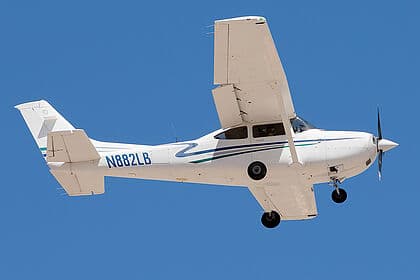
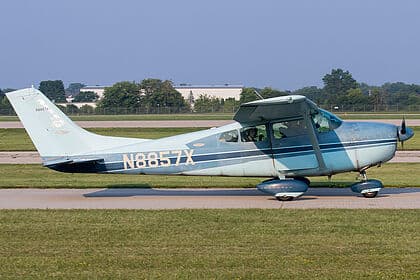
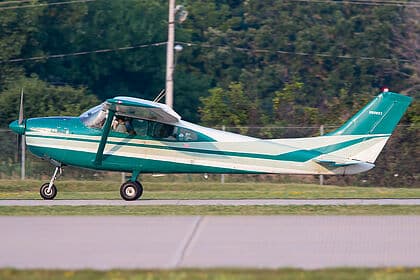
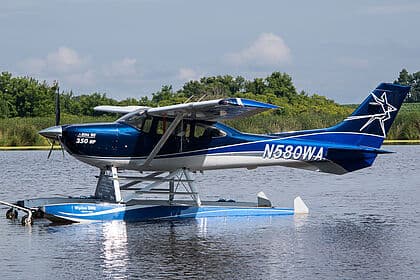
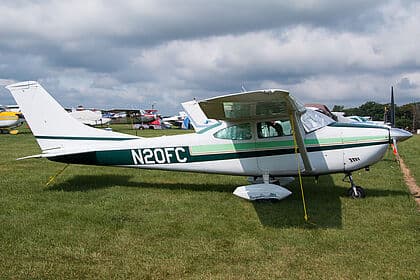
The Cessna 182 wears the classic Cessna profile: a high, strut-braced wing over a fixed tricycle undercarriage and an all-metal fuselage. From a distance it is easy to confuse with the smaller 172, and telling the two apart is the main spotting challenge.
The clues are subtle. The 182 is a little longer and stouter, sits somewhat more nose-high on a beefier nose gear, and usually has a constant-speed propeller, recognisable by broader blades and often a spinner, rather than the 172's simple fixed-pitch propeller. Many 182s also have a slight bulge or more purposeful cowling to clear the larger six-cylinder engine. Against low-wing rivals such as the Cirrus SR22 or Piper Archer, the high wing and bracing strut immediately mark it out as a Cessna.
Frequently asked
What is the difference between a Cessna 172 and a Cessna 182?
The two look almost identical, but the 182 Skylane is the bigger, more powerful sibling. It has a larger six-cylinder engine of around 230 horsepower and a constant-speed propeller, giving faster cruise, a stronger climb and the ability to carry four adults with fuel and baggage. The 172 is lighter, simpler and cheaper to run, which is why it dominates training, while the 182 is favoured for touring.
Is the Cessna 182 a good aircraft for cross-country travel?
Yes; the Skylane is widely regarded as one of the better single-engine tourers of its size. It cruises at around 140 knots, carries a genuinely useful load, and retains the docile, forgiving handling of the Cessna family. Those qualities make it a popular choice for pilots who want to travel regularly with passengers and baggage.
Is the Cessna 182 harder to fly than a 172?
It is only a little more demanding, not dramatically so. The main differences are the constant-speed propeller, which adds one more control to manage, and the heavier nose, which calls for firm elevator work in the landing flare to avoid touching down on the nosewheel first. Pilots stepping up from a 172 usually adapt quickly with a few hours of instruction. Otherwise it retains the same forgiving character.
How much does a Cessna 182 cost?
Prices vary widely with age and condition, so exact figures are hard to quote. Older used Skylanes change hands for a moderate sum, while a new factory 182T costs several hundred thousand dollars, more than a comparable 172. Running costs, including fuel, insurance, hangarage and annual maintenance, are also higher than a 172's because of the bigger engine and constant-speed propeller.
What does the retractable-gear R182 add?
The R182 Skylane RG, built mainly in the late 1970s and 1980s, has landing gear that folds away in flight to reduce drag. That gives it a useful gain in cruise speed over the fixed-gear 182, at the cost of extra complexity, weight and maintenance. It also counts as a complex aircraft for training purposes, so pilots often fly one to build the experience needed for certain ratings.
Compare with
Specs are approximate, compiled from public sources. See our editorial policy.