Gulfstream G650
GLF6Gulfstream · Business jet · Production ended
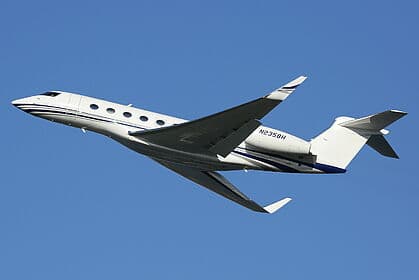
In the wild
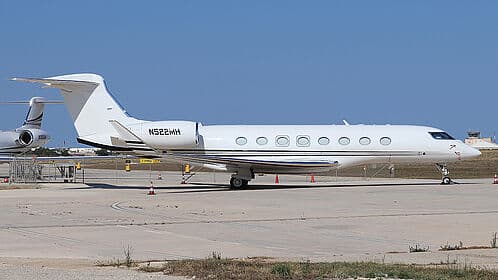
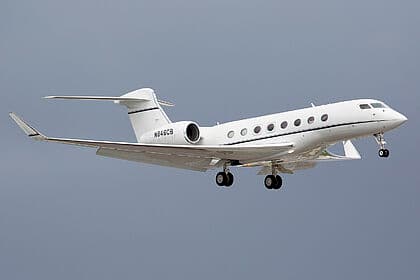
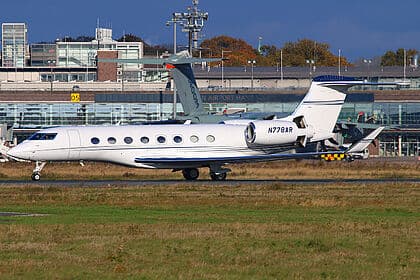
History
The Gulfstream G650 was conceived as the flagship of Gulfstream Aerospace, the Savannah-based manufacturer owned by General Dynamics, and as its answer to the large, ultra-long-range cabins that Bombardier had established with its Global series. Gulfstream had studied a bigger, faster jet for several years and formally unveiled the programme in March 2008, though design work reached back earlier. The aim was ambitious: the largest, fastest and longest-range purpose-built business jet the company had built, with a clean-sheet fuselage wider and taller than anything in its existing range.
The first G650 flew on 25 November 2009 from Savannah. The flight-test campaign was marred by a fatal accident in April 2011, when a test aircraft crashed during one-engine-inoperative take-off trials near Roswell, New Mexico, killing all four on board. Gulfstream revised its take-off performance data and flight-test procedures, and the programme continued to certification. The aircraft received its type certificate in 2012 and entered service late that year.
Technically the G650 broke new ground for Gulfstream. It was the company's first model with fully fly-by-wire flight controls, and it paired a new wide cabin with two Rolls-Royce BR725 engines and a high maximum operating speed of Mach 0.925, placing it among the fastest civil aircraft in service. In 2014 Gulfstream introduced the extended-range G650ER, which raised range to roughly 7,500 nautical miles and served as the basis for a string of distance and speed records, including an 8,379-nautical-mile nonstop flight from Singapore to Tucson in 2019.
Commercially the G650 was a considerable success. Demand outran supply for years after launch, and used examples reportedly changed hands for more than the price of a new aircraft while the order book stretched out. The type became a fixture of corporate flight departments, large charter and fractional fleets, and government and head-of-state transport, and it helped cement Gulfstream's position at the premium end of business aviation.
As of 2026 the G650 is no longer in production. Gulfstream assembled the final aircraft in February 2025, closing a line that had run for well over a decade, and positioned its newer large-cabin models, the G700 and the ultra-long-range G800, as successors. Many hundreds of G650s and G650ERs remain in active service worldwide, however, and the type is still regarded as a benchmark for the large-cabin, long-range class it helped define. For enthusiasts it endures as the aircraft that returned Gulfstream to the front of the ultra-long-range race.
Specifications
- First flight
- 2009
- Entered service
- 2012
- Engines
- 2 × Rolls-Royce BR725
- Typical seating
- 14 seats
- Cruise speed
- Mach 0.85
- Range
- 7,000 nm
- MTOW
- 45,200 kg
- Length
- 30.4 m
- Wingspan
- 30.36 m
- Status
- Production ended
Design notes
The G650's most obvious departures from earlier Gulfstreams are its size and its systems. The cabin cross-section is wider and taller than the company's previous models, giving a genuine stand-up, walk-around interior, and it is lit by unusually large oval windows, among the biggest fitted to any business jet and a signature of the type. The fuselage is a clean-sheet design rather than a stretch of an earlier Gulfstream.
Power comes from two Rolls-Royce BR725 engines, a development of the BR700 family, mounted on the rear fuselage in the classic Gulfstream layout. The wing is swept and optimised for high-speed cruise, contributing to a maximum operating speed of Mach 0.925 and a normal cruise around Mach 0.85, rising to about Mach 0.90 for faster sectors. Range in the extended-range G650ER is roughly 7,500 nautical miles.
The G650 was the first Gulfstream with fully fly-by-wire flight controls, operated through sidesticks rather than the yokes of earlier models, and it introduced an advanced flight deck with large displays. Structurally the aircraft uses aluminium alloys with composite components, and it maintains a low cabin altitude for passenger comfort on very long sectors. The combination of a large, quiet cabin, high speed and intercontinental range is the core of the design, and it set the template that the later G700 and G800 followed.
Notable facts
- Gulfstream's large-cabin, ultra-long-range flagship, with a maximum operating speed of Mach 0.925 that places it among the fastest civil aircraft in service.
- The first Gulfstream model with fully fly-by-wire flight controls, flown through sidesticks rather than a control yoke.
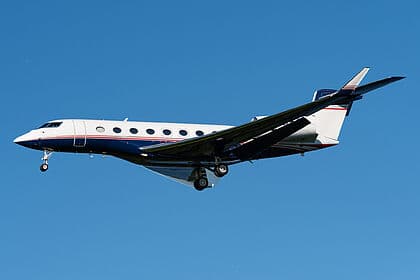
- Fitted with unusually large, oval cabin windows, among the biggest on any business jet and a visual signature of the type.
- In 2019 a G650ER flew 8,379 nautical miles nonstop from Singapore to Tucson, a distance record for the type.
- Production ended in February 2025 after more than a decade; Gulfstream positioned the newer G700 and G800 as its successors.
Who flies it
The G650 and G650ER are flown by a mix of large corporate flight departments, charter and fractional operators, and government and VIP fleets. Because of its range and cabin, the type is a favourite for intercontinental corporate travel and for private and owner-flown operations at the top of the market. Fractional and charter providers such as NetJets, Flexjet and VistaJet have operated G650-family aircraft as flagship large-cabin options, and many are registered to private holding companies and heads of state.
Typical missions are long intercontinental sectors flown nonstop, the sort of routes that give the aircraft its appeal, from North America to Asia or the Middle East, or between Europe and the west coast of the United States. As of 2026, with production ended, most fleet growth comes through the pre-owned market, where demand for the type has remained strong.
Flying on one
Flying on a Gulfstream G650 is, for most people, about the closest aviation comes to luxury travel, and it is the aircraft many charter clients ask for by name. The cabin is large for a business jet, quiet enough to hold a normal conversation at cruise, and lined with the signature oval Gulfstream windows — unusually big and plentiful, flooding the interior with light. Because it is an ultra-long-range jet it is pressurised to a low cabin altitude, which keeps passengers fresher on the very long nonstop sectors it is built for, such as crossing the Pacific in a single leg. Layouts are bespoke: typically a forward club of four facing seats, a mid-cabin conference or dining group, and an aft divan that converts for sleeping, with a full galley and a proper lavatory. Baggage lives in a dedicated hold, not overhead. For the best seat, the aft divan or a club chair beside one of those oval windows is the place to settle in for the long haul.
Variants
- G650 — Baseline model; range about 7,000 nautical miles at Mach 0.85 cruise
- G650ER — Extended-range version; about 7,500 nautical miles and the basis for several distance and speed records
How to spot it
The G650 is a large business jet with two engines mounted on the rear fuselage and a swept T-tail, so the task is to separate it from other large-cabin twins. The clearest Gulfstream signature is the row of large, oval cabin windows, noticeably bigger and more rounded than the windows on most rivals, together with a tall fin and a long, clean fuselage.
Against its closest competitor, the Bombardier Global 7500, the G650 is slightly shorter, and the Global's fuselage looks longer and carries more cabin windows; the two are otherwise similar in layout. Against the trijet Dassault Falcon 900, the engine count settles it at a glance: the G650 has two rear-fuselage engines and a clean tail, whereas the Falcon has three engines, the centre one fed through an S-duct at the base of the fin. The oval windows remain the quickest Gulfstream identifier.
Frequently asked
What is the difference between the Gulfstream G650 and the Bombardier Global 7500?
Both are large-cabin, ultra-long-range business jets and close rivals. The Global 7500 is larger, with a longer fuselage and a four-zone cabin, and a slightly greater range of about 7,700 nautical miles against roughly 7,500 for the extended-range G650ER. The G650 reached the market first, entering service in 2012, six years before the Global 7500. In practice buyers weigh cabin size and layout against the G650's speed and established service record.
How far can a Gulfstream G650 fly nonstop?
A standard G650 has a range of about 7,000 nautical miles, while the extended-range G650ER stretches that to roughly 7,500. That is enough to link most major city pairs nonstop, such as New York to Hong Kong or Los Angeles to Sydney in the right conditions. In 2019 a G650ER set a record by flying 8,379 nautical miles nonstop from Singapore to Tucson, though that exceeded normal operational range.
Is the Gulfstream G650 still in production?
No. As of 2026 the G650 is out of production; Gulfstream built the final example in February 2025 after a run of well over a decade. The company has positioned its newer large-cabin models, the G700 and the longer-range G800, as its successors. Many hundreds of G650s and G650ERs remain in service, and used examples continue to trade actively.
Why is the G650 considered so fast?
The G650 has a maximum operating speed of Mach 0.925, among the highest of any civil aircraft in service, and it cruises comfortably around Mach 0.85 to 0.90. Its swept wing and powerful Rolls-Royce BR725 engines allow high-speed sectors without a large penalty in range. This blend of speed and range is a big part of why it became a flagship for long intercontinental trips.
What are the G650's oval windows about?
The G650 is fitted with unusually large, oval cabin windows, among the biggest on any business jet, which flood the cabin with natural light and have become a visual signature of the type. Gulfstream has continued the feature on its later G700 and G800. For spotters they are one of the quickest ways to identify a G650 at a distance.
Compare with
Specs are approximate, compiled from public sources. See our editorial policy.