Bombardier Global 7500
GL7TBombardier · Business jet · In production
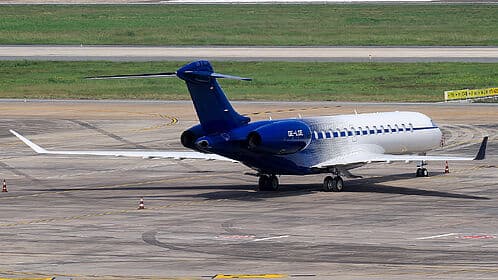
In the wild
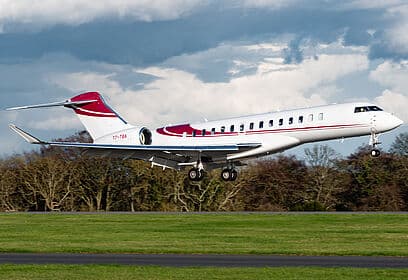
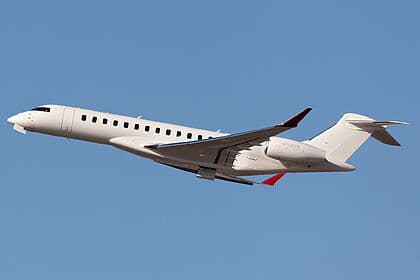
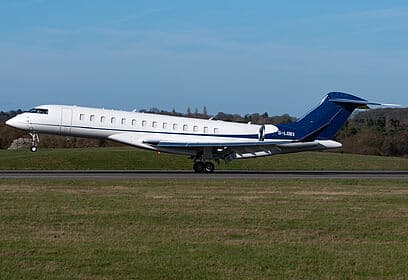
History
The Bombardier Global 7500 is the flagship of the Canadian manufacturer's Global family of large-cabin, ultra-long-range business jets, and was developed to top the range and to answer Gulfstream's G650. Bombardier announced the programme in 2010, initially as the Global 7000, alongside a shorter Global 8000 study; the aircraft was later renamed Global 7500 to reflect its confirmed range of 7,700 nautical miles. It was a substantial undertaking, with a new wing and a new engine, and its development ran later than first planned.
The first Global 7500 flew on 4 November 2016, and after a multi-aircraft flight-test campaign the type was certified and entered service in December 2018. At its introduction Bombardier described it as the largest and longest-range purpose-built business jet then available, with a cabin divided into four distinct living spaces, a configuration no rival offered.
The aircraft is built around a new transonic wing and two General Electric Passport engines developed specifically for it. The four-zone cabin, offering separate club, conference, dining and private stateroom areas, together with a full rear galley and crew rest, became the type's main selling point, aimed at buyers who wanted a genuine long-haul living environment rather than a single cabin. Range of about 7,700 nautical miles allowed nonstop city pairs that few business jets could reach.
Commercially the Global 7500 gave Bombardier a strong competitor at the very top of the market, and it sold steadily to corporate, charter, fractional and private buyers, helping the company refocus on business aviation after exiting commercial aircraft and rail. Deliveries built up through the early 2020s, and the type became a common sight at the major business-aviation hubs.
In 2022 Bombardier revived the Global 8000 name for a higher-performance development of the 7500, promising a range of about 8,000 nautical miles and a top speed near Mach 0.94, among the fastest of any civil aircraft short of the retired Concorde. The Global 8000 shares the 7500's airframe and cabin and entered service in 2025, effectively extending the family rather than replacing the 7500.
As of 2026 the Global 7500, alongside the newer 8000, remains in production and near the top of the ultra-long-range class it helped define. For enthusiasts it is significant as the aircraft that reasserted Bombardier's place against Gulfstream, and as the first purpose-built business jet designed around four separate cabin zones. It is also often noted for its low cabin altitude and flat-floor interior, comfort details that operators tend to cite alongside the headline range.
Specifications
- First flight
- 2016
- Entered service
- 2018
- Engines
- 2 × General Electric Passport
- Typical seating
- 15 seats
- Cruise speed
- Mach 0.85
- Range
- 7,700 nm
- MTOW
- 52,100 kg
- Length
- 33.8 m
- Wingspan
- 31.7 m
- Status
- In production
Design notes
The Global 7500 is defined by its size and its four-zone cabin. Where most business jets offer a single divided cabin, the 7500 provides four distinct living spaces, typically a club section, a conference or dining area, a further lounge and a private rear stateroom, with a dedicated crew rest and a full galley. The cabin is among the largest in any purpose-built business jet.
The aircraft uses a clean-sheet transonic wing, more slender and swept than earlier Global wings, designed to combine high-speed cruise with a smooth ride and good field performance. Power comes from two General Electric Passport engines, a design developed specifically for the aircraft and mounted on the rear fuselage. Maximum take-off weight is around 52 tonnes, large for the class.
Normal cruise is about Mach 0.85, with a high-speed cruise near Mach 0.90 and a maximum operating speed of Mach 0.925; the derived Global 8000 raises the top speed to near Mach 0.94. The flight deck uses fly-by-wire controls and Bombardier's Vision avionics, and the aircraft carries a side-stick controller. A notable feature is the cabin's low pressure altitude and advanced air management, aimed at reducing fatigue on the very long sectors the aircraft is designed to fly. Together these give the 7500 its blend of long range, high speed and a large, quiet interior.
Notable facts
- The first purpose-built business jet designed around a four-zone cabin, with separate lounge, dining, further living and private stateroom areas.
- Widely described as the longest-range purpose-built business jet when it entered service in 2018, at about 7,700 nautical miles.
- Powered by two General Electric Passport engines developed specifically for the aircraft.
- Built on a clean-sheet transonic wing, with fly-by-wire flight controls and a reputation for a smooth ride.
- The higher-performance Global 8000 derivative, certified in 2025, extends range to about 8,000 nautical miles and raises the top speed to near Mach 0.94.
Who flies it
The Global 7500 is operated by large corporate flight departments, charter and fractional providers, and private and government owners at the top of the market. Fractional and membership operators including NetJets, Flexjet and VistaJet have taken the type as a flagship large-cabin aircraft, offering it for the longest intercontinental charters, while many others are held by corporations and private individuals.
Typical missions are ultra-long nonstop sectors, the routes the aircraft was designed for, such as North America to East Asia, the Middle East or Australia, or Europe to the west coast of the United States and beyond. Governments and heads of state also use the type for long-range VIP transport. As of 2026, with the aircraft still in production alongside the faster Global 8000, the fleet continues to grow through both new deliveries and the developing pre-owned market.
Flying on one
The Bombardier Global 7500 is the G650's great rival at the very top of the business-jet market, and its party trick is space: the cabin is divided into four genuine living areas, and it is one of the few private jets that can carry a full-size permanent bed and a proper hot-food galley. Like its rival it flies extremely long nonstop sectors, so the cabin is pressurised low and kept quiet and comfortable for the many hours it stays airborne. The ride is smooth, the windows are large, and the fit and finish are as good as private aviation gets. Typical layouts run a forward club, a dining or conference space, a plush seating area and an aft private suite with that bed and an en-suite lavatory. Luggage travels in a large hold accessible in flight. For the best seat, the rear private suite is unmatched for sleeping on a long crossing, while a club chair suits those who want to work or simply watch the world go by.
Variants
- Global 7500 — Baseline four-zone ultra-long-range model; about 7,700 nautical miles
- Global 8000 — Higher-performance derivative certified in 2025; about 8,000 nautical miles and a top speed near Mach 0.94
How to spot it
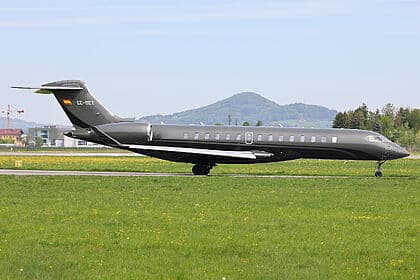
The Global 7500 is a very large business jet, and its sheer size is often the first clue: it has a long fuselage with a high window count, two engines mounted on the rear fuselage and a swept T-tail. The length and the number of cabin windows help separate it from smaller large-cabin jets.
Against its main rival, the Gulfstream G650, the Global is longer and carries more cabin windows, while the G650 shows Gulfstream's trademark large oval windows; the Global's windows are more rectangular. Both are twin-engine, rear-engined T-tail designs, so the fuselage length and window shape are the useful cues. Against the trijet Dassault Falcon 900, the engine count is decisive, as the Global has two rear engines to the Falcon's three. The Global 8000 is externally near-identical to the 7500 and cannot reliably be told apart from outside.
Frequently asked
What is the difference between the Global 7500 and the Gulfstream G650?
They are the two leading large-cabin, ultra-long-range business jets and direct competitors. The Global 7500 is the larger aircraft, with a longer fuselage and a four-zone cabin, and a slightly greater range of about 7,700 nautical miles against roughly 7,500 for the G650ER. The G650 reached the market first, in 2012, while the Global emphasises cabin space and layout. As of 2026 the Global 7500 remains in production, whereas the G650 does not.
How far can the Global 7500 fly nonstop?
The Global 7500 has a range of about 7,700 nautical miles at a long-range cruise speed. That allows genuinely long nonstop city pairs, such as New York to Hong Kong, London to Singapore or Los Angeles to Sydney in the right conditions. The derived Global 8000 pushes range to about 8,000 nautical miles, extending the reach further.
What is the four-zone cabin?
Bombardier designed the Global 7500 with four separate living spaces rather than one divided cabin, which was a first for a purpose-built business jet. A typical layout has a club seating area, a conference or dining space, a further lounge and a private rear stateroom, plus a full galley and crew rest. This gives passengers distinct areas to work, dine, relax and sleep on very long flights.
What is the difference between the Global 7500 and the Global 8000?
The Global 8000 is a higher-performance development of the 7500 that shares the same airframe and four-zone cabin. It offers a longer range of about 8,000 nautical miles and a higher top speed of near Mach 0.94, among the fastest of any civil aircraft. Announced in 2022 and in service from 2025, it effectively extends the family rather than replacing the 7500, and the two are hard to tell apart from outside.
Who flies the Global 7500?
The type is used by large corporate flight departments, private owners and government fleets, and by fractional and charter operators such as NetJets, Flexjet and VistaJet, which offer it as a flagship large-cabin option. Its role is long intercontinental travel, typically the longest sectors a customer might fly nonstop. As of 2026 it remains in production and continues to be delivered to new operators.
Compare with
Specs are approximate, compiled from public sources. See our editorial policy.