Embraer E190 (E190)
Embraer · Regional · Production ended
E190 is the ICAO aircraft type code for the Embraer E190, an Embraer regional jet that first flew in 2004 and entered service in 2005. It typically carries 100 passengers in a two-class layout, cruises at Mach 0.78, and has a range of about 2,450 nautical miles (4,537 km).
Loading live positions…
In the wild
History
The Embraer E190 is the larger fuselage of the E-Jet family, the Brazilian manufacturer's bet that regional airlines and mainline carriers alike wanted a jet between the 50-seat regional jets of the 1990s and the 150-seat A320 and 737. Embraer launched the family in 1999 with the 70-seat E170; the E190, with a longer fuselage, a larger wing and more powerful GE CF34-10E engines, was launched in 2001 and first flew on 12 March 2004.
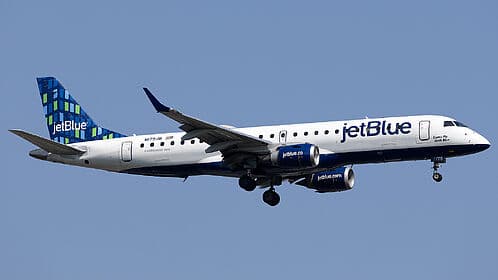
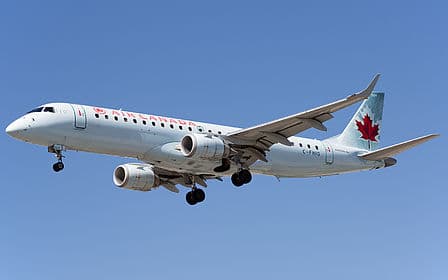
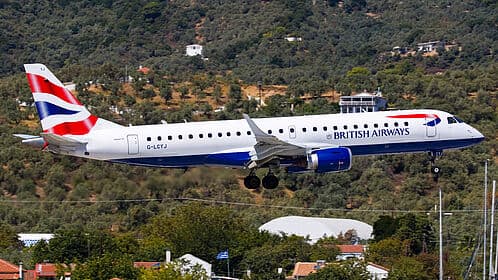
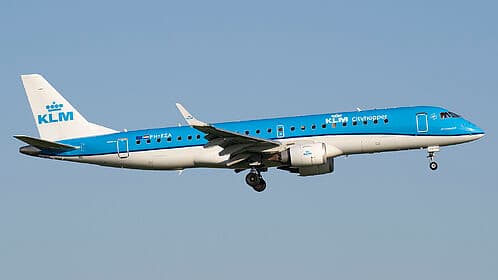
JetBlue was the launch customer, ordering 100 in 2003 and taking the first in September 2005. Its plan was to use a 100-seat jet to open cities too small for the A320, and the E190's 2-2 cabin with no middle seats became a selling point in its own right. European and Asian operators followed quickly: Air Canada, KLM Cityhopper, LOT, Aeroméxico, Austral, Azul, Copa and British Airways CityFlyer all built fleets, and the type became common at slot-constrained city airports such as London City, where its steep-approach certification allowed it to operate.
The E190 was also the basis of the E195, a further stretch of about 120 seats, and of the Lineage 1000 ultra-large business jet. Across the decade it competed with the Bombardier CRJ900 and CRJ1000 and later with the Bombardier C Series, which became the Airbus A220 and offered a wider cabin and newer engines at the same size.
Embraer's answer was the E2 family, launched in 2013: the E190-E2 kept the fuselage and cabin but added Pratt & Whitney geared turbofans, a new high-aspect-ratio wing and full fly-by-wire. First-generation E190 production ended in the early 2020s as the E2 took over, with more than 560 E190s delivered. Hundreds remain in service and the type is a staple of the regional-jet leasing market.
Specifications
- First flight
- 2004
- Entered service
- 2005
- Engines
- 2 × General Electric CF34-10E
- Typical seating
- 100 (2-class)
- Cruise speed
- Mach 0.78
- Range
- 2,450 nm
- MTOW
- 51,800 kg
- Length
- 36.24 m
- Wingspan
- 28.72 m
- Status
- Production ended
Design notes
The E190 is structurally distinct from the smaller E170/E175, with a 5 m longer fuselage, a larger wing of 28.7 m span and a taller tail, although the four E-Jets share the same cockpit, systems architecture and 2-2 cabin cross-section. The cabin's 'double-bubble' fuselage is wider at seat level than a CRJ's, giving seats close to 18 inches wide and a near-flat floor with real bins.
The CF34-10E engines deliver around 18,500 lb of thrust each, roughly double the CF34-8 on the E170, and the aircraft carries a fly-by-wire system for the rudder, spoilers and elevator with conventional yokes, a hybrid Embraer chose for cost and certification simplicity. The Honeywell Primus Epic cockpit uses five large displays. Advanced-range (AR) versions add fuel and weight for about 2,450 nautical miles.
Notable facts
- The larger E-Jet fuselage, sized at 100 seats with a 2-2 cabin that has no middle seat anywhere on board.
- JetBlue was the launch customer in 2005, using it to open smaller cities from New York and Boston.
- Shares its cockpit and type rating with the E170/E175, and with the E195 is the basis of the Lineage 1000 corporate jet.
- Replaced on the line by the E190-E2 (E290), which has new geared turbofans and a new wing but the same cabin cross-section.
- Flown worldwide by KLM Cityhopper, Air Canada, Aeroméxico, LOT, Azul and many others; popular with lessors for its size.
Who flies it
KLM Cityhopper and Air Canada operate two of the largest remaining E190 fleets, feeding Amsterdam and Toronto respectively; British Airways CityFlyer uses it as its main type at London City. In the Americas it serves Aeroméxico Connect, Azul, Copa, Austral and, until its retirement there, JetBlue; in Asia and Africa Air Astana, Mandarin Airlines, Kenya Airways and Airlink fly it. Lessors such as Aercap and Nordic Aviation Capital hold large portfolios. Typical duties are 60- to 180-minute regional and thin mainline routes, including performance-limited airports where its field performance and steep-approach capability matter.
Flying on one
The E190 is the regional jet passengers tend to like. Its 2-2 cabin means every seat is either a window or an aisle and nobody sits in a middle, seats are about 18 inches wide, and the overhead bins take a standard roll-aboard wheels-first on most aircraft, unlike the CRJ family where gate-checking is routine. The cabin is quieter than a CRJ's because the engines are under the wing rather than beside the rear cabin, and the ride is stable for an aircraft of its size. Legroom runs 30–32 inches at most operators, with a few rows of extra pitch at the exits. Boarding is fast with only 25 rows. For the best seat, take a window ahead of the wing on the left side for views on approach; the last row is beside the lavatory and galley.
Variants
- E190LR / E190AR — Long- and advanced-range weight options with more fuel
- E195 (E195) — Stretched sibling seating about 120
- E190-E2 (E290) — Second-generation successor with PW1900G engines
- Lineage 1000 — Corporate jet derivative of the E190
How to spot it
E-Jets are recognisable by their smooth, pointed nose, large cockpit windows and the distinctive 'double-bubble' fuselage that looks slightly pinched at floor level. Telling an E190 from the smaller E175 takes a second look: the E190 is clearly longer, has a taller fin, and its engines are much larger in diameter relative to the wing. The surest cue is the number of windows: an E190 has around 25 per side, an E175 about 20. Against the E190-E2, the E2 has a longer, more slender wing with raked tips in place of the first generation's small winglets, and much larger geared-turbofan nacelles.
Frequently asked
What is the difference between the E190 and the E190-E2?
The E190-E2 (ICAO code E290) is the second-generation version with Pratt & Whitney PW1900G geared turbofans, a new high-aspect-ratio wing, full fly-by-wire and a refreshed cabin, cutting fuel burn per seat by around 17%. The original E190 uses GE CF34-10E engines. Cabin size and seat count are essentially the same.
How many seats does an E190 have?
Around 96–100 in two classes and up to 114 in a single-class layout. JetBlue flew it with 100 seats; KLM Cityhopper and Air Canada use 100 and 97.
Is the E190 a regional jet or a mainline aircraft?
Both. It was designed as a 'right-sized' aircraft for the gap between 70-seat regional jets and 150-seat narrowbodies, and it is flown by regional affiliates feeding hubs as well as by mainline carriers such as JetBlue and Air Canada under their own brands.
Does the E190 have middle seats?
No. The 2-2 cabin layout gives every passenger a window or an aisle, one of the type's most-cited advantages over the 3-3 layout of the A320 and 737.
What aircraft is E190?
E190 is the ICAO type designator for the Embraer E190, a Embraer regional that first flew in 2004. It is the code flight trackers and air traffic control use.
What is the wingspan of the Embraer E190?
The Embraer E190 has a wingspan of 28.72 m (94 ft) and is 36.24 m (119 ft) long.
What engines does the Embraer E190 have?
Two General Electric CF34-10E.
What is the MTOW and range of the Embraer E190?
Maximum take-off weight is 51,800 kg (114,198 lb) and maximum range is about 2,450 nautical miles (4,537 km) at a cruise of Mach 0.78.
How many passengers does the Embraer E190 carry?
Typically 100 passengers in a two-class layout; dense single-class layouts seat more and premium-heavy layouts fewer.
In-depth comparisons
Compare with
Specs are approximate, compiled from public sources. See our editorial policy.