Boeing 777-200LR / 777F
B77LBoeing · Widebody · In production
In the wild
History
The Boeing 777-200LR and the 777F freighter are two closely related members of the 777 family, both built around the same ultra-capable long-range airframe. The 777 itself was launched in the early 1990s as a large twin to sit between the 767 and the 747, and the original 777-200 and stretched 777-300 established the type. To reach the very longest markets, Boeing developed two extended-range models, the 777-300ER and the 777-200LR, sharing a strengthened structure, extra fuel, raked wingtips, and the powerful General Electric GE90-115B engine.
The 777-200LR, marketed as the Worldliner, first flew in 2005 and entered service in 2006 with Pakistan International Airlines. It was designed for extreme range rather than capacity: with the same fuselage length as the original 777-200 but far more fuel and higher weights, it could fly more than 8,500 nautical miles, among the longest of any airliner. It briefly held records for the longest scheduled and longest non-stop flights, and it opened ultra-long city pairs that no previous twin could serve. That very specialisation, however, limited its market, and only around 59 were built before passenger production ended in 2013, making it one of the rarest 777 variants.
The freighter, the 777F, was the more commercially important outcome of the same engineering. Boeing derived it directly from the 777-200LR, using the LR's airframe, engines, and fuel capacity but replacing the passenger cabin with a main-deck cargo hold, a large forward cargo door, and a strengthened floor. It first flew in 2008 and entered service in 2009 with Air France, offering the range and payload of a large freighter with the efficiency of a modern twin. It quickly became one of the best-selling widebody freighters ever, favoured by express operators and combination carriers alike.
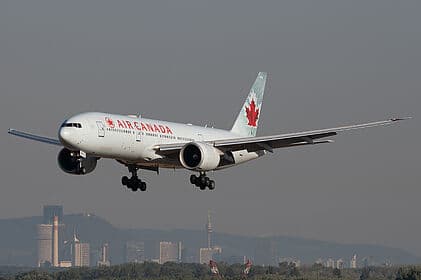
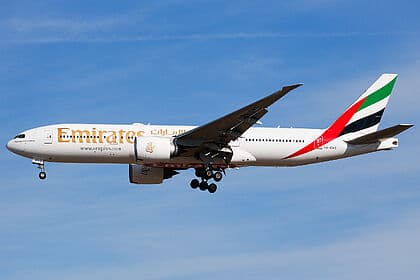
As of 2026 the picture is split. The passenger 777-200LR is out of production and comparatively rare, flown by a small number of carriers such as Emirates, Qatar Airways, and Air Canada on selected ultra-long routes, and its numbers are gradually thinning as newer types arrive. The 777F, by contrast, remains in production and in strong demand, forming the backbone of many cargo fleets, and a next-generation 777-8F freighter has been developed to eventually succeed it. Between them the two versions show how a niche passenger aircraft can prove far more enduring in its cargo form, a pattern the 777 shares with the 767 and MD-11 before it. Taken together, they have kept the long-range 777 airframe relevant for more than two decades, first at the frontier of passenger range and now at the heart of global air cargo.
Specifications
- First flight
- 2005
- Entered service
- 2006
- Engines
- 2 × General Electric GE90-110B1 or GE90-115BL
- Typical seating
- 301 (2-class)
- Cruise speed
- Mach 0.84
- Range
- 8,555 nm
- MTOW
- 347,800 kg
- Length
- 63.73 m
- Wingspan
- 64.8 m
- Status
- In production
Design notes
The 777-200LR and 777F share the long-range 777 airframe, so their engineering is largely common. The defining feature is the General Electric GE90 engine, the sole powerplant, with a fan over three metres across, physically wider than some regional jets' fuselages and among the most powerful jet engines ever certified. The wing carries raked wingtips, extended and swept tips that increase span and efficiency without a vertical winglet, and each main gear leg rides on six wheels across three axles, the unmistakable 777 signature.
The 777-200LR's distinguishing trait is fuel volume: it carries far more fuel than the standard 777-200, with provision for optional auxiliary tanks in the rear cargo hold, plus higher operating weights and a strengthened structure to lift it. The result is extreme range from a relatively short 777 fuselage.
The 777F applies the same airframe to cargo, adding a large upward-hinging main-deck cargo door on the forward left fuselage, a reinforced floor with a powered cargo-handling system, and no cabin windows along most of the body. Both use the 777's fly-by-wire flight deck. Structurally the aircraft is largely aluminium, from before the composite-intensive 777X, and its round, six-metre-wide cross-section is the same as every other 777, giving the family its characteristic wide, cylindrical look.
Notable facts
- The 777-200LR Worldliner was among the longest-range airliners ever built, capable of over 8,500 nm.
- Shares its airframe, GE90 engines, and fuel capacity with the 777F all-cargo freighter.
- Powered exclusively by the General Electric GE90 series, among the most powerful jet engines in service.
- Only about 59 passenger 777-200LRs were built between 2005 and 2013, one of the rarest 777 variants.
- The 777F freighter remained in production as of 2026, long after the passenger -200LR line ended.
Who flies it
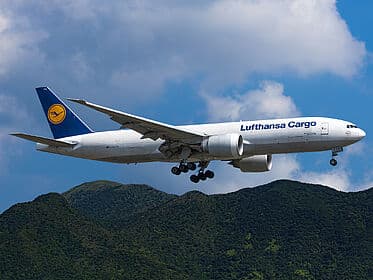
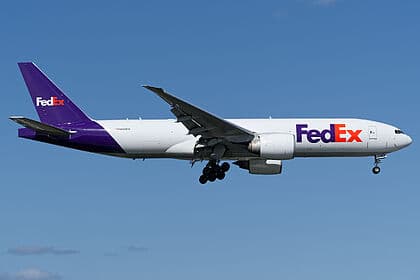
As of 2026 the two versions serve very different operators. The passenger 777-200LR is rare and specialised, flown by a handful of carriers, including Emirates, Qatar Airways, and Air Canada, on selected ultra-long-haul routes where its extreme range is genuinely useful; several early operators have already retired theirs. The 777F freighter, by contrast, is everywhere in the cargo world. It is a core type for express integrators and cargo divisions such as FedEx Express, Emirates SkyCargo, Qatar Airways Cargo, Lufthansa Cargo, and China Southern, among many others, flying long-haul main-deck freight on trunk cargo routes worldwide. In that role it hauls heavy, time-sensitive cargo across oceans with better economics than the older MD-11 and 747-400 freighters it has largely replaced. New 777F deliveries continue, and the fleet is expected to grow further.
Flying on one
The 777-200LR was built to fly farther than almost anything else, and passengers meet it on some of the longest nonstop routes in the world, where you may spend the better part of a day aboard. It shares the wide 777 cabin, so comfort hinges on the same question as the -300ER: most operators fly it ten-abreast in a 3-4-3 economy layout at around seventeen inches a seat, while a few keep a roomier nine-abreast. On flights this long the difference is felt keenly. It is an older-generation cabin, so cabin altitude and humidity are ordinary, though the aircraft's size makes for a very smooth, quiet ride, and premium cabins are usually a priority on ultra-long routes. Overhead bins are large. For the best economy seat, choose a window over a ten-abreast middle, look out for the rare nine-abreast operators, and on such long sectors an exit row or bulkhead for legroom is well worth seeking; avoid the last rows by the aft galleys.
Variants
- 777F (Freighter) — All-cargo version, still built; a major FedEx, Qatar, and Emirates SkyCargo type
- 777-200ER (B772) — Earlier, shorter-range extended-range passenger 777-200
- 777-8F — 777X-generation freighter developed as the eventual 777F successor
How to spot it
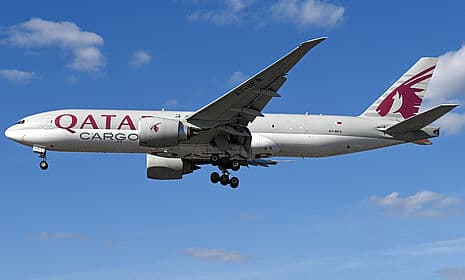
Both versions are large twin-engine widebodies with the 777's perfectly round fuselage, enormous GE90 engines, and six-wheel main landing gear, the surest 777 family cue against the four-wheel bogies of the A330, A340, and 767. Distinguishing the 777-200LR from the longer, best-selling 777-300ER comes down to length: the -200LR has the shorter original 777-200 fuselage, so there is much less body ahead of and behind the wing, whereas the -300ER is one of the longest airliners flying. Both wear raked wingtips, so the tips do not separate them. The 777F is obvious once you notice the lack of cabin windows along the fuselage and the bulged main-deck cargo door on the forward left side. Cargo-airline colours are another strong hint that you are looking at a 777F rather than a passenger jet.
Frequently asked
What is the difference between the 777-200LR and the 777F?
They share the same airframe, engines, and fuel system, but the 777-200LR is a passenger aircraft built for extreme range, while the 777F is a dedicated freighter with a main-deck cargo door, a reinforced floor, and no passenger cabin. The freighter trades ultra-long range for heavy payload. The LR is now rare, whereas the 777F remains in production.
How do you tell a 777-200LR from a 777-300ER?
Both wear raked wingtips and ride on six-wheel bogies, so the tell is length: the -200LR uses the short original 777-200 fuselage, while the -300ER is much longer, one of the longest airliners in service. Seen alone, judge how much fuselage sits fore and aft of the wing, or count the doors. The -300ER has far more of both.
Why was so little of the passenger 777-200LR built?
The 777-200LR was optimised for extreme range rather than capacity, which suited only a small number of ultra-long routes, so demand was limited and only about 59 were built before production ended in 2013. Most airlines preferred the higher-capacity 777-300ER for their long-haul flying. The same airframe proved far more successful in its 777F freighter form.
Is the 777F still being made?
Yes. As of 2026 the 777F freighter remains in production and in strong demand, unlike the passenger 777-200LR, which ended in 2013. Boeing has also developed a next-generation 777-8F freighter, based on the 777X, to eventually succeed it. The current 777F is one of the best-selling large freighters ever built.
Who flies the 777F freighter?
It is a mainstay of the air-cargo world, operated by express integrators and airline cargo divisions such as FedEx Express, Emirates SkyCargo, Qatar Airways Cargo, and Lufthansa Cargo, among many others. They use it for long-haul main-deck freight on trunk cargo routes. It has largely replaced older freighters like the MD-11 and some 747s.
Compare with
Specs are approximate, compiled from public sources. See our editorial policy.