Bombardier Challenger 600 series (CL60)
Bombardier · Business jet · In production
CL60 is the ICAO aircraft type code for the Bombardier Challenger 600 series, a Bombardier business jet that first flew in 1978 and entered service in 1980. It typically carries 10 people, cruises at Mach 0.8, and has a range of about 4,000 nautical miles (7,408 km).

Loading live positions…
In the wild
History
Bill Lear, who had already put his name on the Learjet, sketched the first version of this airplane in the mid-1970s. His LearStar 600 was a long-range business jet with a supercritical wing and a cabin wide enough to walk around in, but Lear had no factory to build it. Canadair did. The Montreal company, nationalized by the Canadian government in 1976, wanted products of its own; it backed the concept late in 1975, bought it outright in April 1976 and launched the program on October 29 that year with orders and deposits for 53 aircraft and federal financial guarantees behind it.
The design grew as Canadair's engineers worked on it. The horizontal tail moved to the top of the fin after tests showed the original low position sat in the engine exhaust, the fuel went into the wings, and the gross weight rose more than once. Lear fell out with the program, reportedly calling the heavier result "Fat Albert", and in March 1977 it became the Challenger 600. Federal Express, the original launch customer, ordered 25 but eventually canceled after US airline deregulation changed its plans.
The first Challenger flew from Montreal on November 8, 1978. Testing moved to Mojave, California, for better weather, and on April 3, 1980 a prototype crashed there after a deep stall when its recovery parachute failed to separate, killing one of the test pilots. Transport Canada certified the CL-600 in August 1980 and the FAA in November.
Its Lycoming ALF 502L engines, developed for the airplane, disappointed, and sales were slow. The program cost about C$1.5 billion, and the losses pushed Canadair close to bankruptcy. The fix was the CL-601, first flown on April 10, 1982 with General Electric CF34 turbofans and winglets, which Flight International credited with a boom in orders. Bombardier bought Canadair in 1986 and kept developing the line. The 601-3A introduced a glass cockpit, and the Challenger 604, launched in 1995, added fuel, new landing gear for higher weights and Collins Pro Line 4 avionics; more than 360 were delivered before the 605 replaced it in 2006 with bigger windows and Pro Line 21. NetJets ordered 25 of a further update in June 2012, when it was still called the 605NG. Bombardier unveiled it as the Challenger 650 in October 2014, and it entered service with NetJets in November 2015. The family's 1,000th aircraft, also a 650, went to NetJets the following month.
Canadair had designed the fuselage with stretching in mind, and Bombardier used it twice: for the CRJ airliner and, with a new wing, for the Global Express. On flight plans and trackers, every business-jet Challenger from the 600 to the 650 shares the ICAO code CL60.
Specifications
- First flight
- 1978
- Entered service
- 1980
- Engines
- 2 × General Electric CF34-3B
- Typical seating
- 10 seats
- Cruise speed
- Mach 0.8
- Range
- 4,000 nm
- MTOW
- 21,863 kg
- Length
- 20.85 m
- Wingspan
- 19.61 m
- Status
- In production
Design notes
The Challenger was sized from the inside out. Canadair drew the fuselage around a cabin with an unobstructed floor and 6 ft 1 in of headroom in the center, then packed the wing box, underfloor fuel tanks, air ducts and control runs into the space around it, and it planned equal-length plugs ahead of and behind the center section so the body could be stretched later. Flight International called the result a "miniaturised twinjet airliner in every respect." On the current 650, Bombardier lists cabin width as 7 ft 11 in (2.41 m), which it calls the widest in the class.
It was one of the first business jets designed with a supercritical wing, and the wing alone reportedly spent more than 1,800 hours in the transonic wind tunnel at Canada's National Aeronautical Establishment. A twin-spar box runs the full span and forms five fuel tanks that held up to 14,661 lb on the original, almost half its empty weight. Kevlar was molded into the wing-to-body fairing, flap shrouds and wingtips.
The engines ride in pods on the rear fuselage, set lower than on Lear's concept to avoid unfavorable pitch behavior, and have thrust reversers. Since the 601 they have been General Electric CF34s; the 650's CF34-3B delivers 9,220 lb of takeoff thrust, about 5 percent more than on the 605. Canadair also gave the airplane airliner-style redundancy, with three hydraulic systems and, on the first production model, a Sperry autopilot certifiable for Category 3A automatic landings. The cabin is pressurized to a maximum differential of 9.3 psi. The 650 flies on Collins Pro Line 21 Advanced avionics with synthetic vision, cruises at Mach 0.80 and tops out at Mach 0.85 and 41,000 ft.
Notable facts
- Conceived by Learjet founder Bill Lear as the LearStar 600 and developed by Canadair, which launched it in October 1976 as one of the first business jets designed around a supercritical wing.
- The fuselage was drawn around a walk-about cabin; the current 650's is 7 ft 11 in (2.41 m) wide, which Bombardier calls the widest in its class.
- Every model from the 1980 Challenger 600 to the current 650 carries the ICAO code CL60, and Bombardier says the platform has passed 1,000 deliveries.
- Canadair built stretch into the original fuselage, and Bombardier later used that body for the CRJ regional airliner and, with a new wing, the Global Express.
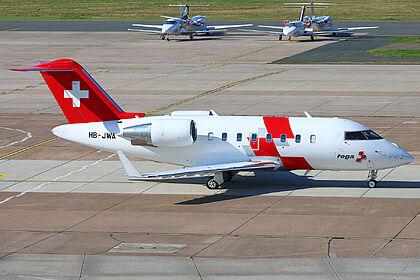
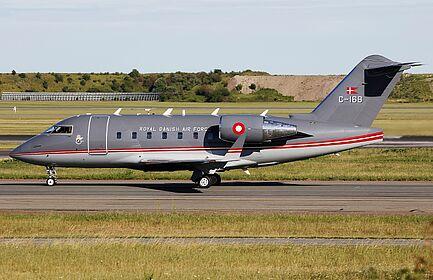
- Air ambulance and military users include Swiss Air-Rescue Rega, the Royal Canadian Air Force (as the CC-144), the Royal Danish Air Force and the US Army.
Who flies it
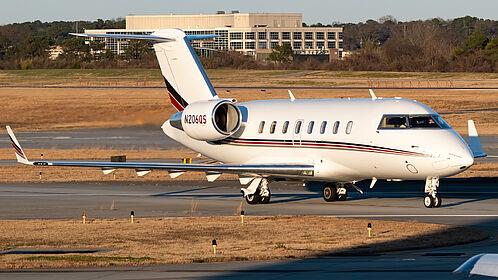
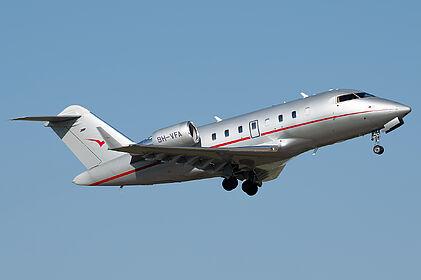
NetJets has been the decisive customer for the late-model Challengers: it ordered the 650 while it was still the 605NG, put it into service in 2015 and took the 1,000th member of the family. Its 650s fly in the United States with QS registrations and in Europe with Portuguese CS-CL marks, and VistaJet operates Challenger 605s registered in Malta as 9H-VF. The wide cabin has also made the Challenger a natural air ambulance and state transport. Swiss Air-Rescue Rega ordered three Challenger 650s in 2015 for repatriation flights from its Zurich base, and the Swiss Air Force bought two of Rega's earlier CL-604s. The Royal Canadian Air Force has flown Challengers as the CC-144 since 1982, in versions from the 600 to the 650; the Royal Danish Air Force uses CL-604 Multi-Mission Aircraft, able to land on the short gravel strips common in the Arctic, for maritime patrol and search and rescue; and the US Army flies Challenger 650-based ARTEMIS reconnaissance jets.
Flying on one
Width is the Challenger's main selling point. Bombardier lists the 650's cabin at 7 ft 11 in (2.41 m) across, 2.11 m at floor level, 6 ft high and 25 ft 7 in long, so it is noticeably roomier side to side than a Challenger 3500 while being only slightly longer. The standard plan seats ten: a four-chair club behind the forward galley, then a second seating group or a three-place divan facing two chairs, with the lavatory at the back; the maximum is 12. Seats swivel 180 degrees, slide on tracks, recline and berth, and Bombardier claims the most sleeping capacity in the class. A sound-insulating sliding door separates the entry and galley from the cabin, and the 115 cu ft baggage compartment can be reached at any time in flight. A range of about 4,000 nautical miles with six aboard makes London to New York a nonstop trip. Passengers reach one through a NetJets share, VistaJet program hours, a charter booking or a company flight department, and in Switzerland some arrive on a stretcher with a Rega medical crew. Because the family has been built for more than four decades, the cabin depends heavily on the airframe's age: a 601 or 604 has smaller windows and older systems, while a 605 or 650 has the larger windows and current cabin electronics.
Variants
- Challenger 600 — Original CL-600-1A11 with Lycoming ALF 502L engines, no winglets and a truncated tail cone; 81 built through 1982
- Challenger 601 — General Electric CF34 engines and winglets from 1982; the 601-3A added a glass cockpit and the 601-3R made the tail fuel tank standard
- Challenger 604 — Launched in 1995 with CF34-3B engines, extra fuel tanks, new landing gear for higher weights and Collins Pro Line 4 avionics; more than 360 delivered through 2006
- Challenger 605 — From 2006: larger cabin windows, a streamlined tail cone and Collins Pro Line 21 avionics
- Challenger 650 — In service with NetJets from November 2015: Pro Line 21 Advanced avionics, a redesigned cabin and about 5 percent more takeoff thrust; 4,000 nm with six passengers
How to spot it
All Challengers share a deep, round fuselage on a comparatively short swept wing, a T-tail and two engine pods slung on the tail cone. Three details date one. The original 600 has no winglets, fully cowled Lycoming engines and a blunt, cut-off tail cone. From the 601 on, winglets appear and the CF34s show exposed exhaust nozzles. The 605 and 650 then gained a streamlined, tapering tail cone and larger cabin windows; telling those two apart needs the registration. The CRJ200 and its executive twin, the Challenger 850, use the same body stretched by about six meters, with a much longer run of windows, and show up on trackers as CRJ2. A Challenger 350 is a closer match in length but looks lanky beside a 650: a slimmer fuselage, a 21 m wing against the 650's 19.6 m and winglets angled well outward.
Frequently asked
Why does a Challenger 650 show as CL60 on a flight tracker?
ICAO type designators follow the airframe family rather than the marketing name, and the 650 is the latest version of the CL-600 that first flew in 1978, so it shares CL60 with the 600, 601, 604 and 605. Transport Canada does split pilot type ratings, CL60 for the 600 and 601 and CL64 for the 604, 605 and 650, but that is a licensing code, not the one trackers use.
What is the difference between the Challenger 604, 605 and 650?
The 604, built from 1996 to 2006, introduced CF34-3B engines, extra fuel tanks and Collins Pro Line 4 avionics. The 605 of 2006 added larger cabin windows, a reshaped tail cone and Pro Line 21, and the 650 of 2015 brought Pro Line 21 Advanced with synthetic vision, a redesigned cabin and about 5 percent more takeoff thrust. Range and speed are similar across the three, since most of the changes were inside.
Is the Challenger 650 related to the CRJ regional jet?
Yes. Bombardier stretched the Challenger's fuselage to create the Canadair Regional Jet, and later sold the Challenger 800 and 850 as executive versions of the CRJ200. Those airliner-based jets are about six meters longer and carry the CRJ2 code, so they never appear as CL60.
How far can a Challenger 650 fly?
Bombardier quotes 4,000 nautical miles with six passengers and NBAA IFR reserves at long-range cruise, which AOPA noted is enough for London to New York. The 604's added fuel tanks are what gave the later models that reach. Earlier 600s and 601s carry less fuel and fly shorter legs.
Is the Challenger 650 still in production?
Yes. As of 2026 Bombardier still lists the Challenger 650 among its current aircraft and describes the platform as the best-selling large business jet of all time, with more than 1,000 deliveries. That keeps a design first flown in 1978 on the production line nearly five decades later.
What aircraft is CL60?
CL60 is the ICAO type designator for the Bombardier Challenger 600 series, a Bombardier business jet that first flew in 1978. It is the code flight trackers and air traffic control use.
What is the wingspan of the Bombardier Challenger 600 series?
The Bombardier Challenger 600 series has a wingspan of 19.61 m (64 ft) and is 20.85 m (68 ft) long.
What engines does the Bombardier Challenger 600 series have?
Two General Electric CF34-3B.
What is the MTOW and range of the Bombardier Challenger 600 series?
Maximum takeoff weight is 21,863 kg (48,199 lb) and maximum range is about 4,000 nautical miles (7,408 km) at a cruise of Mach 0.8.
How many passengers does the Bombardier Challenger 600 series carry?
Typically 10 people including the pilot.
Compare with
Specs are approximate, compiled from public sources. See our editorial policy.