Bombardier Global Express / 6000 / 6500 (GLEX)
Bombardier · Business jet · In production
GLEX is the ICAO aircraft type code for the Bombardier Global Express / 6000 / 6500, a Bombardier business jet that first flew in 1996 and entered service in 1999. It typically carries 13 people, cruises at Mach 0.85, and has a range of about 6,600 nautical miles (12,223 km).

Loading live positions…
In the wild
History
By the early 1990s Gulfstream was preparing the GV, and Bombardier, which had bought Canadair and its Challenger in 1986, decided to meet it with a bigger airplane: eight passengers and four crew carried 6,500 nautical miles nonstop. It unveiled the Global Express at the NBAA convention in October 1991 and launched the program in December 1993, guaranteeing the airplane's empty weight and range in reply to Gulfstream's criticism.
The work was shared out. By 1994 about 200 engineers, half from Canadair and half from partner companies, sat in a joint definition team in Montreal. Mitsubishi Heavy Industries took the wing and center fuselage; Bombardier's Shorts subsidiary in Belfast the nacelles, horizontal stabilizer and forward fuselage; de Havilland in Toronto the rear fuselage, fin and final assembly; Honeywell the core avionics; and BMW Rolls-Royce the BR710 engines. Bombardier borrowed airline thinking for reliability, following ETOPS design rules it was not required to meet and aiming for 99.5 percent dispatch reliability, but it kept mechanical flight controls rather than fly-by-wire because of the cost and customers' wariness.
Gulfstream reached the market first: the GV flew in November 1995 and entered service in June 1997. The first Global Express took off from Toronto on October 13, 1996, for a flight of 2 hours 46 minutes. Four prototypes logged about 2,200 test hours, Transport Canada certified the type in July 1998, and the first aircraft entered service in July 1999. Its cabin, built on the Challenger's cross-section, was the largest of any purpose-built business jet until Gulfstream's G650 arrived.
Bombardier improved it in steps instead of replacing it. The Global Express XRS, announced in October 2003, added fuel in the wing-to-body fairing, standard enhanced vision and a lower cabin altitude; the first customer airplanes went out in late 2005, ahead of schedule. Renamed Global 6000 and given the Vision flight deck based on Rockwell Collins Pro Line Fusion, the design went into production in 2012, with the first delivery at the end of March that year. A shortened version, the Global 5000, went its own way under the code GL5T.
The current model, the Global 6500, was unveiled in May 2018 with Rolls-Royce Pearl 15 engines, a reworked wing good for Mach 0.90 and a cabin borrowing the Global 7500's Nuage seats. Transport Canada approved it on September 24, 2019, and the first one entered service a week later. Final assembly moved from Downsview to a new Bombardier plant at Toronto Pearson around 2023.
The airframe also found a second career in uniform. The RAF flew Sentinel R1 ground-surveillance jets from 2007 to 2021, the US Air Force uses the E-11A as a flying communications relay, Saab's GlobalEye mounts an Erieye radar on a Global 6000 or 6500, Germany bought Global 6500s for its Pegasus signals-intelligence program, and the US Army has taken Global 6500s for reconnaissance. Trackers generally list these conversions under GLEX alongside the business jets.
Specifications
- First flight
- 1996
- Entered service
- 1999
- Engines
- 2 × Rolls-Royce BR710A2-20 (Global Express to Global 6000) or Pearl 15 (Global 6500)
- Typical seating
- 13 seats
- Cruise speed
- Mach 0.85
- Range
- 6,600 nm
- MTOW
- 45,132 kg
- Length
- 30.3 m
- Wingspan
- 28.65 m
- Status
- In production
Design notes
Bombardier kept one thing from the Challenger: the fuselage cross-section, which gives the Global a cabin 7 ft 11 in (2.41 m) at its widest and, on the 6000 and 6500, 6 ft 2 in (1.88 m) tall. Nearly everything else was new. The supercritical wing, swept 35 degrees and spanning 94 ft with 1,021 sq ft of area, carries winglets and is deliberately flexible. Business & Commercial Aviation put the Global 6000's wing loading at 97.5 lb per square foot, the highest among its competitors, and credited it with a comfortable ride in turbulence; Bombardier markets the 6500's version as the Smooth Flex Wing.
The original engines were BMW Rolls-Royce BR710s under FADEC control, rated at 14,750 lb on the 6000. The 6500's Pearl 15, a development of the same engine family, is rated at 15,125 lb and was quoted at launch as burning up to 13 percent less fuel. The airframe is aluminum alloy and composite, and the flight controls remain conventional.
For the 6500, Bombardier gives a top speed of Mach 0.90, high-speed cruise at Mach 0.88, typical cruise at Mach 0.85, an initial cruise altitude of 41,000 ft at maximum weight and a 51,000 ft ceiling, and endurance runs to about 14 hours. Fuel burn falls steeply as the airplane lightens, from about 5,000 lb in the first hour to about 2,500 lb an hour after the third, according to BCA. The 6500 also needs about 330 ft less runway than the 6000 at the same 99,500 lb maximum takeoff weight: 6,145 ft against 6,476 ft at sea level.
The cockpit moved from Honeywell Primus 2000XP displays to the Vision flight deck in 2012, which put synthetic vision on the head-up display; current aircraft also offer a combined vision system and controller-pilot datalink.
Notable facts
- Bombardier's answer to the Gulfstream GV: unveiled in 1991, it first flew on October 13, 1996 and entered service in July 1999, pairing the Challenger's cabin cross-section with an all-new wing and T-tail.
- One code spans four generations: the Global Express, the XRS, the Global 6000 and the Pearl-powered Global 6500. The shorter Global 5000/5500 is GL5T and the larger Global 7500 is GL7T.
- The Global 6500 flies about 6,600 nautical miles at Mach 0.85 with eight passengers and four crew, by Bombardier's figures, and tops out at Mach 0.90 and 51,000 ft.
- A favorite platform for military conversions, including the RAF's Sentinel R1, the US Air Force's E-11A communications relay, Saab's GlobalEye and Germany's Pegasus signals-intelligence jets.
- Partners built much of the airframe from the start: Mitsubishi Heavy Industries the wing and center fuselage, Shorts in Belfast the nacelles and forward fuselage, and de Havilland in Toronto the tail and final assembly.
Who flies it
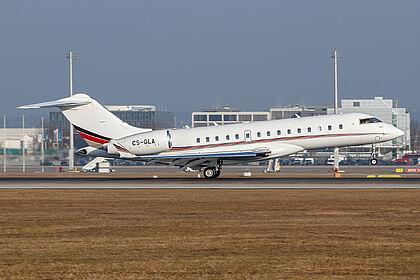
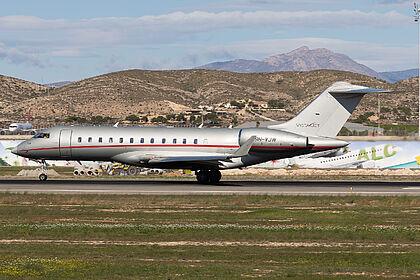
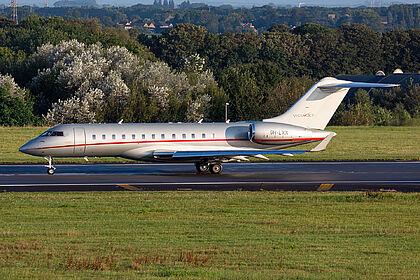
Fractional and membership fleets fly the type in quantity. NetJets operates Global 6000s in the United States under QS registrations and in Europe as CS-GL, and VistaJet's silver Globals are registered in Malta with 9H marks such as 9H-VJ. Charter and aircraft-management companies and corporate flight departments make up much of the rest of the civil fleet; most operators fly 450 to 600 hours a year, and fleet operators often pass 100 hours a month. Governments use it for VIP and special missions. Germany's air force flies Global 6000 VIP transports alongside its Global 5000s and is fielding Global 6500s for signals intelligence. Sweden operates Global 6500s for VIP work and is buying GlobalEye, which the United Arab Emirates already flies. Malaysia has a Global 6000 VIP transport, and Canada has ordered six Global 6500s for delivery from 2027. The US Air Force's E-11As and the US Army's Global 6500 reconnaissance jets complete a long military list.
Flying on one
A Global 6000 or 6500 is a cabin to spend a night in. Both have 43 ft 3 in of cabin length, 7 ft 11 in of width and 6 ft 2 in of height, and the floor is 6 ft 6 in across. That is the same cross-section as a Challenger 650 with about 17 ft 8 in more length, enough for three zones plus a crew rest. On the 6500, Bombardier's pattern is a forward Club suite with four Nuage seats, a Conference suite with a dining table and an optional Nuage chaise, and an aft Private suite with two more Nuage seats and a three-place divan that makes a bed; up to 17 passengers can be carried. The crew rest has a berthable seat, power and storage, which matters on flights long enough to need a relief pilot. Operators list the baggage hold at about 195 cu ft, reachable in flight. The XRS brought cabin altitude down to 4,500 ft while cruising at 45,000 ft and to 5,700 ft at the 51,000 ft ceiling. People fly on one through a NetJets share, a VistaJet membership, a long-range charter or a corporate or government flight department. With endurance of around 14 hours, it is built for the overnight crossings that smaller jets would break with a fuel stop.
Variants
- Global Express — Original BD-700-1A10, in service from July 1999 with BMW Rolls-Royce BR710 engines and Honeywell Primus 2000XP avionics; quoted at 6,500 nm at Mach 0.80
- Global Express XRS — Announced in October 2003 and delivered from late 2005, with an extra fuel tank in the wing-to-body fairing, enhanced vision as standard and a lower cabin altitude
- Global 6000 — The XRS renamed and fitted with the Vision flight deck based on Rockwell Collins Pro Line Fusion; first delivered in March 2012, about 6,000 nm at Mach 0.85
- Global 6500 — Rolls-Royce Pearl 15 engines, a reworked wing for Mach 0.90 and Nuage seats; in service from October 2019, about 6,600 nm
- Military derivatives — Sentinel R1, E-11A, GlobalEye, Pegasus and other mission aircraft built on Global Express, 6000 and 6500 airframes
How to spot it
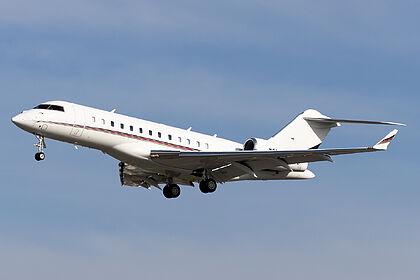
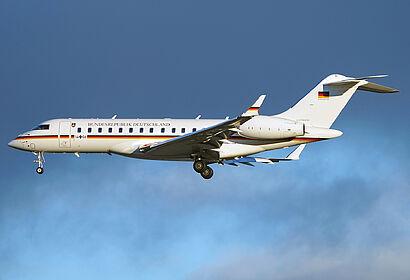
A Global is long and low, with a slender fuselage, a sharply swept wing carrying upright winglets, a T-tail and two big engines high on the tail cone. Within the BD-700 family, length is the clue: the Global 6000 and 6500 measure 99 ft 5 in (30.3 m), about 2 ft 7 in more than the Global 5000 and 5500, almost all of it in the cabin, while the Global 7500 is far longer at 33.8 m and hangs much larger GE Passport engines. The Global Express, XRS, 6000 and 6500 look almost identical from outside, so the registration or the transponder record is the way to separate them. Gulfstream's GV and G550 have big oval windows; the Global's are smaller and more numerous. Military conversions stand out: the Sentinel carried a long canoe radar under its belly, and GlobalEye wears a radar beam on its back.
Frequently asked
What does GLEX mean on a flight tracker?
GLEX is the ICAO type designator for the Bombardier Global Express family: the original Global Express, the Global Express XRS, the Global 6000 and the Global 6500. Military conversions such as the US Air Force's E-11A usually appear under it too. The shorter Global 5000 and 5500 use GL5T, and the Global 7500 and 8000 use GL7T.
What is the difference between the Global 6000 and the Global 6500?
The 6500, in service since 2019, replaced the 6000's BR710 engines with Rolls-Royce Pearl 15s, reworked the wing for a Mach 0.90 top speed and brought in the Global 7500's Nuage seats. Bombardier quotes 6,600 nautical miles for the 6500 against 6,000 for the 6000, both at Mach 0.85 with eight passengers. The fuselage and cabin size are the same, and the two look alike from outside.
Is the Global 6000 the same aircraft as the Global Express?
Essentially, yes. The Global 6000 is the Global Express XRS renamed and fitted with Bombardier's Vision flight deck in 2012, and the XRS was itself an improved Global Express with more fuel. All of them are the BD-700-1A10 on the type certificate and share the GLEX code.
How far can a Global 6500 fly?
Bombardier quotes 6,600 nautical miles at Mach 0.85 with eight passengers and four crew, under NBAA IFR reserves. The original Global Express was quoted at 6,500 nautical miles at a slower Mach 0.80, and the Global 6000 at 6,000 nautical miles at Mach 0.85. Headwinds, weather and payload shorten real-world legs.
Why do air forces turn Global 6000s into surveillance aircraft?
The airframe combines a 51,000 ft ceiling, endurance of around 14 hours and a large pressurized cabin with room for mission crews and electronics. Those traits made it the base for the RAF's Sentinel R1, the US Air Force's E-11A, Saab's GlobalEye and Germany's Pegasus. Germany chose a Global over the unmanned Triton for Pegasus partly because a crewed jet fits more easily into civil air traffic control.
What aircraft is GLEX?
GLEX is the ICAO type designator for the Bombardier Global Express / 6000 / 6500, a Bombardier business jet that first flew in 1996. It is the code flight trackers and air traffic control use.
What is the wingspan of the Bombardier Global Express / 6000 / 6500?
The Bombardier Global Express / 6000 / 6500 has a wingspan of 28.65 m (94 ft) and is 30.3 m (99 ft) long.
What engines does the Bombardier Global Express / 6000 / 6500 have?
Two Rolls-Royce BR710A2-20 (Global Express to Global 6000) or Pearl 15 (Global 6500).
What is the MTOW and range of the Bombardier Global Express / 6000 / 6500?
Maximum takeoff weight is 45,132 kg (99,498 lb) and maximum range is about 6,600 nautical miles (12,223 km) at a cruise of Mach 0.85.
How many passengers does the Bombardier Global Express / 6000 / 6500 carry?
Typically 13 people including the pilot.
Compare with
Specs are approximate, compiled from public sources. See our editorial policy.