Bombardier Dash 8 Q400
DH8DDe Havilland Canada · Regional · Production ended
In the wild
History
The Bombardier Dash 8-400, marketed as the Q400 and designated DH8D by ICAO, is the largest and fastest member of the Dash 8 family of twin turboprops. The line began with De Havilland Canada, which developed the roughly 37-to-40-seat DHC-8 Series 100 in the early 1980s; it first flew in 1983 and entered service in 1984. De Havilland Canada passed through Boeing ownership before Bombardier acquired the company in 1992 and continued the Dash 8, adding the stretched Series 300 and, later, the much larger Series 400.
In the mid-1990s Bombardier introduced an active noise and vibration suppression system to the Dash 8 to counter the cabin noise associated with turboprops. Aircraft fitted with it were rebranded the Q Series, the Q standing for quiet, so the Series 100, 200, 300 and 400 became the Q100, Q200, Q300 and Q400. The system uses tuned actuators to cancel much of the noise and vibration transmitted into the cabin, addressing one of the traditional passenger objections to propeller aircraft. The branding applied across the range, and the Dash 8 and Q Series names have often been used interchangeably for the same aircraft ever since.
The Dash 8-400 was a substantial development rather than a simple stretch. It first flew in 1998 and entered service in 2000 with Scandinavian Airlines. Seating roughly 70 to 90, it was designed to cruise far faster than earlier turboprops, at speeds approaching those of regional jets, while retaining a turboprop's lower fuel burn. The aim was explicit: to give airlines a propeller aircraft that could hold a schedule alongside jets on short routes but cost less to run.
That positioning captures the central trade-off the Q400 was built around. A turboprop burns markedly less fuel than a regional jet on short sectors and performs well from shorter runways, but it is slower and, historically, noisier; the Q400's high cruising speed and noise-suppression system were intended to narrow both gaps. Against the ATR 72, its main rival, the Q400 is faster but burns more fuel, so airlines have chosen between them according to whether speed or economy matters more on their networks. In 2019 Bombardier sold the Dash 8 program to Longview Aviation Capital, which revived the De Havilland Canada name; production was subsequently suspended. A Q400 operated by Colgan Air was involved in a fatal accident near Buffalo in 2009, an event whose investigation contributed to stricter United States pilot experience and training rules. The type remains widely flown, though no new examples are currently being built.
Specifications
- First flight
- 1998
- Entered service
- 2000
- Engines
- 2 × Pratt & Whitney Canada PW150A (turboprop)
- Typical seating
- 78 (2-class)
- Cruise speed
- Mach 0.55
- Range
- 1,100 nm
- MTOW
- 29,574 kg
- Length
- 32.84 m
- Wingspan
- 28.42 m
- Status
- Production ended
Design notes
The Q400 is built for speed unusual among turboprops. Its two Pratt and Whitney Canada PW150A engines are considerably more powerful than those of smaller Dash 8s and of the ATR, and each drives a six-blade propeller. This lets the aircraft cruise at around 360 knots, close to jet speeds and well above the roughly 275 knots of an ATR 72, so it can share airways and schedules with regional jets on short routes.
Structurally it is a high-wing design with a T-tail and a long, slender fuselage. The main landing gear retracts forward into the engine nacelles, which are therefore long and extend well behind the wing, a distinctive feature.
The cabin, seating around 70 to 90 depending on layout, is fitted with the active noise and vibration suppression system that gives the Q its name; tuned actuators counter engine and propeller noise to make the interior quieter than an untreated turboprop. The trade-off for the Q400's speed is higher fuel burn than the slower ATR, so its economics favour longer or busier short-haul routes where the time saving is worth the extra fuel. Some operators have configured high-density single-class cabins seating close to 90. The aircraft's short-field performance and steep-approach capability have also let it serve constrained airports, including those with short runways close to city centres, that many jets cannot use.
Notable facts
- The fastest current-generation regional turboprop, cruising notably quicker than an ATR.
- The 'Q' denotes the active noise-and-vibration suppression system in the cabin.
- Competes with regional jets on speed while burning far less fuel than a jet.
- Six-blade propellers on two Pratt & Whitney Canada PW150A engines.
Who flies it
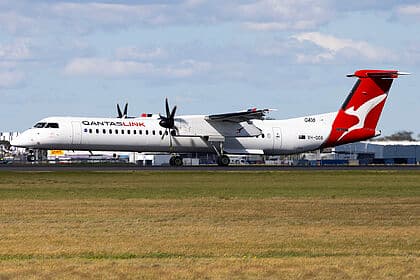
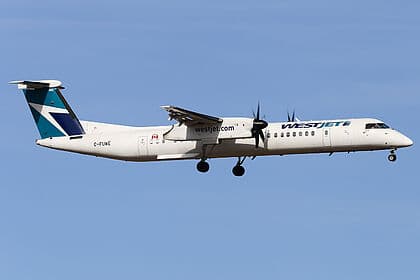
The Q400 has been operated worldwide by regional and short-haul carriers, often where its speed lets it stand in for a regional jet. Notable users have included Porter Airlines and WestJet Encore in Canada and QantasLink in Australia, and, before their respective changes, Flybe in the United Kingdom and Horizon Air in the United States. Many operators run it on busy short-haul routes and hub feeds where its jet-like cruise keeps it competitive on block times. In some markets it flies in mainline colours; in others it operates for a regional subsidiary or franchise partner feeding a larger network. The type competes most directly with the ATR 72, and an airline's choice between the two usually reflects its route lengths and its balance between speed and fuel cost. With production suspended, current operators fly existing aircraft, and some fleets are being retired as jets or newer turboprops take over.
Flying on one
The Dash 8 Q400 is a fast, capable turboprop, and flying on one blends jet-like speed with propeller character. The cabin is four-abreast in a 2-2 layout, so there are no middle seats. The "Q" stands for the active noise-and-vibration suppression system fitted to quieten the cabin drone; it helps, but this is still a turboprop, and you will hear and feel the props, most of all in the rows level with them. Overhead bins are small, so larger roll-aboards are commonly gate-checked at the aircraft steps and returned there on arrival. The Q400 cruises lower than a jet, so short sectors can be a little livelier in weather, though it is quicker than most turboprops and holds its own against regional jets on schedule. For the best seat, choose a row forward of the propeller line, where noise and vibration are lowest; the seats level with the props are the ones to avoid if you are sensitive to noise. It suits short, frequent regional hops.
How to spot it
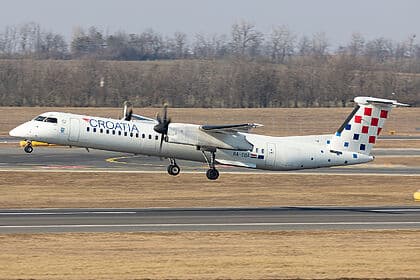
The Q400 is a high-wing twin turboprop with a T-tail, but it is longer and more slender than most propliners, which helps identification. The key cue against its main look-alike, the ATR 72, is the engine nacelles: the Q400's main landing gear folds into long nacelles that extend well behind the wing, whereas the ATR's gear tucks into fairings on the lower fuselage, leaving short nacelles. The Q400 also has a longer, more pointed nose, a taller tail and six-blade propellers set further outboard. Compared with the shorter Dash 8 Q300 and Q100, the Q400 is markedly longer, with more windows and a taller fin. Its overall length and the long nacelles are the fastest way to call it correctly from the ground.
Frequently asked
How do you tell a Q400 from an ATR 72?
The clearest difference is the engine nacelles and landing gear. The Q400's main gear retracts into long nacelles that stretch behind the wing, while the ATR 72 folds its gear into fairings on the lower fuselage and has short nacelles. The Q400 is also longer, has a more pointed nose and a taller tail, and cruises noticeably faster.
What does the Q in Q400 stand for?
It stands for quiet. Bombardier fitted the Dash 8 with an active noise and vibration suppression system to reduce cabin noise, and rebranded the aircraft as the Q Series. The Dash 8-400 accordingly became the Q400, and its ICAO type code is DH8D.
Why choose a Q400 turboprop instead of a regional jet?
On short routes a turboprop burns considerably less fuel than a jet and performs well from shorter runways. The Q400 was designed to cruise almost as fast as a regional jet, around 360 knots, so it narrows the usual speed penalty while keeping lower operating costs. The trade-offs are that it is still slower than a jet and, to some passengers, feels different in the cabin.
How is the Q400 different from earlier Dash 8s?
The Dash 8-400 is much larger, faster and more powerful than the Series 100, 200 and 300 that preceded it, seating around 70 to 90 rather than roughly 37 to 56. It uses more powerful PW150A engines and a longer fuselage. It shares the family's high-wing, T-tail layout and the Q noise-suppression system.
Is the Q400 still in production?
No. Bombardier sold the Dash 8 program to Longview Aviation Capital, under the revived De Havilland Canada name, in 2019, and production was later suspended. Many aircraft remain in service worldwide, so the type will continue flying for the foreseeable future.
Compare with
Specs are approximate, compiled from public sources. See our editorial policy.