Dassault Falcon 2000 (F2TH)
Dassault Aviation · Business jet · In production
F2TH is the ICAO aircraft type code for the Dassault Falcon 2000, a Dassault Aviation business jet that first flew in 1993 and entered service in 1995. It typically carries 10 people, cruises at Mach 0.8, and has a range of about 4,000 nautical miles (7,408 km).

Loading live positions…
In the wild
History
Dassault unveiled the airplane at the 1989 Paris Air Show as the Falcon X, the intended follow-on to its Falcon 20 and 200. The shortcut to a big cabin was the Falcon 900 trijet: the new twin inherited the 900's fuselage diameter, wing design and landing gear along with other systems, but had a shorter cabin and one engine fewer. Alenia of Italy joined as a 25 percent risk-sharing partner, designing and producing the rear fuselage and taking responsibility for the engine nacelles, pylons and thrust reversers.
In 1990 Dassault chose the CFE738 to power it, a turbofan from CFE, the company General Electric and the Garrett engine division of AlliedSignal had formed in 1987. Dassault describes the result as the first business jet in the world designed on a fully digital mockup. The prototype took off from Bordeaux-Mérignac on March 4, 1993, with Jean Pus and Guy Mitaux-Maurouard at the controls, and stayed up for 1 hr 15 min. Certification came in November 1994 and customer deliveries began early in 1995. Dassault quoted that first version at 5,555 km, about 3,000 nm, with eight passengers at Mach 0.80.
Nearly everything since has been evolution under the same type certificate. The 2000EX, certified in 2003, swapped the CFE738s for 7,000 lb Pratt & Whitney Canada PW308Cs and stretched the range to nearly 3,900 nm. A year later the 2000EX EASy brought Dassault's EASy flight deck, built on Honeywell's Primus Epic, to the type. The 2000DX of 2007 was a shorter-range version of the EX EASy at 3,250 nm, and the 2000LX of 2009 added Aviation Partners blended winglets and new slats to reach 4,000 nm.
In 2011 Dassault introduced the 2000S, a lower-priced model with less range and better short-field performance. At the NBAA convention in Orlando in October 2012 it launched the 2000LXS, which combined the S's inboard leading-edge slats and EASy II avionics with the LX's range. When the type marked 20 years in March 2013, Dassault counted nearly 500 delivered. EASA certified the S and LXS that month, the FAA followed in April, and the first 2000S went to a Turkish customer in April as well.
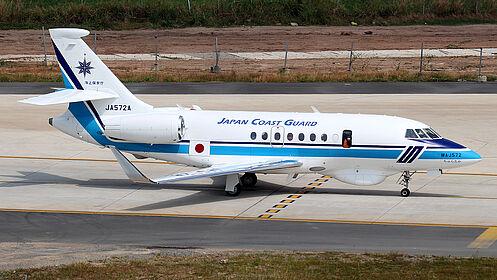
The LXS has since become a platform for government missions. The Japan Coast Guard ordered six maritime surveillance versions in 2015, and France's AVSIMAR program plans twelve Falcon 2000LXS Albatros maritime patrol jets for the French Navy by 2031; the DGA accepted the first two in 2026, and Dassault calls the LXS the latest model in the Falcon 2000 series. Production is also moving beyond France. In June 2025 Dassault announced that Dassault Reliance Aerospace in Nagpur, India, would assemble Falcon 2000s, with the first Indian-built aircraft expected in 2028.
Specifications
- First flight
- 1993
- Entered service
- 1995
- Engines
- 2 × Pratt & Whitney Canada PW308C (CFE738 on the original Falcon 2000)
- Typical seating
- 10 seats
- Cruise speed
- Mach 0.8
- Range
- 4,000 nm
- MTOW
- 19,414 kg
- Length
- 20.23 m
- Wingspan
- 21.38 m
- Status
- In production
Design notes
Because the Falcon 2000 keeps the Falcon 900's fuselage diameter, its cabin has the trijet's cross-section: 6 ft 2 in high and 7 ft 8 in wide, according to Dassault. On the 2000LXS the cabin is 26 ft 2 in long excluding the cockpit and baggage area, with 1,024 cu ft of volume and a 130.6 cu ft baggage hold.
The wing also came from the 900, with a modified leading edge, and the original 2000 did without the 900's inboard slats. Dassault put slats back along the whole span on the 2000S and 2000LXS, and the LXS now approaches at 105 knots and needs 2,260 ft of landing distance with six passengers aboard. The LX's Aviation Partners blended winglets widened the span from 63 ft 5 in to 70 ft 2 in, and the same winglets are sold as a retrofit for older 2000s.
The original CFE738-1-1B produced 5,918 lb of thrust; the PW308C that replaced it on the 2000EX gives 7,000 lb. Maximum takeoff weight on the LXS is 42,800 lb (19,414 kg). Cockpits moved from the Collins Pro Line 4 of 1995 to the EASy suite of 2004 and then EASy II, which on the LXS can include Dassault's FalconEye combined vision system. The LXS is certified to 47,000 ft and limited to Mach 0.86.
Notable facts
- Dassault describes the Falcon 2000 as the first business jet in the world designed on a fully digital mockup.
- It inherited the Falcon 900's fuselage diameter, wing design and landing gear, so its cabin is as wide as the trijet's.
- The original model's CFE738 turbofan, from a GE and AlliedSignal joint venture, was chosen for the Falcon 2000 in 1990 and never found another production application.
- EASA certifies just two models, the 2000 and 2000EX; the EX EASy, DX, LX, LXS and S are factory modification standards of the 2000EX, which is why all of them appear as F2TH.
- The 2000LXS approaches at 105 knots and lands in 2,260 ft with six passengers, thanks to inboard slats added on the 2000S and LXS.
Who flies it
Companies and private owners account for most Falcon 2000s, and the type is a regular in charter and fractional fleets: NetJets Europe flies 2000EX EASy jets on Portuguese registrations, and charter operators such as Canada's Skyservice run earlier models.
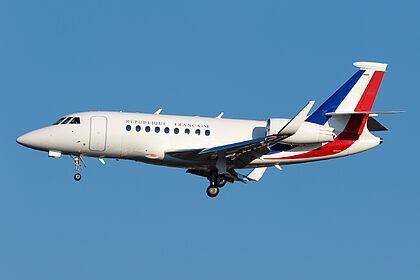
Governments use it for official travel. France's air and space force includes the 2000EX and 2000LX in its government transport fleet, and Slovenia and Bulgaria fly Falcon 2000s for state business.
The mission versions are the growth area. The Japan Coast Guard flies 2000LXS-based maritime surveillance jets, registered in the JA57xA series. The French Navy's Albatros adds a multifunction radar under the fuselage, an optronic turret, observation windows and a system for dropping search-and-rescue equipment, and it replaces the navy's older Falcon 50 and Falcon 200 patrol aircraft.
Flying on one
The cabin is the Falcon 900's cross-section in a shorter tube: 7 ft 8 in wide and 6 ft 2 in high on Dassault's figures. That makes it 6 in wider and 2 in taller than a Challenger 3500 (7 ft 2 in by 6 ft 0 in), and 2 in taller but 3 in narrower than a Challenger 650 (7 ft 11 in by 6 ft 0 in), using Bombardier's figures for both. Most passengers can walk to their seats upright.
Typical cabins put the galley forward and an enclosed lavatory at the back. Dassault quotes eight to ten passengers, and a common ten-seat plan has a four-chair club forward, then a four-place conference group facing two more club seats. Bags go in the 130.6 cu ft compartment behind the cabin, which operators generally describe as reachable in flight, though that depends on the individual aircraft.
The LXS covers 4,000 nm. Dassault's own examples include New York to Berlin, Dubai to London City and Beijing to Mumbai, and its 2,260 ft landing distance lets it use short runways. The original 2000s are rated for about 3,000 nm and the 2000EX for nearly 3,900 nm, so an older airplane suits transcontinental trips better than long ocean crossings.
Variants
- Falcon 2000 — Original model with CFE738 engines; certified 1994, about 3,000 nm
- Falcon 2000EX — PW308C engines of 7,000 lb thrust; certified 2003, nearly 3,900 nm
- Falcon 2000EX EASy — Honeywell Primus Epic-based EASy flight deck; certified 2004
- Falcon 2000DX — Shorter-range (3,250 nm) EX EASy; certified 2007
- Falcon 2000LX — Aviation Partners blended winglets and new slats, 4,000 nm; certified 2009
- Falcon 2000S and 2000LXS — Inboard slats and EASy II; the S flies 3,350 nm, the LXS 4,000 nm; both certified 2013
- Falcon 2000MSA and Albatros — 2000LXS-based maritime surveillance jets for the Japan Coast Guard and the French Navy
How to spot it
Picture a Falcon 900 with the center engine taken away. The Falcon 2000 has two engines on the rear fuselage, a plain, tapering tail cone and no intake at the root of the fin. Its horizontal tail is mounted partway up the fin rather than on top, which separates it from T-tailed rivals such as the Challenger 350 (CL35), Challenger 650 (CL60) and Citation Longitude (C700).
Telling the versions apart is harder. The LX, S and LXS have blended winglets from the factory, but older 2000s and 2000EXs can carry the same winglets as a retrofit, so winglets alone do not prove the model; a registration lookup is more reliable. The military Albatros is easier, with a radar housing under the fuselage and a sensor turret.
Frequently asked
Why do all Falcon 2000 versions show as F2TH?
EASA's type-certificate data sheet recognizes only two models, the Falcon 2000 and the 2000EX. The EX EASy, DX, LX, LXS and S are commercial names for 2000EXs built with particular factory modifications, so ICAO lists a single designator, F2TH, for every Falcon 2000.
What is the difference between the Falcon 2000LX, 2000S and 2000LXS?
The 2000LX of 2009 is a 2000EX EASy with blended winglets and new slats, rated for 4,000 nm. The 2000S of 2013 added inboard slats for shorter landings but carries less fuel, for 3,350 nm at a lower price. The 2000LXS, certified at the same time, combines the S's slats and EASy II flight deck with the LX's 4,000 nm range.
Is the Falcon 2000 a twin-engine Falcon 900?
Close to it. Dassault built the 2000 around the Falcon 900's fuselage diameter, wing design and landing gear, so the cabin cross-section is the same, but the cabin is shorter and the center engine is gone. The trade-off is range: about 4,000 nm for the 2000LXS against roughly 4,750 nm for the 900LX.
Is the Falcon 2000 still in production?
Yes. The 2000LXS is the current model, and in September 2026 Dassault still described it as the latest in the series as the French Navy took its first Albatros patrol versions. Dassault also plans final assembly in Nagpur, India, with the first Indian-built Falcon 2000 expected in 2028.
How far can a Falcon 2000LXS fly?
Dassault rates the 2000LXS at 4,000 nm at Mach 0.80 with six passengers, two crew and NBAA IFR reserves. Earlier versions fly less far: about 3,000 nm for the original 2000, nearly 3,900 nm for the 2000EX and 3,250 nm for the DX.
What engines does the Falcon 2000 use?
The original Falcon 2000 has two CFE738-1-1B turbofans of 5,918 lb thrust each, an engine developed by General Electric and AlliedSignal's Garrett division. Every model from the 2000EX of 2003 onward uses the Pratt & Whitney Canada PW308C, rated at 7,000 lb.
What aircraft is F2TH?
F2TH is the ICAO type designator for the Dassault Falcon 2000, a Dassault Aviation business jet that first flew in 1993. It is the code flight trackers and air traffic control use.
What is the wingspan of the Dassault Falcon 2000?
The Dassault Falcon 2000 has a wingspan of 21.38 m (70 ft) and is 20.23 m (66 ft) long.
What engines does the Dassault Falcon 2000 have?
Two Pratt & Whitney Canada PW308C (CFE738 on the original Falcon 2000).
What is the MTOW and range of the Dassault Falcon 2000?
Maximum takeoff weight is 19,414 kg (42,800 lb) and maximum range is about 4,000 nautical miles (7,408 km) at a cruise of Mach 0.8.
How many passengers does the Dassault Falcon 2000 carry?
Typically 10 people including the pilot.
Compare with
Specs are approximate, compiled from public sources. See our editorial policy.