Embraer E190-E2
E290Embraer · Regional · In production
In the wild
History
The Embraer E190-E2 is the middle member of the second-generation E-Jet family, the E-Jets E2, which the Brazilian manufacturer Embraer launched at the Paris Air Show in 2013. The original E-Jets, comprising the E170, E175, E190 and E195, had established Embraer as a significant competitor in the market between roughly 70 and 130 seats during the 2000s. Rather than design an all-new aircraft, Embraer chose to re-engine and refine that proven airframe, pairing it with new Pratt and Whitney geared-turbofan engines and a redesigned wing. It was a substantial reinvestment in a product line that had become central to the company's commercial aircraft business. The three E2 variants, designated E175-E2, E190-E2 and E195-E2, kept the fuselage cross-sections of their predecessors while changing much of what surrounded them.
The E190-E2 was the first member of the family to fly, taking to the air on 23 May 2016 from Embraer's site at Sao Jose dos Campos. The flight-test fleet included aircraft wearing distinctive predator-themed nose art applied under the company's Profit Hunter marketing banner. Certification by Brazilian, United States and European authorities followed in early 2018, a schedule Embraer contrasted with the delays that had affected several competing clean-sheet designs of the period.
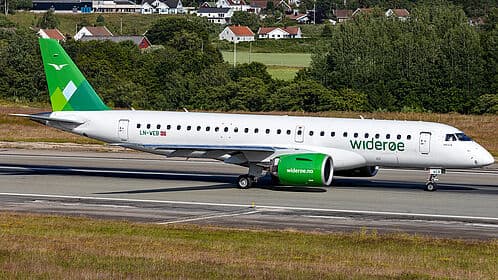
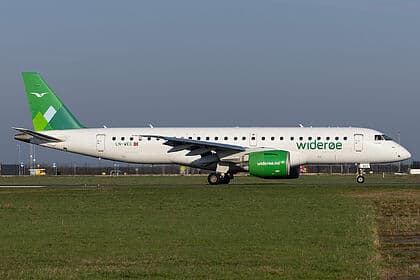
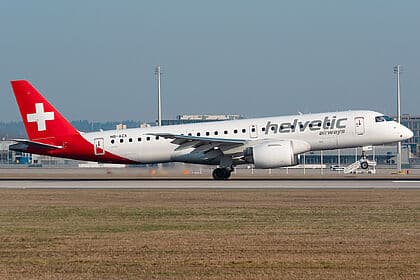
The type entered commercial service in April 2018 with Wideroe, the Norwegian regional carrier, which flew it on short domestic sectors. Operators including Azul of Brazil and Helvetic Airways of Switzerland followed, the latter using the aircraft partly on wet-lease flying for other carriers. The larger E195-E2 entered service in 2019 and went on to attract the greater share of the family's orders, in part because spreading trip costs over more seats improved its per-passenger economics.
Commercially the E2 family has sold more slowly than the first-generation E-Jets, and two reasons are commonly cited. The first is competition from the Airbus A220, originally the Bombardier CSeries, which targets the same airlines and has drawn large orders. The second is the effect of United States scope clauses, contractual limits in mainline pilot agreements that cap regional jets at weights and seat counts the E2s exceed. Those limits effectively closed the important North American regional market to the family and left the smallest variant, the E175-E2, without customers, its program slowed while Embraer continued to build first-generation E175s for that market. The E190-E2 nonetheless found a place with operators that valued its low seat-mile and trip costs on thinner routes, and it remains in production as part of the range of Embraer, which is often described as the third-largest maker of commercial jets after Airbus and Boeing.
Specifications
- First flight
- 2016
- Entered service
- 2018
- Engines
- 2 × Pratt & Whitney PW1900G (geared turbofan)
- Typical seating
- 97 (2-class)
- Cruise speed
- Mach 0.82
- Range
- 2,850 nm
- MTOW
- 56,400 kg
- Length
- 36.24 m
- Wingspan
- 33.72 m
- Status
- In production
Design notes
Two changes define the E2 against the original E-Jet. The first is propulsion: each E190-E2 is powered by two Pratt and Whitney PW1900G engines, members of the PW1000G geared-turbofan family. A reduction gearbox lets the large fan turn more slowly than the turbine that drives it, which improves efficiency and lowers noise, and Embraer cites double-digit reductions in fuel burn per seat against the earlier E190. The second is the wing, an entirely new design with a greater span and higher aspect ratio, more slender than the first-generation wing it replaces.
Inside, the E190-E2 keeps the E-Jet's four-abreast, two-plus-two cabin cross-section, so no passenger sits in a middle seat. Embraer pairs this with larger overhead bins and a cabin environment made quieter in part by the geared engines.
In the flight deck, the E2 introduces full fly-by-wire flight controls with Honeywell avionics; the first-generation E-Jets used fly-by-wire for only part of the control system. Embraer also emphasises long maintenance intervals, quoting extended times between heavy checks. The redesign reaches into the systems and structure as well, though the family deliberately retained enough commonality with the original E-Jets to ease pilot transition through differences training rather than a wholly separate conversion. The result is an aircraft that looks familiar from inside the cabin but is substantially new in its wing, engines, systems and flight controls.
Notable facts
- The first Embraer commercial jet with fly-by-wire flight controls.
- A second-generation E-Jet with a new high-aspect-ratio wing and Pratt & Whitney geared-turbofan engines.
- Entered service with Widerøe in April 2018.
- Typically seats around 100 in a 2+2 layout with no middle seats.
- Part of the E-Jet E2 family alongside the E175-E2 and E195-E2.
Who flies it
The E190-E2 is flown by a relatively small but international group of operators rather than by the United States regional affiliates that took thousands of first-generation E-Jets. Launch operator Wideroe uses it on Norwegian domestic routes, while Azul in Brazil, Helvetic Airways in Switzerland, and carriers across Europe, the Middle East and Asia operate the type on short and medium mainline and regional sectors. Because United States scope clauses limit regional jets to lower weights and seat counts than the E2 offers, the aircraft is generally flown by mainline carriers or their wet-lease partners outside North America rather than under the American regional model. Its role is typically to serve thinner routes that would not fill a larger narrowbody, or to add frequency on busier ones, where its low trip cost and roughly 100-seat capacity suit the demand.
Flying on one
After a diet of cramped fifty-seaters, the E190-E2 is a genuine relief to fly on. Its cabin is arranged four-abreast in a 2-2 layout, which means there are no middle seats at all — everyone gets a window or an aisle, and there is no scramble to avoid the dreaded centre place. Just as importantly for anyone travelling with a carry-on, the overhead bins are full size and take standard roll-aboards, so you rarely face the gate-check ritual that plagues smaller regional jets like the CRJ. The E2 uses a geared turbofan that is markedly quieter than older regional jets, and the cabin feels more like a small mainline aircraft than a commuter. Ceilings are reasonable and the ride is smooth. Because there is no bad lateral position, the best seat is simply about legroom and quiet: a forward row or an over-wing seat keeps you away from the rear galley and the engines. For most passengers, the 2-2 layout and the real overhead bins are the whole story.
Variants
- E195-E2 (E295) — Stretched, up to about 146 seats
- E175-E2 (E275) — Shortest E2; program slowed by U.S. scope clauses
How to spot it
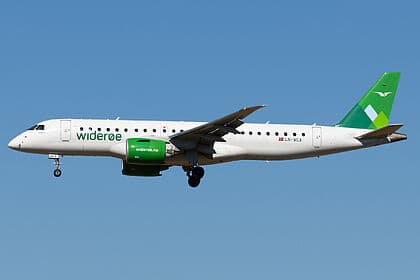
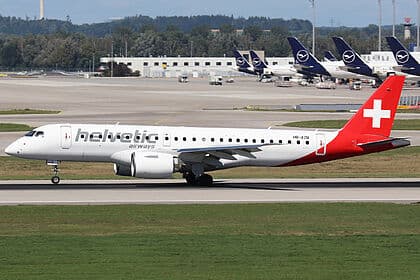
From a distance the E190-E2 looks much like the first-generation E190, so the cues are in the detail. The E2 wing is longer and more slender, and its winglets curve up in a smooth raked blend rather than the angular, canted winglets of the original E-Jet. The engine nacelles are noticeably larger in diameter, reflecting the wide fan of the geared turbofan. Against a CRJ the differences are stark: the E-Jet mounts its two engines on pylons under the wing and uses a low-set tailplane, whereas the CRJ family carries its engines on the rear fuselage beneath a T-tail. The E-Jet fuselage is also rounder and wider, with larger cabin windows set higher on the side than the CRJ's small, low windows. Telling the E190-E2 from the stretched E195-E2 comes down to fuselage length and window count.
Frequently asked
How can you tell an Embraer E-Jet from a Bombardier CRJ?
Look at the engines and the tail. An E-Jet, including the E190-E2, mounts its engines on pylons beneath the wing and has a conventional tailplane low on the fuselage, whereas every CRJ carries its engines against the rear fuselage under a T-tail. The E-Jet also has a wider, rounder fuselage with larger windows, while the CRJ cabin is narrower and its windows sit lower and smaller.
What is the difference between the E190 and the E190-E2?
The E190-E2 is a re-engined and re-winged development of the original E190. It uses Pratt and Whitney geared-turbofan engines, a longer and more slender wing, and full fly-by-wire flight controls, and Embraer quotes substantially lower fuel burn per seat. The fuselage cross-section and roughly 100-seat capacity are broadly similar between the two.
Why is the E190-E2 uncommon at United States regional airlines?
Mainline pilot contracts in the United States contain scope clauses that cap regional jets at about 76 seats and roughly 86,000 pounds maximum weight. The E2 family exceeds those limits, so American regional carriers cannot operate it under existing agreements. Those carriers instead continue to take the first-generation E175, which fits within scope.
What engines power the E190-E2?
It is powered by two Pratt and Whitney PW1900G engines from the PW1000G geared-turbofan family. A reduction gearbox allows the fan to spin more slowly than the driving turbine, which improves fuel efficiency and reduces noise. The same engine family, in different thrust ratings, also powers the Airbus A220.
How many passengers does the E190-E2 carry?
A typical two-class layout seats around 97 passengers, and single-class configurations can reach roughly 114. All seating uses a two-plus-two arrangement, so there are no middle seats. The larger E195-E2 stretches the design to seat up to about 146.
Compare with
Specs are approximate, compiled from public sources. See our editorial policy.