Boeing 737 MAX 8
B38MBoeing · Narrowbody · In production
In the wild
History
The Boeing 737 MAX 8 is the re-engined, fourth-generation development of the 737 and the direct successor to the 737-800. Its origins lie in Boeing's response to the Airbus A320neo. When Airbus launched the neo in 2010 and began accumulating orders rapidly, Boeing initially weighed an all-new single-aisle design, but in 2011, after a major United States customer prepared to order the Airbus, Boeing committed instead to re-engining the 737. The programme was named the 737 MAX, and the MAX 8 was its core model, matched in size to the best-selling 737-800.
The central change was the engine. The MAX uses the CFM LEAP-1B, a large, high-bypass turbofan that promised a substantial cut in fuel burn. Fitting a bigger engine to the low-slung 737 required aerodynamic and structural changes, including mounting the engine further forward and higher and lengthening the nose landing gear. The aircraft first flew in 2016 and entered service in 2017, initially with Malindo Air of Malaysia. Orders were strong, and the MAX 8 looked set to repeat the commercial success of the 737-800.
That trajectory was interrupted by two fatal accidents. In October 2018 a Lion Air MAX 8 crashed shortly after take-off, and in March 2019 an Ethiopian Airlines MAX 8 crashed in similar circumstances. Investigations centred on a new flight-control function, the Manoeuvring Characteristics Augmentation System, or MCAS, which could repeatedly command nose-down trim based on input from a single angle-of-attack sensor. After the second crash, regulators worldwide grounded the type in March 2019, in what became one of the longest groundings of a modern airliner.
The grounding lasted until late 2020. Boeing revised the MCAS software to use both angle-of-attack sensors, added safeguards and limits, and changed flight-crew training and documentation. The United States Federal Aviation Administration cleared the aircraft to return in November 2020, with other regulators following over the subsequent months, so return dates varied by country. The episode damaged Boeing's reputation and finances, led to intense scrutiny of its certification practices, and prompted continuing oversight changes.
Since returning to service the MAX 8 has resumed high-rate deliveries and remains Boeing's principal single-aisle product. Airlines that had waited out the grounding took delivery of stored and newly built aircraft, and the type re-established itself on short- and medium-haul networks. Boeing has continued to work through the wider MAX family, with the smaller MAX 7 and the stretched MAX 9 and MAX 10 at various stages of certification and service, and further production and quality issues across the 737 line have kept the programme under close attention into the 2020s.
Commercially the MAX 8 competes directly with the Airbus A320neo, and the two dominate new narrowbody orders. It offers operators of earlier 737s a familiar aircraft with markedly lower fuel burn and a shared type rating, the same commonality argument Boeing has used for the 737 for decades. Its history, however, is inseparable from the accidents and grounding, which remain central to how the type is understood and which reshaped debates about automation, certification and regulatory independence.
Specifications
- First flight
- 2016
- Entered service
- 2017
- Engines
- 2 × CFM LEAP-1B
- Typical seating
- 162 (2-class)
- Cruise speed
- Mach 0.79
- Range
- 3,500 nm
- MTOW
- 82,190 kg
- Length
- 39.52 m
- Wingspan
- 35.9 m
- Status
- In production
Design notes
The defining change on the MAX is the CFM LEAP-1B engine, considerably larger in diameter than the CFM56 of the 737-800. Because the 737 sits low to the ground, Boeing mounted the engine higher and further forward and extended the nose landing gear to maintain clearance, changes that subtly altered the aircraft's aerodynamics and handling. The nacelles retain the flattened lower lip characteristic of the 737 family but are visibly larger.
To recover fuel efficiency Boeing added the Advanced Technology winglet, a distinctive split-tip device that extends both upward and downward, and reshaped the tail cone into a longer, more streamlined form with a revised auxiliary power unit exhaust. The MAX also introduced fly-by-wire control for the spoilers, a first for the 737 line, while the rest of the control system remained conventional, preserving commonality with earlier variants.
The forward-mounted, higher-set engines changed the aircraft's pitch behaviour in some conditions, which is why Boeing introduced MCAS to make the MAX handle like earlier 737s for certification and crew-commonality reasons. In its original form the system relied on a single angle-of-attack sensor and could trigger repeatedly, factors identified in the two accidents; the revised system uses both sensors, limits its authority and can be more readily overridden.
Inside, the MAX 8 offers the Boeing Sky Interior with sculpted sidewalls and LED lighting, and a six-abreast cabin using the long-standing 737 cross-section. The flight deck adds larger displays but deliberately preserves the look, feel and type rating of the previous 737, allowing crews to transition with only differences training.
Notable facts
- Re-engined development of the 737 with CFM LEAP-1B engines and split-tip winglets.
- Entered service in 2017.
- Grounded worldwide from March 2019 to late 2020 after two fatal accidents (Lion Air 610 and Ethiopian 302) linked to the MCAS flight-control system.
- Returned to service following software and training changes.
- The high-density 737 MAX 200 seats up to 200 passengers.
Who flies it
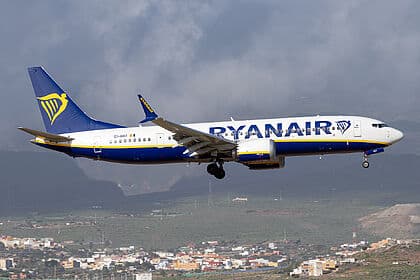
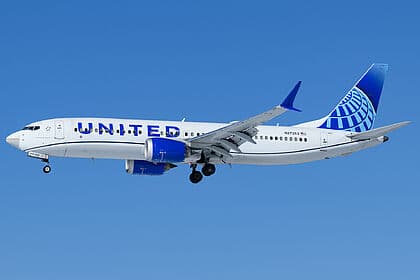
The 737 MAX 8 is operated by a wide range of airlines, many of them long-standing Boeing 737 customers who moved up from the 737-800. Large users include Southwest, Ryanair, which flies the high-density MAX 8 200 version, United, American and numerous carriers across Asia, Latin America and the Middle East. In most fleets it is replacing older 737NGs on the same short- and medium-haul routes.
Its role is mainstream single-aisle passenger flying: domestic trunk routes, regional international sectors and leisure services. After the grounding, uptake resumed steadily, though some operators adjusted order books and delivery schedules, and continued production and quality issues have at times slowed deliveries. As the principal competitor to the Airbus A320neo, the MAX 8 is central to Boeing's narrowbody presence, and its numbers in service continue to grow as the backlog is worked off.
Flying on one
To a passenger the 737 MAX 8 looks and feels much like the 737-800 it succeeds, with two welcome upgrades. The cabin is the same width as the rest of the 737 family, so seats are still commonly around seventeen inches in the usual six-abreast layout — a shade tighter than an A320neo. What changes is the detail: the LEAP engines are markedly quieter than the older CFM56, and the aircraft comes with Boeing's Sky Interior, whose large pivoting overhead bins hold noticeably more roll-aboards and cut down on gate-checking. The mood lighting and sculpted sidewalls make the cabin feel more modern than an older 737. Ride quality and comfort otherwise track the 737-800. For the best seat, aim for an over-wing exit row for legroom and a forward window to stay ahead of galley traffic; as ever, the last row by the rear galley is the one to avoid. How dense the layout feels still depends heavily on the operator.
Variants
- 737 MAX 7 / MAX 9 / MAX 10 — Shorter and stretched MAX variants
- 737 MAX 200 — High-density version seating up to 200
How to spot it
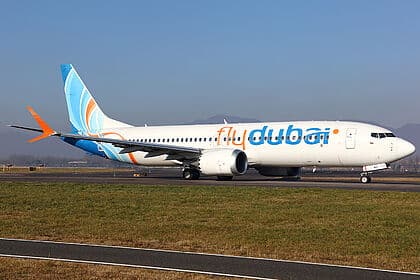
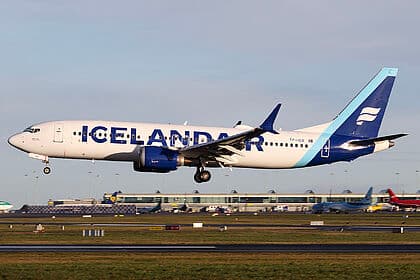
The surest MAX identifier is the winglet. The MAX 8 wears an Advanced Technology winglet that splits into an upward and a downward tip, unlike the single upswept blended winglet common on the 737-800. The engines are larger than the 737-800's, mounted higher and further forward, and the aft fuselage ends in a longer, more pointed tail cone.
Against the Airbus A320neo, the MAX keeps the general 737 signatures: a pointed nose, a low stance and engine intakes flattened along the bottom, whereas the Airbus has a rounder nose, a taller stance and near-circular nacelles. Both re-engined types have large engines, so the winglets are the fastest discriminator: split-tip on the MAX, smoothly blended Sharklets on the A320neo. Note that some older 737NGs carry retrofitted split-scimitar winglets that can be mistaken for the MAX device.
Frequently asked
How do you tell a 737 MAX 8 from a 737-800?
The clearest cue is the winglet: the MAX 8 has a split-tip Advanced Technology winglet extending both up and down, while the 737-800 usually has a single blended winglet pointing only upward. The MAX also has larger engine nacelles, set higher and further forward, and a longer, more pointed tail cone. Be aware that some 737-800s were retrofitted with split-scimitar winglets that can look similar at a glance.
What was the MCAS and why was it involved in the accidents?
MCAS, the Manoeuvring Characteristics Augmentation System, was a flight-control function added because the MAX's larger, forward-mounted engines changed its pitch behaviour, and Boeing wanted it to handle like earlier 737s. In its original form it could repeatedly command nose-down trim based on a single angle-of-attack sensor. Investigations into the Lion Air and Ethiopian Airlines crashes identified this behaviour as a central factor, and the system was subsequently redesigned.
How long was the 737 MAX grounded?
The worldwide grounding began in March 2019, after the second accident, and lasted until late 2020. The United States cleared the aircraft to return in November 2020, with other regulators following over the following months, so the exact end date varied by country. It was among the longest groundings of a modern airliner.
Is the 737 MAX 8 safe to fly now?
Regulators including the FAA and EASA returned the aircraft to service only after Boeing revised the MCAS software, added safeguards and changed pilot training. The type has since flown large numbers of flights, and its record after return to service is closely monitored. As with any airliner, oversight is ongoing, and the MAX has remained under particular scrutiny given its history.
What engines does the 737 MAX 8 use?
It is powered by the CFM International LEAP-1B, a high-bypass turbofan developed specifically for the MAX. It is larger and more efficient than the CFM56 used on the 737-800, which is the main reason for the aircraft's lower fuel burn. Unlike the Airbus A320neo, the MAX is offered with only this one engine type.
In-depth comparisons
Compare with
Specs are approximate, compiled from public sources. See our editorial policy.